





Why Your Friday Night Binge Depends More on Servers Than Storylines


Friday night. You’ve got snacks on the table, the lights dimmed, and your streaming app already lined up with that new series everyone’s talking about. You press play—and within seconds, the first episode starts rolling in crisp high definition. It feels simple. Almost too simple. But here’s the thing: that smooth experience has less to do with the actors on screen and more to do with the silent army of servers, networks, and algorithms working behind the scenes. Your binge session isn’t powered by Hollywood alone—it’s powered by IT.
Why Recommendations Feel Psychic
Ever wonder how your streaming platform seems to know what you’ll want to watch next? That’s not luck. it’s machine learning. Algorithms track your viewing patterns: the genres you binge, the shows you abandon halfway, the nights you stay up late watching rom-coms instead of thrillers.Behind those patterns, AI is running complex recommendation engines, trained on billions of data points from viewers worldwide. The goal isn’t just to keep you watching, but to predict what will keep you hooked. It’s personalization at scale and it’s only possible because of IT systems capable of crunching massive datasets in real time. This is where technology becomes less of a background tool and more of a co-creator in your entertainment journey.
The Gaming Paradox: Simple Fun, Complex Tech
The same story plays out in gaming. On the surface, gaming is about fun immersive worlds, fast reflexes, and shared adventures with friends. But beneath the surface, it’s a technological puzzle that IT has solved piece by piece. Online multiplayer games demand milliseconds of response time. Too much lag, and the entire experience falls apart. To solve this, companies use edge computing, placing servers closer to players geographically so the game feels instant. Cloud gaming has pushed this even further letting you play high-end titles on a budget laptop or even a phone, because the heavy lifting is done in data centers, not your device. That perfect headshot you landed last night? Thank a server farm for it.
Concerts Without Venues
Entertainment isn’t just movies and games anymore. The pandemic accelerated a whole new category: virtual concerts and digital events. Millions of fans tuned in to live performances from their bedrooms, creating shared experiences that once required stadiums and arenas. Pulling this off isn’t a matter of pointing a camera at a stage. It takes high-bandwidth streaming, real-time synchronization across regions, interactive chat features, and resilient servers that don’t buckle under global demand. IT has transformed what it means to “attend” an event, allowing fans from São Paulo to Singapore to stand side by side virtually. The artist might deliver the performance, but IT ensures it reaches the crowd without missing a beat.
Security: Protecting the Show
There’s also a darker side to entertainment: piracy, account hacks, and data leaks. Behind the joy of streaming lies a battlefield where IT teams constantly fight to protect both content and users. Encryption protocols secure the streams so they can’t be stolen mid-flight. Authentication systems prevent bots from hijacking accounts. Security monitoring tools track suspicious patterns, ready to shut down breaches before they spiral. It’s not glamorous, but it’s essential. Without IT security, your binge could end not with credits, but with a compromised password.
The Road Ahead
Looking forward, the relationship between IT and entertainment will only deepen. AI is moving beyond recommendations into actual content generation creating trailers, dubbing voices, even scripting dialogue. Virtual and augmented reality promise to blur the line between audience and performer. Blockchain is exploring new ways to manage digital rights and pay artists fairly. These innovations will reshape entertainment in ways we can only guess at today. But one thing is certain: the next time you sit down for a Friday night binge, remember that the real star isn’t just on your screen. It’s in the servers, networks, and IT teams making sure the story reaches you, flawlessly, every single time.
Final Thought
We often think of entertainment as art and it absolutely is. But in today’s world, it’s also engineering. The magic you see is built on technology you don’t. That’s why, when your show runs without a glitch, your game feels alive, or your favorite artist’s concert streams across continents, you’re not just witnessing creativity. You’re witnessing IT at its finest. So yes, storylines matter. But your Friday night binge? It depends a lot more on servers than you might think.

Ready to build your next digital product?
Talk to Zygobit about web apps, mobile apps, AI solutions, automation, and scalable software development tailored to your business goals.
Explore Related Articles
More reading on web, mobile, AI, and product engineering from the Zygobit team.

The Evolution of Entertainment: How Technology is Changing the Game
Entertainment has come a long way from traditional cinema and radio. Today, we live in a digital era where content is consumed on-demand, experiences are immersive, and creators can reach global audiences with just a smartphone. This blog explores how cutting-edge technology is reshaping the entertainment landscape—and how IT companies like ours play a crucial role in this transformation.

The Rise of Digital Entertainment: Where Tech Meets Creativity
Entertainment has evolved from passive viewing to fully interactive, on-demand experiences—all powered by advanced technologies. From streaming services to AI-driven music curation, digital entertainment is now at the center of modern culture. In this blog, we explore how tech innovations are transforming the entertainment industry and how our IT services enable that transformation.
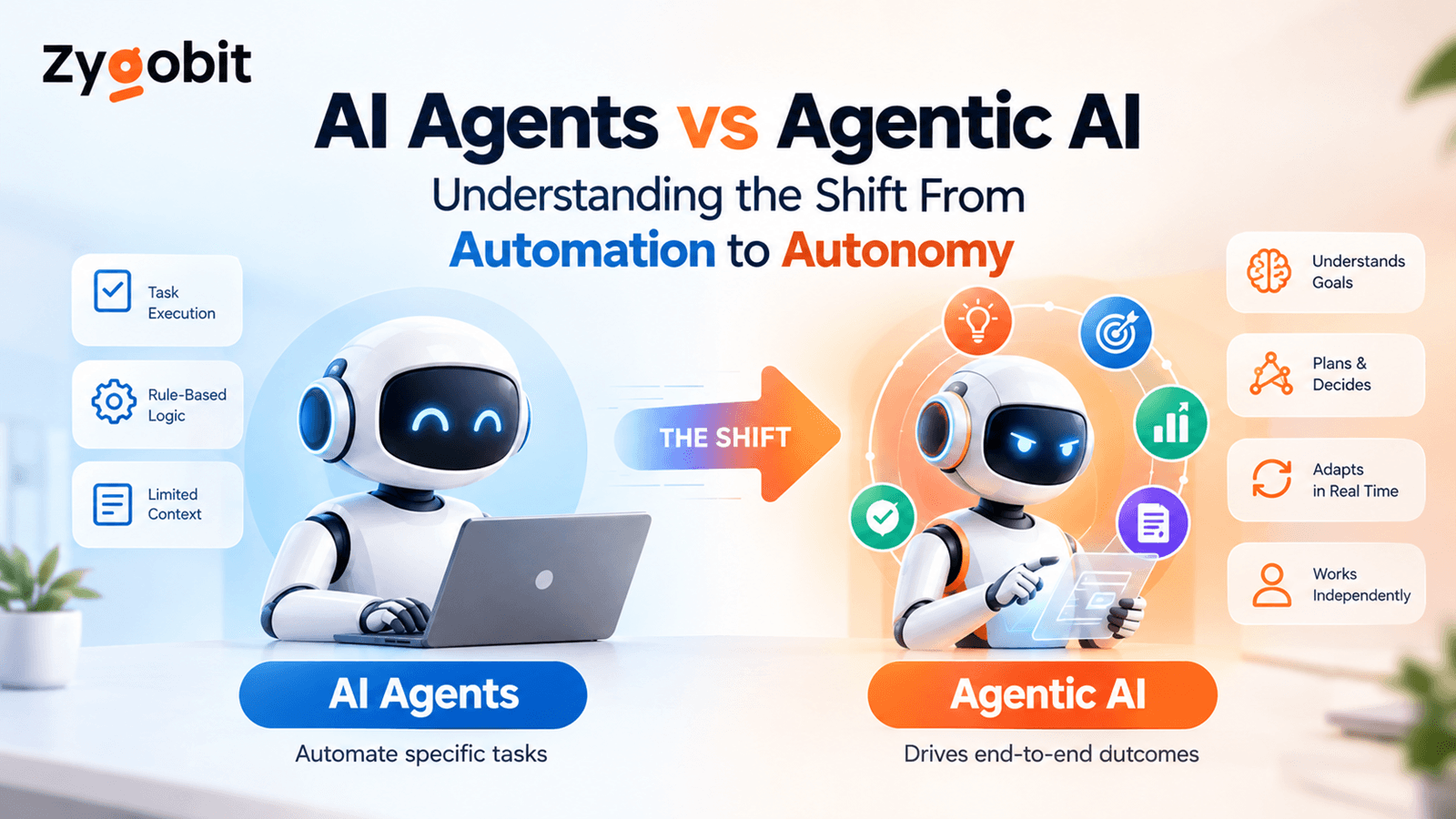
AI Agents vs Agentic AI Understanding the Shift From Automation to Autonomy
AI agents are changing business automation by moving beyond simple responses to intelligent action. This article explains the difference between AI agents and agentic AI, including planning, tool use, workflow orchestration, state management, human approvals, security, observability, and enterprise use cases.