





Mobile Application Development Services for Startups & Enterprises

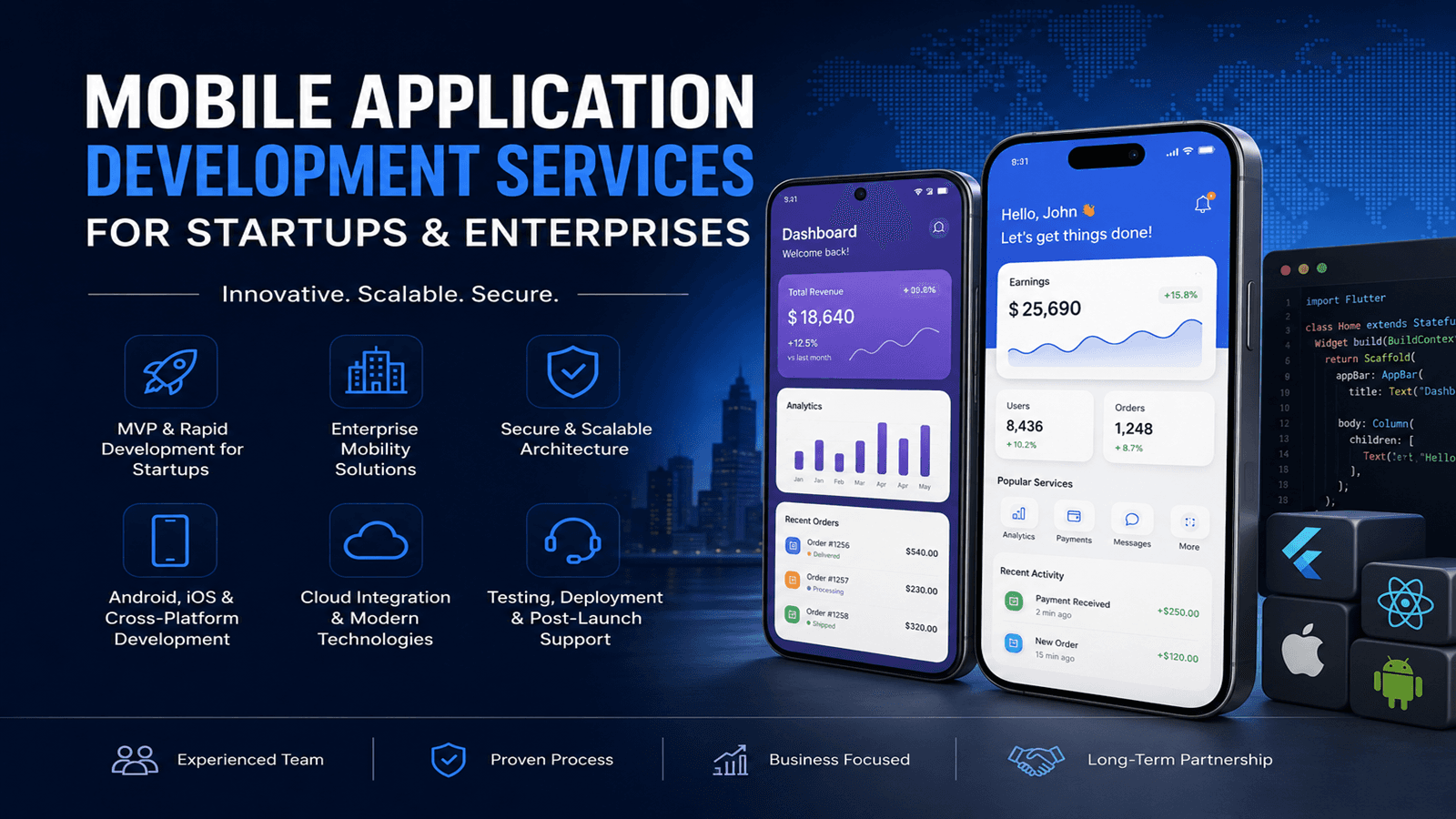
Explore professional mobile application development services for startups and enterprises. From MVP development and UI/UX design to iOS, Android, Flutter, React Native, backend integration, testing, deployment, and ongoing support, we build secure, scalable, and high-performing mobile apps designed to improve customer engagement, streamline operations, and support long-term business growth.
Mobile applications have become a critical part of modern business strategy. From early-stage startups validating new ideas to enterprises modernizing complex operations, businesses increasingly rely on mobile technology to improve customer experiences, automate processes, and create new digital revenue opportunities.
A successful mobile application is no longer defined only by how it looks. Users expect fast performance, intuitive navigation, strong security, reliable functionality, and seamless experiences across devices. At the same time, businesses need applications that are scalable, maintainable, and capable of integrating with existing systems.
This is why professional mobile application development services go far beyond coding. The development process combines product strategy, UI/UX design, mobile engineering, backend development, API integrations, cloud infrastructure, testing, security, deployment, and ongoing optimization.
For startups, the priority is often launching quickly, validating product-market fit, and building a foundation that can scale. For established organizations, enterprise mobile application development usually requires deeper integrations, security controls, workflow automation, scalability, and long-term maintainability.
Choosing the right development strategy from the beginning can significantly influence the performance, cost, scalability, and long-term success of a mobile product.
Our Mobile Application Development Services
Modern businesses have different technical requirements, business models, user expectations, and growth objectives. Our mobile application development services are structured to support the complete product lifecycle, from early planning and prototyping through development, deployment, and continuous improvement.
Core Mobile Development Services Include:
Custom mobile app development: Purpose-built applications designed around specific business requirements and user workflows.
Android and iOS app development: Native and platform-optimized mobile experiences using modern technologies.
Cross-platform app development: Efficient development using Flutter and React Native for businesses targeting both Android and iOS.
Full-stack mobile development: Mobile frontend, backend systems, databases, APIs, authentication, and cloud infrastructure.
UI/UX design and prototyping: User-focused interfaces designed to improve usability, engagement, and conversion.
Mobile app testing and maintenance: Quality assurance, performance optimization, security testing, updates, and post-launch support.
Our approach begins by understanding the business problem before selecting technologies or building features. This helps ensure that every component of the application contributes to a measurable product or business objective.
Strong mobile products are built when business strategy, user experience, architecture, security, and engineering decisions work together rather than being treated as separate activities.
Solutions for Startups
Startups operate in an environment where speed, budget efficiency, experimentation, and adaptability are extremely important. Building an overly complex application before validating demand can increase development costs and delay valuable market feedback.
Effective mobile app development for startups therefore starts with identifying the product's core value proposition and determining which features are necessary to validate it.
Startup-Focused Development Services:
MVP app development: Launching the essential product experience needed to validate assumptions with real users.
Rapid product development: Agile development cycles designed to reduce time to market.
Scalable mobile architecture: Building a technical foundation that can support future users, features, and integrations.
Startup product development: Supporting product discovery, architecture planning, development, testing, and deployment.
Flexible development approach: Prioritizing features based on business objectives, user feedback, and available resources.
A well-planned MVP is not simply a smaller application. It is a strategically focused product designed to answer important questions about demand, usability, customer behavior, and commercial potential.
Rather than investing heavily in every possible feature from the beginning, startups can launch the most important functionality, collect real-world feedback, measure user behavior, and improve the product based on evidence.
This approach reduces unnecessary development while allowing the product to evolve alongside the market.
Solutions for Enterprises
Enterprise applications operate in a significantly different environment. They may need to support thousands or millions of users, connect with existing business systems, comply with internal security requirements, manage complex permissions, and maintain consistent performance across departments and locations.
For this reason, enterprise mobile application development requires careful architecture, security planning, integration strategy, testing, monitoring, and governance.
Enterprise Mobile Capabilities Include:
Enterprise application development: Secure and scalable mobile systems designed around complex organizational requirements.
Enterprise mobility solutions: Applications that improve employee, customer, partner, and operational workflows.
System integration: Connecting mobile applications with ERP, CRM, payment, analytics, identity, and other business platforms.
Secure mobile development: Authentication, authorization, encryption, role-based permissions, and secure API architecture.
Business process automation: Digitizing manual workflows and connecting employees with real-time business information.
Application modernization: Replacing outdated systems with modern mobile and cloud-based solutions.
Enterprise architecture must also consider reliability, maintainability, observability, data governance, and future scalability.
A successful enterprise mobile solution should integrate naturally into the organization's technology ecosystem rather than becoming another disconnected platform that creates additional operational complexity.
Technologies We Use
Technology selection has a direct impact on application performance, development speed, scalability, maintenance requirements, and long-term cost.
Instead of selecting technologies simply because they are popular, an experienced mobile application development company should evaluate the product's functionality, performance expectations, target platforms, integration requirements, team structure, and future roadmap.
Our Mobile Technology Stack Includes:
Kotlin and modern Android technologies for native Android applications
Swift and SwiftUI for high-performance native iOS development
Flutter for efficient cross-platform mobile development
React Native for shared mobile development using the React ecosystem
Node.js and modern backend technologies for APIs and business logic
Cloud infrastructure and databases for scalable application environments
We also integrate modern technologies such as artificial intelligence, machine learning APIs, payment systems, real-time communication, geolocation, analytics, IoT services, third-party APIs, and cloud-based infrastructure when they provide meaningful value to the application.
Native development may be appropriate when advanced platform-specific functionality or maximum performance is required. Cross-platform development may be a better option when businesses need faster development across Android and iOS while maintaining a shared codebase.
The right choice depends on the product rather than following a universal development approach.
AI-Powered Mobile Application Development
Artificial intelligence is becoming an important component of modern mobile applications.
However, successful AI mobile app development requires more than simply connecting an application to an AI API. The AI functionality should solve a clear user problem and fit naturally within the overall product experience.
Mobile applications can incorporate AI for intelligent search, recommendations, conversational assistants, document processing, image analysis, workflow automation, predictive insights, personalization, and customer support.
Developers must also consider data privacy, response accuracy, model costs, latency, security, and appropriate fallback mechanisms.
For businesses, AI can create significant value when it reduces manual work, improves decision-making, personalizes experiences, or enables capabilities that were previously difficult to automate.
The most effective AI-powered applications treat artificial intelligence as part of the product architecture rather than adding it simply as a feature.
Mobile App Development Process
A structured mobile app development process helps reduce uncertainty, identify technical risks early, and maintain alignment between business objectives and development activities.
Our development workflow typically moves through several connected stages.
Discovery and Requirement Analysis
The first stage focuses on understanding the business model, target users, application goals, required features, competitors, integrations, and technical constraints.
Clear requirements at this stage help prevent unnecessary development and reduce costly changes later.
UI/UX Design and Prototyping
Designers translate requirements into user journeys, wireframes, interfaces, and interactive prototypes.
Good mobile design focuses on more than visual appearance. It considers navigation, accessibility, user behavior, information hierarchy, device sizes, and the actions users need to complete.
Architecture and Development
Once the product structure is established, developers build the mobile application, backend infrastructure, database architecture, APIs, authentication systems, integrations, and administrative functionality.
Architecture decisions are made with scalability and maintainability in mind.
Testing and Quality Assurance
Continuous testing helps identify functionality, compatibility, usability, performance, and security problems before production deployment.
Applications are tested across different devices, screen sizes, operating system versions, network conditions, and real-world usage scenarios.
Deployment and Post-Launch Support
After validation, the application is prepared for deployment through the Apple App Store, Google Play Store, enterprise distribution, or another appropriate release method.
Development does not necessarily end at launch. Analytics, user feedback, crash monitoring, performance data, and changing business requirements provide information that can guide future improvements.
A mature development lifecycle treats mobile applications as evolving digital products rather than one-time software projects.
Why Choose the Right Mobile App Development Company
Selecting a mobile app development company influences far more than the initial development cost.
The development partner affects architecture decisions, product quality, security, scalability, maintainability, release timelines, and the application's ability to evolve after launch.
Businesses should look for developers who understand both engineering and product strategy.
A strong development partner should be able to explain why specific technologies are recommended, identify unnecessary complexity, anticipate technical risks, communicate progress clearly, and design the application around long-term business requirements.
Technical expertise is important, but communication, transparency, documentation, testing standards, and understanding of business objectives are equally important.
The objective should not simply be delivering an application. It should be building a reliable digital product capable of supporting measurable business outcomes.
Industries We Serve
Mobile applications are being used across almost every major industry, although each sector introduces different technical and operational requirements.
Our industry-specific mobile app development capabilities support businesses across sectors such as:
Healthcare: Patient portals, appointment platforms, telehealth applications, clinical workflows, and secure healthcare solutions.
Fintech: Digital wallets, payment applications, financial dashboards, transaction systems, and secure financial platforms.
Ecommerce and marketplaces: Product discovery, checkout, order management, seller platforms, and customer engagement.
Real estate: Property discovery, lead management, CRM applications, property management, and communication platforms.
Education and SaaS: Learning applications, subscription products, productivity tools, dashboards, and collaborative platforms.
Logistics and on-demand services: Tracking, dispatching, delivery management, booking, and location-based applications.
Industry knowledge helps development teams anticipate compliance requirements, user expectations, integrations, operational workflows, and technical challenges earlier in the product lifecycle.
That reduces development risk while improving the relevance and usability of the final product.
Benefits of Mobile Application Development
Businesses invest in mobile application development for different reasons, but the strongest applications usually create value across customer experience, operations, data, and revenue.
A mobile application creates a direct digital connection between a business and its users. Unlike browser-based interactions alone, applications can provide personalized experiences, push notifications, offline capabilities, camera and location functionality, secure authentication, and deeper integration with the mobile device.
The most significant benefits include:
Improved customer engagement and retention
Faster access to products, services, and business functionality
Automation of repetitive operational processes
Better collection of customer and product usage data
Personalized user experiences
Stronger digital brand presence
New digital products and revenue opportunities
Improved employee productivity through internal applications
However, simply launching an application does not guarantee these outcomes.
The application must solve a genuine user problem, provide a strong experience, perform reliably, and continue improving based on user behavior and business data.
Building Scalable Mobile Applications
Scalability should be considered during architecture planning rather than only after an application becomes successful.
As user activity grows, mobile applications may experience increased API requests, database operations, file storage requirements, background processing, notifications, transactions, and third-party service usage.
Poor architectural decisions at an early stage can eventually create performance bottlenecks and make future development increasingly expensive.
Scalable app development requires attention to backend architecture, database design, caching, cloud infrastructure, API performance, asynchronous processing, monitoring, and security.
At the same time, overengineering an early-stage application can create unnecessary complexity.
The goal is therefore to build an architecture appropriate for today's requirements while maintaining a clear path for tomorrow's growth.
Mobile Application Security
Security should be incorporated throughout the application lifecycle rather than added immediately before launch.
Mobile applications frequently process authentication credentials, personal information, payment data, business records, location information, and other sensitive data.
Strong secure mobile app development practices may include encrypted communication, secure authentication, authorization controls, protected API endpoints, secure credential storage, input validation, logging, monitoring, and dependency management.
Applications operating in regulated industries may also require additional compliance controls depending on their jurisdiction, business model, and the type of information being processed.
Security requirements should therefore be identified during discovery and architecture planning.
Building security into the foundation is generally more effective than attempting to retrofit it after the application has already been developed.
Mobile App Maintenance and Continuous Improvement
Launching an application is an important milestone, but it is rarely the final stage of a successful mobile product.
Operating systems evolve, devices change, third-party APIs are updated, security vulnerabilities are discovered, and customer expectations continue to increase.
Professional mobile app maintenance services help keep applications stable, secure, and competitive after release.
Maintenance may include performance monitoring, bug resolution, operating system compatibility updates, security patches, dependency upgrades, analytics review, infrastructure optimization, and new feature development.
User feedback and behavioral analytics also provide valuable information about where users experience friction and which features create the most value.
This makes continuous improvement an important component of long-term mobile product strategy.
Conclusion
Mobile applications have evolved from optional digital channels into strategic business platforms.
For startups, startup mobile application development can provide a faster path from product idea to market validation. A focused MVP allows businesses to test assumptions, understand customer behavior, and establish a scalable foundation before making larger investments.
For established organizations, enterprise mobile application development can modernize workflows, connect business systems, improve customer experiences, automate operations, and support broader digital transformation initiatives.
The success of any application ultimately depends on more than technology alone.
Product strategy, architecture, UI/UX design, security, performance, scalability, testing, and long-term maintenance must work together throughout the development lifecycle.
Choosing experienced mobile app developers and a development partner capable of understanding both technical and business requirements can significantly reduce risk and improve the quality of the final product.
If you are planning to get a mobile app developed, start by clearly defining the problem the application needs to solve, the users it will serve, the most important features, and the business outcome you expect from the product.
From there, a professional mobile app development consultation can help determine the appropriate technology stack, development approach, architecture, timeline, and realistic mobile app development cost required to turn the concept into a scalable digital product.

Ready to build your next digital product?
Talk to Zygobit about web apps, mobile apps, AI solutions, automation, and scalable software development tailored to your business goals.
Explore Related Articles
More reading on web, mobile, AI, and product engineering from the Zygobit team.
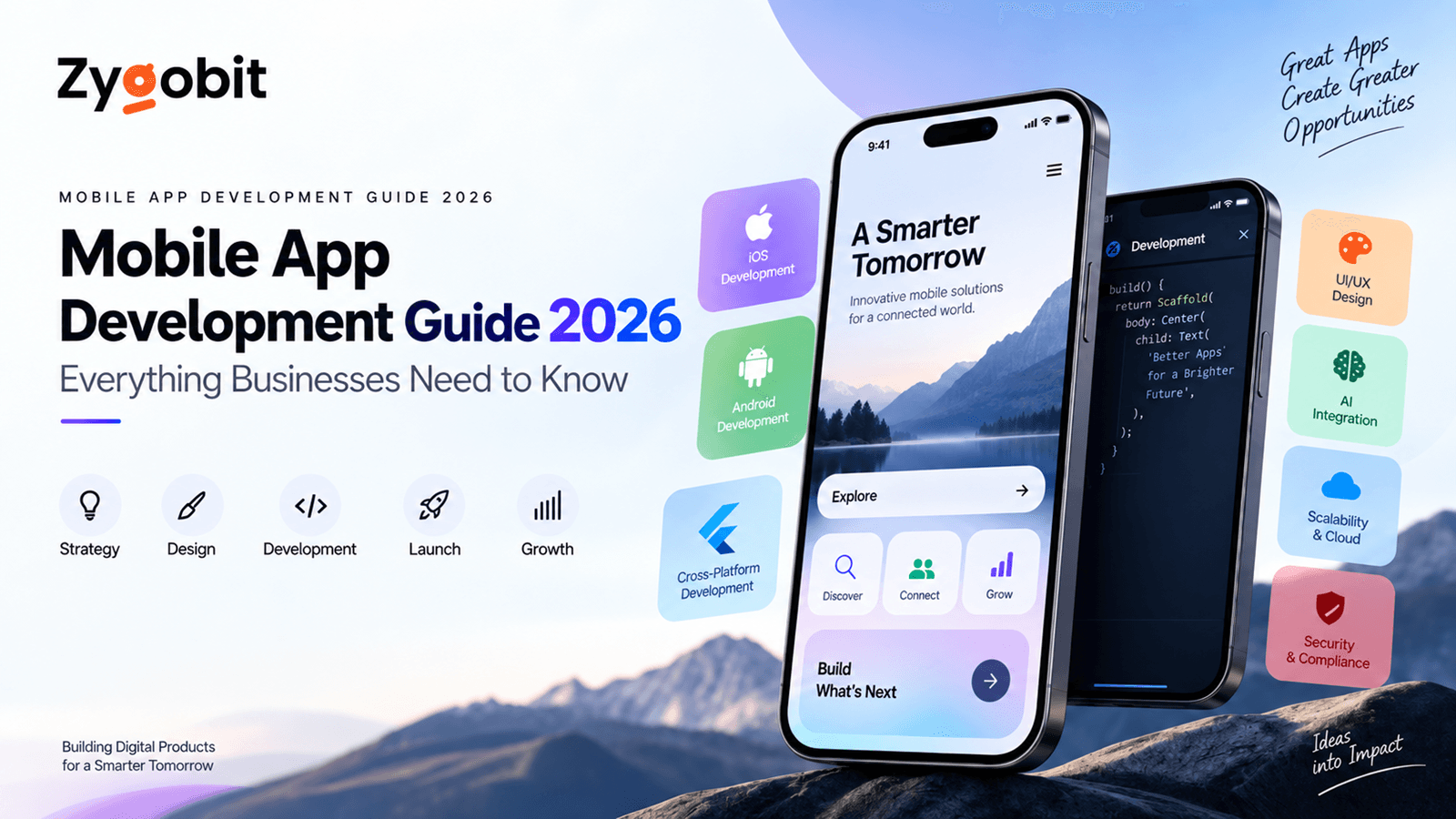
Mobile App Development Guide 2026 Everything Businesses Need to Know
Explore the complete mobile app development guide for 2026 and learn how businesses can plan, design, build, secure, test, launch, and scale successful mobile applications. Discover the right development approach, modern technologies, AI integration, UX best practices, backend architecture, cost factors, and key steps for creating high-performing, scalable digital products.
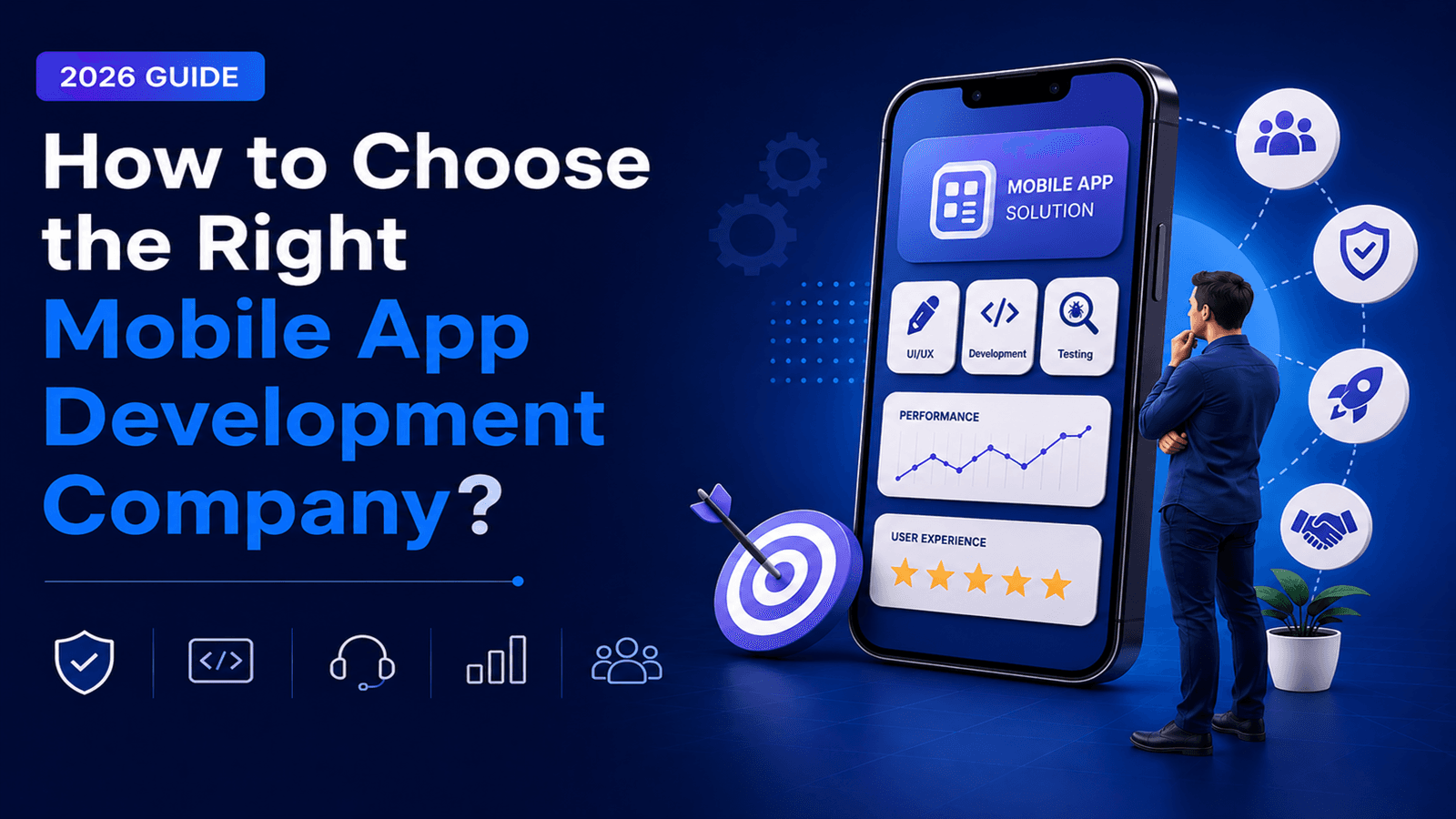
How to Choose the Right Mobile App Development Company in 2026
Learn how to choose the right mobile app development company in 2026. Explore key factors such as industry experience, technical expertise, UI/UX design, scalability, security, pricing, communication, testing, and post-launch support. Use this guide to compare development partners and make a confident decision for your mobile app project.

Top 20 Hybrid Mobile App Development Companies in 2026
Choosing the right hybrid mobile app development company is key to building scalable, high-performance apps. This list highlights the top 20 companies in 2026, recognized for expertise in Flutter, React Native, Ionic, and .NET MAUI. Compare proven partners that deliver cost-effective, cross-platform mobile solutions for startups, enterprises, and growing businesses.