





How to Build an AI Solution for Your Business: A Practical Guide for 2026

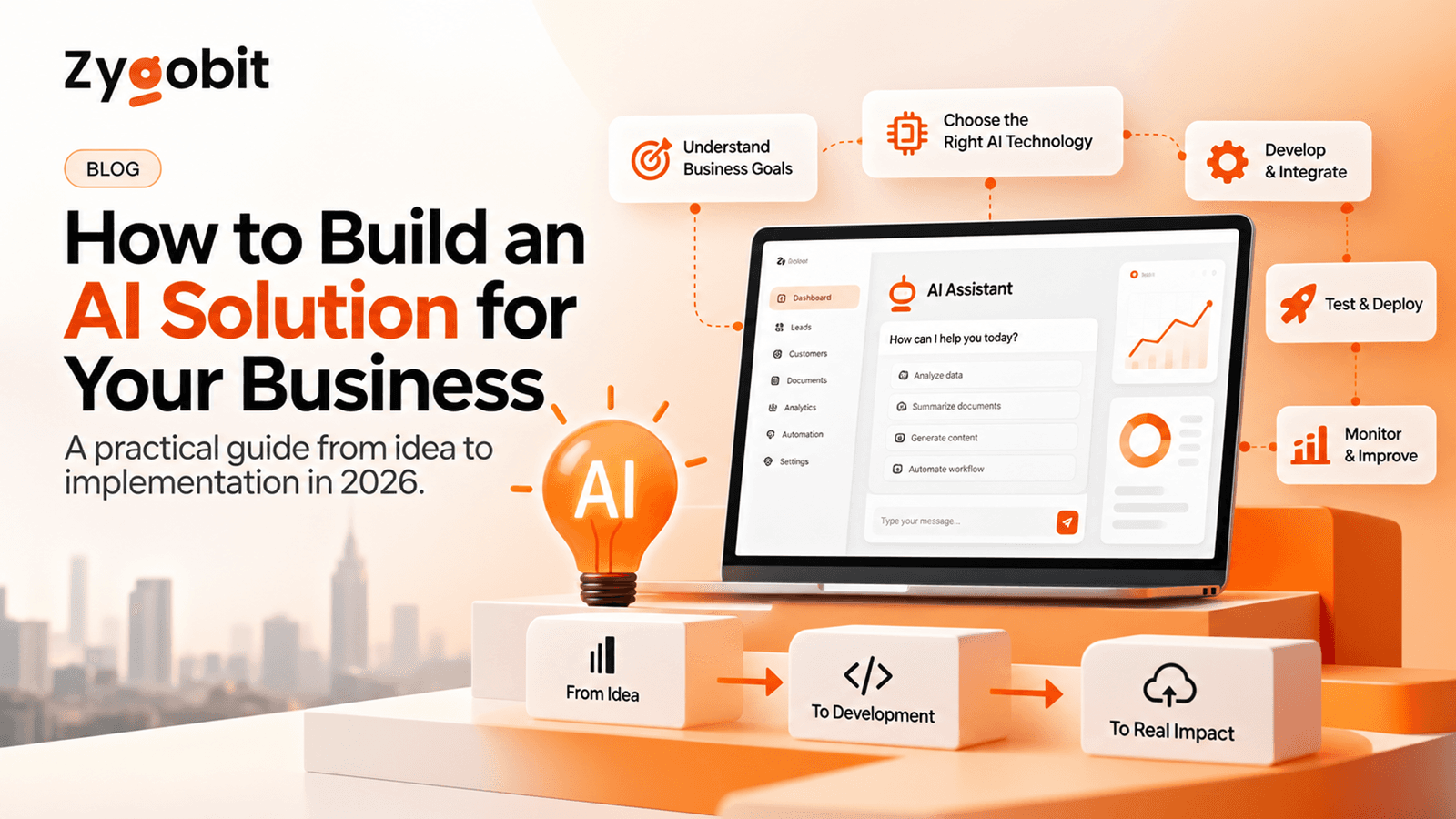
Learn how to build an AI solution for your business in 2026. Explore custom AI development, AI integration, machine learning, and automation. Discover the key steps from planning and choosing the right technology to development, testing, and deployment to create scalable, secure, and cost-effective AI solutions.
Artificial intelligence is no longer limited to research labs or large technology companies. Businesses are using AI to improve customer support, process documents, forecast demand, analyze information, and automate repetitive tasks.
However, building an AI solution is not as simple as connecting an application to a language model.
A successful AI project requires a clearly defined business problem, reliable data, an appropriate technology stack, and a plan for measuring results after deployment.
For startups and growing businesses, the important question is not whether AI can be added to their operations. It is whether the investment will solve a meaningful problem.
This guide explains how to build an AI solution, which technologies to consider, what challenges to expect, and how to approach AI development without unnecessary complexity.
What Is Custom AI Development?
Custom AI development is the process of designing, building, and deploying artificial intelligence systems for specific business requirements.
Unlike ready-made AI software, custom solutions can be integrated into a company's applications, databases, and operational workflows.
A custom AI solution might:
Analyze customer inquiries and suggest appropriate responses.
Extract information from invoices, contracts, or reports.
Predict inventory requirements using historical data.
Recommend relevant products or services.
Search internal documents and return relevant answers.
Automate parts of a multi-step business process.
Not every solution requires training a model from scratch. Many businesses can achieve their goals by integrating existing AI models with their software and proprietary data.
The right approach depends on the problem, available data, performance requirements, and operational constraints.
Businesses considering custom systems can explore Zygobit's AI development services to understand how machine learning, generative AI, and agentic AI can support different application requirements.
Step 1: Identify a Business Problem Worth Solving
The first stage of AI development should focus on the business problem rather than the technology.
For example, a company may want an AI chatbot because competitors have one. But the real challenge could be that its support team spends several hours each day answering similar customer questions.
That distinction matters.
Instead of starting with "We need a chatbot," a more useful objective would be:
Reduce the time employees spend handling routine support inquiries without compromising response quality.
This gives the project a measurable outcome.
Before committing to development, consider the following questions:
Which process currently consumes unnecessary time?
What information is required to complete the task?
Does the process involve repetitive decisions, predictions, or unstructured data?
What happens if the AI produces an incorrect result?
How will success be measured?
Some problems are better solved with ordinary software rules or improved workflows. AI becomes valuable when it addresses complexity that conventional automation cannot handle efficiently.
Businesses that need help evaluating opportunities can begin with AI consulting and strategy before investing in a complete development project.
Step 2: Choose the Right Type of AI Technology
AI development covers several technologies, and choosing the appropriate one significantly affects project cost, performance, and maintenance.
Machine Learning for Predictions and Pattern Recognition
Machine learning uses data to identify patterns and generate predictions.
It is suitable for applications such as demand forecasting, anomaly detection, customer segmentation, and recommendation systems.
For example, an e-commerce business could use historical sales, seasonality, and product information to estimate future demand.
However, predictions depend on data quality. A model trained on incomplete or unrepresentative information may produce unreliable results.
Companies working with structured business data can evaluate machine learning and AI development services for predictive applications.
Generative AI for Content and Knowledge-Based Tasks
Generative AI creates text, code, images, and other outputs based on user instructions and available context.
Business applications include document summarization, intelligent knowledge assistants, content drafting, and conversational interfaces.
One useful approach is retrieval-augmented generation (RAG).
RAG retrieves relevant information from a defined knowledge source and supplies it to a language model before generating a response.
For example, an internal assistant could retrieve information from company policies and technical documentation to answer employees' questions.
RAG can improve grounding, but it does not guarantee that every answer will be accurate. Retrieval quality, document access permissions, and response evaluation remain important.
Organizations can explore generative AI development when building applications powered by large language models.
Agentic AI for Multi-Step Workflows
Agentic AI extends beyond generating a single response.
An AI agent can use software tools and APIs to perform a sequence of authorized actions based on a task.
Consider a customer service workflow.
A conventional chatbot might explain how to reschedule an appointment. An AI agent could check appointment availability, propose alternatives, and initiate a change through a connected scheduling system.
Such workflows require access controls, clearly defined permissions, monitoring, and human approval for sensitive actions.
For businesses handling complex operational processes, agentic AI development can provide a foundation for controlled, tool-enabled automation.
Step 3: Assess Your Data and Existing Systems
Data readiness is one of the most important considerations in AI development.
A business may have years of customer records, support conversations, and operational information. However, that does not necessarily mean the data is immediately suitable for an AI application.
Information may be distributed across multiple platforms, contain duplicate records, or lack the structure required for reliable processing.
A practical data assessment should examine:
Availability: Is the required information accessible?
Quality: Are records accurate, consistent, and sufficiently complete?
Relevance: Does the data represent the problem being solved?
Privacy: Can the information legally and appropriately be processed?
Integration: Can the application access the information through secure APIs or other supported interfaces?
For example, a property management platform may store tenant records, rental payments, maintenance requests, and occupancy data.
Before introducing AI-based insights, those records need consistent formats and appropriate access permissions.
In many cases, the solution does not require replacing existing software.
Through AI integration services, businesses can add intelligent capabilities to current CRMs, applications, and internal systems.
Step 4: Build a Small Proof of Concept
Developing a complete AI platform before validating the underlying idea can create unnecessary financial and technical risk.
A proof of concept (PoC) helps establish whether an AI approach is feasible.
Consider a business that receives hundreds of invoices from different suppliers.
The proposed system would extract invoice numbers, payment amounts, supplier details, and due dates.
Rather than immediately automating the complete accounting process, the team could first test extraction accuracy on a representative sample of invoices.
The initial validation should answer three questions:
Can the technology perform the required task with acceptable quality?
Does it work on realistic data, including difficult cases?
Can the process deliver enough value to justify development and operating costs?
For a document extraction system, useful metrics might include field-level accuracy, processing time, and the percentage of documents requiring manual correction.
The objective is not to build an impressive demonstration. It is to establish whether the proposed application can work under real business conditions.
Step 5: Develop and Integrate the AI Application
After validating the concept, the next stage involves developing the production application.
Depending on the requirements, this could include a web interface, mobile application, backend APIs, databases, AI model services, and integrations with third-party platforms.
A typical architecture contains several components.
Application layer: The interface employees or customers use to interact with the solution.
Backend services: The business logic, authentication, permissions, and APIs that coordinate requests.
AI processing layer: The hosted model, custom model, retrieval system, or agent responsible for performing intelligent tasks.
Data layer: Databases, document repositories, vector indexes, and other information sources.
Monitoring layer: Logging, performance tracking, error reporting, and quality evaluation.
For example, an AI-powered customer support application may retrieve relevant documentation, generate a suggested response, and save the interaction in an existing CRM.
This requires more than a functioning language model. The surrounding application must handle authentication, failures, response delays, data access, and user experience.
Businesses can also consider AI automation services when their primary objective is to streamline existing processes instead of developing a completely new product.
Step 6: Test Accuracy, Security, and Reliability
An AI application that works during a demonstration may behave differently when exposed to real users.
Inputs can be incomplete, unexpected, misleading, or outside the model's intended scope.
For this reason, testing should cover more than whether the application produces a response.
Evaluate Output Quality
Define clear standards for correct and incorrect responses.
For a document assistant, evaluation could include factual accuracy, citation relevance, and whether the application acknowledges missing information.
For predictive machine learning, use appropriate test datasets and metrics such as precision, recall, or forecasting error.
Protect Sensitive Information
Security controls should reflect the type of data being processed.
Depending on the application, these may include encryption, role-based access, data retention policies, audit logs, and restrictions on third-party model access.
Healthcare, financial, and other regulated applications may have additional requirements that need specialist review.
Plan for Model Errors
AI systems can make mistakes, including generating plausible but incorrect information.
A reliable application should define what happens when confidence is insufficient or a task cannot be completed safely.
For sensitive operations, the system should escalate to a human rather than make an unrestricted decision.
Test Operating Costs
AI application costs may change significantly as usage grows.
The team should measure response latency, model usage, infrastructure requirements, and estimated cost per completed task.
These tests help establish whether the solution can operate sustainably beyond its initial launch.
Step 7: Deploy, Monitor, and Improve
AI development does not end when an application becomes available to users.
Data changes, business requirements evolve, and model providers may introduce new capabilities or pricing structures.
A production AI system requires ongoing monitoring.
Important areas include:
Response accuracy and task completion rates.
User feedback and failure patterns.
Application latency and availability.
AI model and infrastructure costs.
Security events and integration failures.
Changes in data quality or model performance.
For instance, a customer support assistant may perform well with the original knowledge base but become less reliable when policies and product features change.
Updating the source documents, testing new scenarios, and reviewing performance can help maintain output quality.
Continuous evaluation is particularly important for AI solutions that influence financial decisions, business operations, or customer-facing communications.
Build, Buy, or Integrate: Which AI Approach Makes Sense?
Not every business needs a fully custom AI system. The right approach depends on your business requirements, existing technology, budget, and long-term goals.
There are three common ways to adopt AI in your business.
1. Buy an Existing AI Tool
Ready-made AI tools are suitable for businesses that need solutions for common tasks such as customer support, content generation, meeting transcription, or data analysis.
These tools are generally faster to implement and require less technical effort. However, they may offer limited customization and may not integrate seamlessly with your existing business processes.
2. Integrate AI Into Existing Software
AI integration is a practical option for businesses that already have websites, mobile applications, CRMs, or internal management systems.
Instead of developing an entirely new platform, businesses can add intelligent features such as AI chatbots, document processing, predictive analytics, or workflow automation.
This approach requires secure API connections, appropriate access permissions, and reliable testing.
Businesses can explore AI integration services to understand how AI capabilities can be incorporated into existing applications.
3. Build a Custom AI Solution
Custom AI development is suitable for businesses with specialized requirements that existing tools cannot adequately address.
It allows companies to develop AI-powered applications tailored to their workflows, data sources, and operational objectives.
Although custom solutions typically require greater development effort, investment, and ongoing maintenance, they provide more control over features, integrations, and scalability.
Businesses with unique requirements can explore Zygobit's custom AI development services.
Which Approach Should You Choose?
For simple and standardized tasks, purchasing an existing AI tool may be the most efficient option.
If your business already uses established software and needs additional intelligent capabilities, AI integration may offer a better balance between cost and functionality.
For specialized workflows, proprietary products, or complex operational requirements, custom AI development may be the more appropriate long-term investment.
The best decision is the one that solves your business problem efficiently without introducing unnecessary technical complexity.
Common Mistakes Businesses Make During AI Development
AI projects can fail even when the technology itself is capable.
Several recurring mistakes create unnecessary risks.
Starting Without a Clear Success Metric
A vague goal such as "improve productivity with AI" provides little direction.
Define a measurable outcome, such as reducing manual processing time or improving document extraction accuracy.
Using AI When Conventional Automation Is Enough
Not every task requires machine learning or a large language model.
Predictable workflows with fixed rules may be handled more reliably and inexpensively through traditional software.
Ignoring Data Quality
AI cannot consistently compensate for incorrect records, missing information, or poorly structured source documents.
Data preparation should be included in the project scope.
Giving AI Unrestricted Access to Business Systems
An AI agent with permission to modify records, issue refunds, or send messages can create operational risks if controls are insufficient.
Apply least-privilege access, approval requirements, and audit logging.
Treating Deployment as the Final Milestone
Models, integrations, and source information require maintenance.
Without clear ownership and monitoring, application quality can deteriorate after launch.
Avoiding these mistakes often has more impact on project success than selecting the latest AI model.
How Much Does It Cost to Build a Custom AI Solution?
The cost of AI development depends on the complexity of the application, data readiness, infrastructure, and integration requirements.
A simple proof of concept using an existing model has a different cost structure from a production system requiring custom machine learning, multiple software integrations, and extensive security controls.
Several factors influence development cost:
Project scope: A document summarization feature typically requires less development than an enterprise-wide workflow platform.
Model strategy: Using an existing model API differs from training, fine-tuning, or hosting a specialized model.
Data preparation: Cleaning documents, labeling records, and connecting different data sources can add substantial effort.
Integrations: Connecting legacy software, databases, and third-party APIs often introduces additional complexity.
Production requirements: Authentication, monitoring, reliability, compliance, and support must be included in the budget.
Ongoing operations: AI model usage, hosting, storage, observability, and maintenance create recurring costs.
Instead of relying on a generic price estimate, businesses should request a scope based on their specific use case, expected usage, and technical environment.
A staged approach can reduce financial exposure by validating the most important assumptions before expanding development.
How Zygobit Approaches AI Development
At Zygobit, AI development begins with understanding the business problem and identifying the most suitable technical approach.
Our services cover machine learning, generative AI, AI agents, workflow automation, and integration with existing software.
We support startups and growing businesses that need to move beyond demonstrations and build AI capabilities into usable products.
Depending on the project, this can involve:
Evaluating AI opportunities and technical feasibility.
Selecting existing models or developing specialized solutions.
Building AI-powered web and mobile applications.
Connecting AI capabilities with existing business platforms.
Implementing testing, monitoring, and operational safeguards.
Supporting applications after deployment.
The objective is to build software that addresses an identifiable business requirement and can be maintained as usage grows.
Businesses exploring a new project can learn more about our custom AI development services.
Final Thoughts
Building an AI solution is a business and engineering decision, not simply a technology upgrade.
The strongest projects begin with a specific operational problem, realistic expectations, and measurable success criteria.
By choosing appropriate technologies, validating assumptions early, and incorporating security and monitoring into development, businesses can create AI applications that deliver practical value.
Whether the goal is to improve customer experiences, analyze business data, automate workflows, or launch an AI-powered product, a structured development process helps reduce unnecessary risk.
Planning an AI project for your business?
Zygobit helps businesses evaluate, build, integrate, and maintain AI-powered software.
Explore AI Development Services or Book a Strategy Call.
Frequently Asked Questions
How do you build an AI solution for a business?
Start by identifying a measurable business problem. Evaluate the available data, select an appropriate AI approach, validate the concept using real examples, and develop the necessary application and integrations. Before deployment, test accuracy, security, and reliability. Continue monitoring the system after launch.
Does a business need to train its own AI model?
No. Many businesses can use existing AI models through APIs or managed services. Custom model training is more appropriate when specialized requirements, proprietary data, performance constraints, or deployment considerations justify the additional investment.
What is the difference between AI development and AI integration?
AI development involves building AI-powered applications or models. AI integration focuses on connecting AI capabilities to existing business software, databases, and workflows. A project may require either approach or a combination of both.
How long does custom AI development take?
The timeline depends on the complexity of the use case, data quality, integrations, and production requirements. A focused prototype may take substantially less time than a production system that requires multiple integrations, security reviews, and extensive testing.
Can AI be added to an existing website or mobile application?
Yes. AI features such as document assistants, recommendations, intelligent search, and customer support capabilities can often be integrated into existing applications through APIs and backend services.
How can businesses measure the success of an AI project?
Success should be evaluated against business-specific metrics, including processing time, task completion rate, error rate, customer satisfaction, operational costs, and the amount of human review required.
What is the biggest challenge in AI development?
There is no single challenge for every project. Common difficulties include poor data quality, unclear objectives, unreliable outputs, complicated integrations, and insufficient monitoring. Identifying these risks during planning helps businesses make better implementation decisions.

Ready to build your next digital product?
Talk to Zygobit about web apps, mobile apps, AI solutions, automation, and scalable software development tailored to your business goals.
Explore Related Articles
More reading on web, mobile, AI, and product engineering from the Zygobit team.
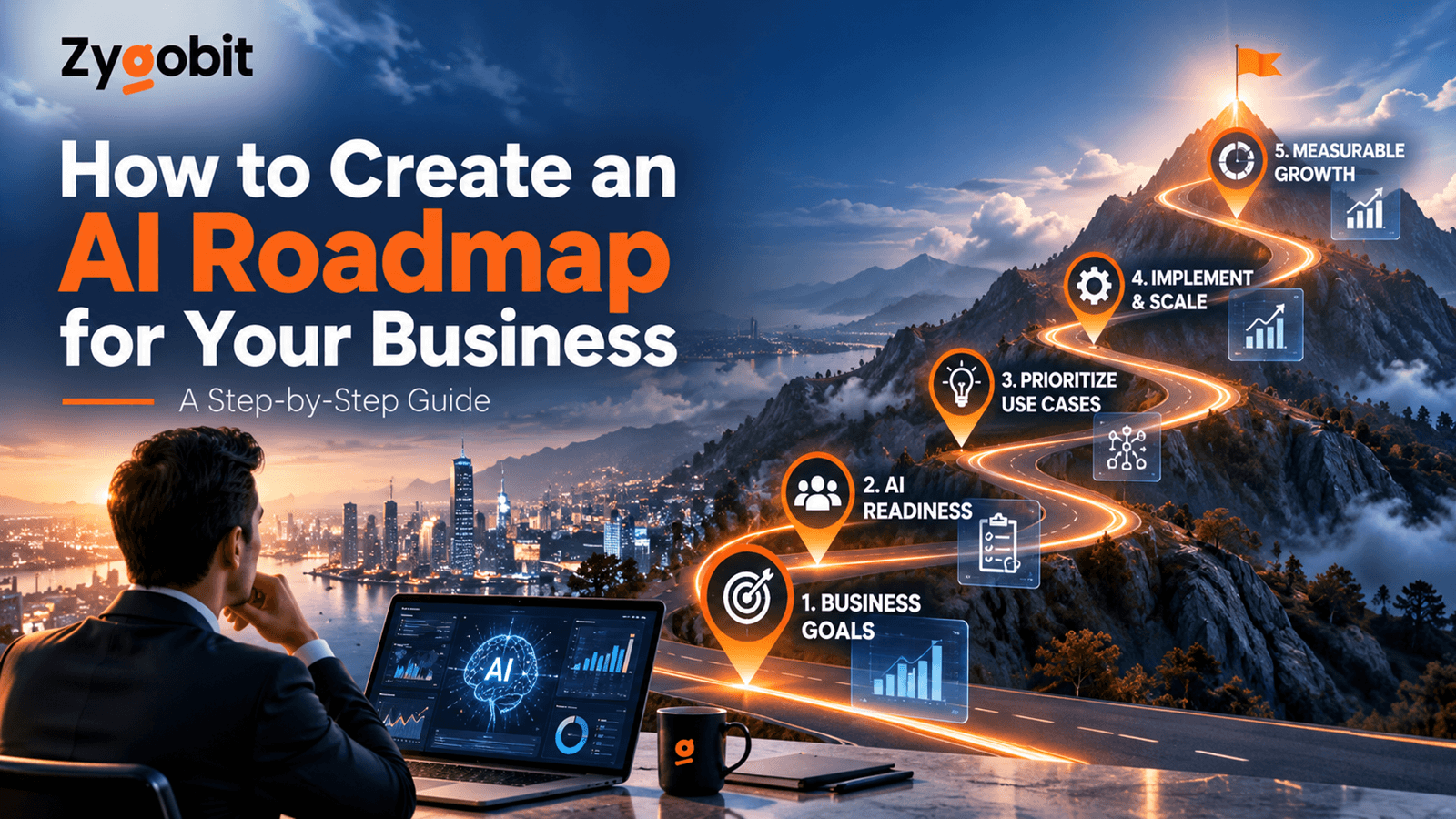
How to Create an AI Roadmap for Your Business A Step-by-Step Guide
Discover how to create an effective AI roadmap for your business with this step-by-step guide. Learn how to assess AI readiness, identify high-value use cases, prioritise opportunities, estimate implementation costs, and measure results. Explore how AI roadmap consulting helps businesses reduce risks, make smarter technology investments, and achieve sustainable growth through artificial intelligence.
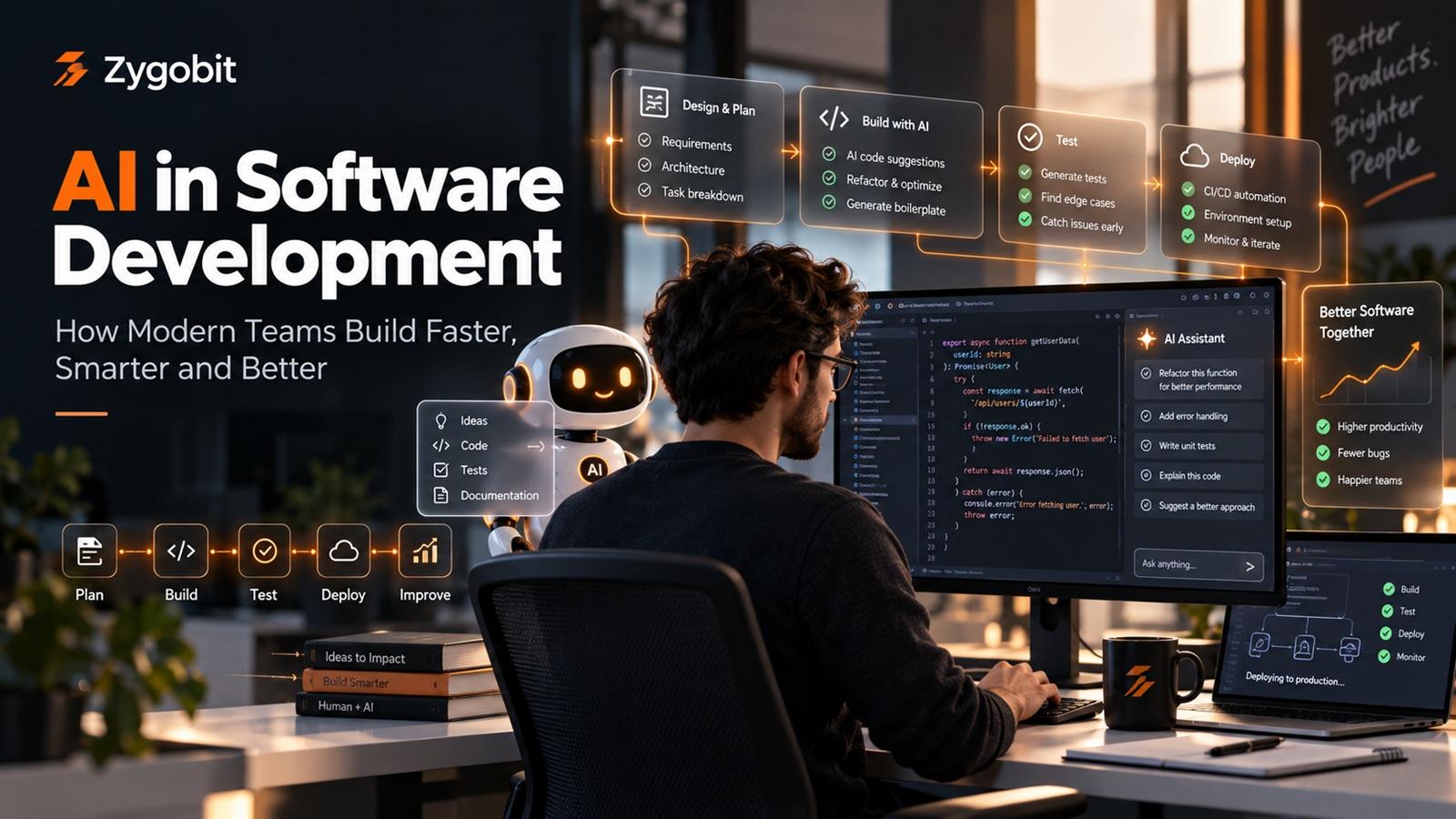
AI in Software Development: How Modern Teams Build Faster, Smarter and Better
Discover how AI is transforming software development across coding, testing, reviews, automation, and deployment. Learn how Zygobit helps businesses build smarter, faster, and more scalable AI-powered software solutions.
Top 10 AI Development Companies in USA to Build Next-Gen AI Products in 2026
Discover the top 10 AI development companies in the USA for 2026 helping businesses build next-gen AI products. Explore leading firms specializing in Generative AI, Agentic AI, machine learning, RAG, automation, web and mobile product engineering. See why Zygobit stands out as an AI-first development partner for startups and growing businesses looking to turn innovative ideas into scalable, production-ready AI solutions.