





AI in Software Development: How Modern Teams Build Faster, Smarter and Better

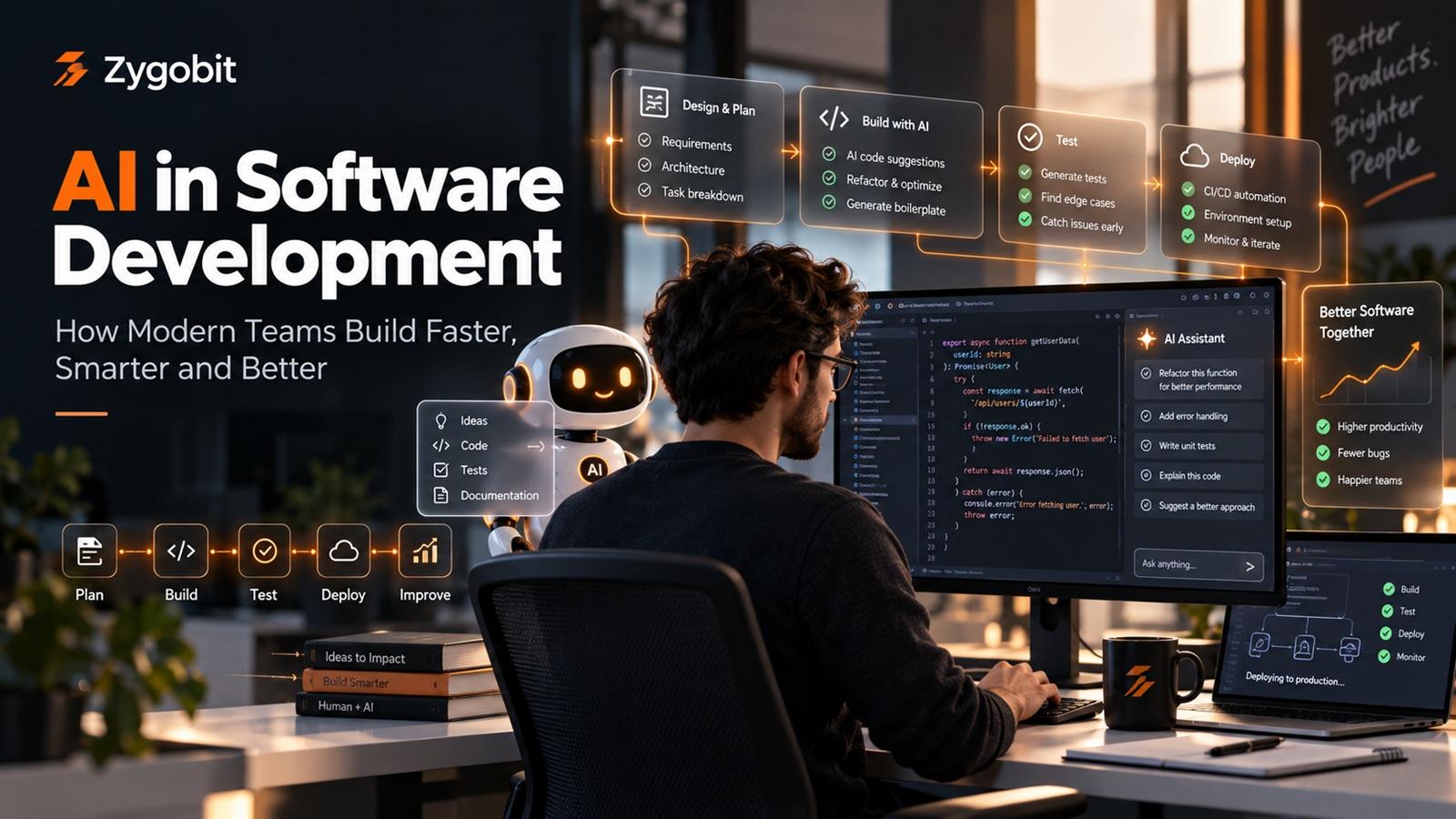
Discover how AI is transforming software development across coding, testing, reviews, automation, and deployment. Learn how Zygobit helps businesses build smarter, faster, and more scalable AI-powered software solutions.
Artificial intelligence is changing software development, but not simply by helping developers write code faster.
The bigger transformation is happening across the entire software development lifecycle. AI is now helping teams understand requirements, plan features, generate code, create tests, review changes, produce documentation, analyze bugs, automate workflows and support deployment.
For businesses building modern digital products, this creates an important opportunity. Development teams can reduce repetitive work and spend more time solving product, architecture and customer problems.
But adding an AI coding assistant does not automatically create an AI-powered development process.
The real value comes when AI becomes part of the complete engineering workflow.
At Zygobit, we see AI-assisted software development as a combination of engineering experience, automation, intelligent tooling and human decision-making. AI can accelerate many activities, but developers, architects and product teams still provide the context, judgment and accountability required to build reliable software.
What Is AI in Software Development?
AI in software development refers to the use of artificial intelligence throughout the process of designing, developing, testing, deploying and maintaining software.
Most people first associate AI development with tools that generate code. That is only one part of the picture.
Modern AI systems can help interpret requirements before development begins. They can suggest technical architectures, generate frontend and backend components, explain unfamiliar codebases, create database queries, generate unit tests, analyze pull requests, identify potential bugs and assist developers during debugging.
Businesses can also use professional AI development services to integrate artificial intelligence directly into existing products, internal systems and operational workflows.
AI can also help engineering teams maintain documentation and transform technical information into more understandable material for product managers, QA teams and other stakeholders.
This makes AI increasingly relevant throughout the entire Software Development Life Cycle rather than only inside the developer's code editor.
AI Is Moving Beyond Code Generation
Code generation receives much of the attention because its impact is immediately visible.
A developer can describe a component and receive working code within seconds. AI can generate API handlers, database queries, validation logic, test cases or repetitive boilerplate that previously required considerable manual work.
However, faster code generation does not necessarily mean faster product delivery.
Software development contains many stages between writing code and releasing a feature.
Requirements have to be understood. Technical decisions need to be made. Code needs testing. Pull requests need reviewing. Bugs need fixing. Deployments must be monitored. Documentation needs maintaining.
When AI speeds up only the coding stage but the rest of the workflow remains slow, engineering teams simply move the bottleneck somewhere else.
That is why organizations should think about AI development as workflow optimization rather than code generation alone. Businesses dealing with repetitive operational processes can also explore AI automation services to connect AI with the systems their teams already use.
Where AI Can Improve the Software Development Lifecycle
The strongest AI development environments use artificial intelligence across several stages of product engineering.
During product discovery, AI can help organize requirements, transform meeting notes into technical tasks and identify missing information before development starts.
During planning, development teams can use AI to break large features into smaller implementation tasks and explore possible architectural approaches.
During development, coding assistants can generate repetitive code, explain existing modules, refactor functions and help developers work with unfamiliar libraries or frameworks.
For businesses developing browser-based platforms, dashboards, SaaS products or internal systems, AI can also be integrated alongside custom web application development.
Testing is another strong area for AI adoption. AI systems can generate test scenarios, identify edge cases, create automated tests and help developers understand failures more quickly.
Code review can also become more efficient. AI-assisted review systems can inspect changes for common programming mistakes, inconsistent patterns, security risks and missing test coverage before a human reviewer examines the pull request.
Documentation can be produced directly from APIs, code structures and product specifications, reducing the amount of documentation developers need to maintain manually.
AI can also support DevOps teams by analyzing logs, deployment failures and infrastructure alerts.
The result is not an engineering organization where AI replaces developers. It is an engineering organization where developers spend less time performing predictable work.
The Biggest Mistake Companies Make With AI Development
One of the most common mistakes is measuring AI adoption instead of measuring engineering outcomes.
A company might purchase AI coding tools for its entire development team and consider the initiative successful because developers are actively using them.
But tool usage alone does not tell you whether the development process has actually improved.
AI could generate significantly more code while the team continues experiencing slow releases, overloaded reviewers, production bugs and unclear requirements.
The important question is not how much AI-generated code a company produces.
The important question is whether the engineering team can deliver useful, stable software more efficiently.
That requires looking beyond the code editor.
Measuring the Real Impact of AI in Software Development
The effectiveness of AI development should be measured using engineering and business outcomes.
One useful metric is development cycle time. Teams can compare how long features or code changes take to move from development into production before and after introducing AI-assisted workflows.
Quality should be measured at the same time.
If development becomes faster but production defects increase significantly, the organization has not achieved meaningful productivity.
Teams should also examine where developers spend their time.
A successful AI implementation should gradually reduce the amount of time engineers spend creating boilerplate code, repetitive tests, routine documentation and predictable configuration.
That capacity can then move toward system design, difficult integrations, product decisions, architecture, optimization and complex debugging.
Deployment frequency, review time, defect rates, automated test coverage and production incidents can provide additional indicators of whether AI is actually improving the development lifecycle.
The goal should always be better software delivery rather than simply more software output.
AI Tools Developers Are Using Today
The AI development ecosystem has expanded rapidly.
GitHub Copilot remains one of the most recognizable AI coding assistants and integrates directly with common development environments.
Cursor has become popular among developers who prefer an AI-first coding environment where the assistant can understand and work across larger parts of a project.
OpenAI models are frequently used for debugging, architecture discussions, API development, documentation and technical problem-solving.
Claude is also commonly used by engineering teams for code reasoning, understanding larger codebases and working through complex development problems.
Amazon Q Developer provides AI capabilities that can be particularly useful for teams working heavily within the AWS ecosystem.
JetBrains and other development platform providers are also integrating AI directly into their IDE environments.
However, choosing the right AI tool should depend on the development environment rather than popularity alone.
A tool that works extremely well for an individual developer may not necessarily integrate effectively into a company's broader engineering workflow.
Businesses exploring more advanced autonomous workflows can also consider Agentic AI development, where AI agents can interact with tools, systems and business processes to complete multi-step tasks.
Why AI Tools Need Context
One major limitation of AI development tools is context.
AI can produce technically valid code that is completely wrong for the product.
A coding assistant does not automatically understand why a particular architecture was selected, which business rules must never be changed, how permissions work inside the application or which integrations depend on a specific implementation.
This is why high-quality software teams provide AI systems with structured context.
That context may include coding standards, architecture documentation, database structure, API conventions, security requirements, naming patterns and product rules.
When AI understands the environment it is working within, the quality of its recommendations improves significantly.
Without that context, developers may spend more time correcting AI-generated code than the AI originally saved.
Human Review Still Matters
AI can review code quickly, but human engineering judgment remains important.
Software contains business decisions that cannot always be evaluated by analyzing syntax or programming patterns.
A piece of code can be technically correct while implementing the wrong business behavior.
Security, privacy, financial calculations, access permissions and critical product workflows also require careful oversight.
The most effective approach is therefore not choosing between AI development and human development.
It is designing a workflow where each handles the work they are best suited for.
AI can handle repetitive analysis, generate implementation options, inspect patterns and perform routine checks.
Developers can evaluate architecture, business logic, security implications, maintainability and product impact.
AI-Assisted Testing
Testing is one of the areas where AI can provide substantial practical value.
Writing comprehensive test cases takes time, particularly when developers need to consider many different inputs and edge cases.
AI can examine functionality and suggest scenarios that developers may not immediately consider.
It can generate unit tests around existing code, identify areas with weak test coverage and help explain why tests are failing.
AI-assisted testing can also improve regression testing by helping teams understand which parts of a system may be affected when code changes.
However, automatically generated tests still require validation.
A test can technically pass while testing the wrong behavior.
Teams therefore need clear acceptance criteria and product requirements so AI-generated tests verify the intended outcome.
AI for Code Review
Code review is another development stage that can benefit from automation.
Traditional pull request reviews can create delays when experienced developers become responsible for reviewing large amounts of routine code.
AI can perform an initial review before the pull request reaches a human engineer.
It can flag potentially unsafe patterns, duplicated code, missing error handling, inconsistent implementation and possible performance problems.
The human reviewer can then focus on questions that require deeper understanding.
Does the implementation match the product requirement? Does the architecture make sense? Will the approach remain maintainable as the product grows?
This combination can make reviews more focused without removing human accountability.
AI and Software Documentation
Documentation is frequently postponed during fast-moving software projects.
Developers naturally prioritize building and fixing functionality, which means technical documentation can quickly become outdated.
AI can reduce this problem.
Development teams can generate documentation from APIs, source code, architecture files and database models.
AI can also summarize complex technical implementations for non-technical stakeholders and create onboarding material for developers joining an existing project.
This becomes particularly useful for large web platforms, SaaS products and mobile applications where multiple systems and integrations need to remain understandable over time.
AI in Mobile App Development
AI is also changing how mobile applications are designed and built.
Developers can use AI to accelerate UI implementation, API integration, debugging, test generation and application documentation.
More importantly, AI can become part of the application itself.
Mobile products can incorporate intelligent search, recommendations, document processing, conversational assistants, image recognition, predictive functionality and workflow automation.
Businesses planning these kinds of products can combine AI capabilities with mobile app development services to build applications for iOS and Android around real operational or customer use cases.
The objective should not be to add AI simply because it is popular.
AI should solve a clear user or business problem inside the application.
From AI Assistants to AI Agents
The next stage of AI development is moving beyond assistants that wait for instructions.
AI agents are designed to pursue goals, interact with tools and execute multiple steps within defined boundaries.
Instead of asking an assistant to generate a single piece of code, an engineering team may eventually assign an agent a broader objective.
The agent could analyze an issue, inspect the relevant code, propose an implementation, generate changes, create tests and prepare the work for review.
Similar patterns can be applied outside engineering.
AI agents can support customer service, sales operations, internal reporting, data processing and other workflows that involve multiple connected actions.
This is one reason AI use cases for modern businesses are expanding well beyond simple chatbots and content generation.
Human oversight remains important, particularly where agents interact with production systems, customer data or business-critical processes.
Implementing AI in an Existing Development Team
Companies do not need to transform their complete development process at once.
A practical starting point is identifying where engineering time is being lost.
The problem could be repetitive development work, slow testing, delayed code reviews, outdated documentation, difficult debugging or manual deployment processes.
Once the bottleneck is clear, the team can introduce AI into that specific area.
The results should then be measured.
If the change saves time without reducing quality, the workflow can be expanded.
If it creates additional complexity, the team should adjust or remove it.
This incremental approach is usually more effective than introducing several AI tools simultaneously without clear objectives.
Building AI-Powered Software for Business
There is an important difference between using AI to develop software and building software that uses AI.
The first improves the engineering process.
The second creates AI capabilities for customers or internal teams.
Businesses are increasingly combining both.
An engineering team might use AI coding assistants internally while building a customer-facing platform containing intelligent search, recommendations, automation or conversational interfaces.
The underlying application still requires traditional software engineering.
The AI model needs a reliable frontend, backend infrastructure, authentication, databases, APIs, monitoring and security controls around it.
That is why effective AI products require both AI capability and strong software engineering.
At Zygobit, our approach combines AI development, web engineering, mobile development and workflow automation so AI becomes part of a usable production system rather than an isolated experiment.
The Future of AI in Software Development
Software development is moving toward deeper collaboration between developers and intelligent systems.
AI assistants will continue becoming more aware of complete codebases rather than individual files.
Agents will increasingly perform multi-step engineering tasks.
Testing and code review will become more automated.
Documentation will become easier to maintain as AI systems continuously analyze changes across projects.
Developers will likely spend less time producing repetitive implementation code and more time defining systems, reviewing decisions and solving difficult technical or product problems.
The companies that benefit most will not necessarily be those using the largest number of AI tools.
They will be the organizations that understand where AI creates meaningful value and integrate it into their development processes carefully.
Conclusion
AI in software development is much bigger than code generation.
Its real potential comes from improving the entire path from an idea to production software.
AI can help teams plan work, write code, test applications, review changes, maintain documentation, investigate problems and automate repetitive processes.
But AI does not remove the need for experienced developers.
It changes where their time and judgment are most valuable.
Businesses that combine artificial intelligence with strong engineering practices can build products more efficiently while maintaining the quality, security and scalability required for long-term growth.
Zygobit works with startups, SMEs and growing businesses to design and develop AI-powered systems, web platforms, mobile applications and intelligent workflow automation.
If you are exploring how AI could fit into an existing product or planning a new AI-powered application, you can contact Zygobit to discuss the project.
Frequently Asked Questions
What is AI in software development?
AI in software development is the use of artificial intelligence to assist with activities such as requirements analysis, coding, testing, debugging, code review, documentation and software deployment.
How is AI used by software developers?
Developers use AI for code generation, debugging, refactoring, test generation, documentation, architecture exploration and understanding unfamiliar codebases.
Can AI build complete software applications?
AI can generate significant parts of an application and automate many development activities, but complete production software still requires architecture decisions, business context, integration, security, testing and human review.
Will AI replace software developers?
AI is more likely to change how developers work than eliminate the need for software engineers. Developers remain responsible for architecture, business logic, technical decisions, security, product understanding and quality control.
How can businesses integrate AI into existing software?
Businesses can connect AI models with existing databases, APIs, CRMs, SaaS platforms and internal systems. Depending on the use case, this can enable intelligent search, workflow automation, recommendations, document processing, conversational interfaces or AI agents.
What is the difference between AI automation and Agentic AI?
AI automation usually applies artificial intelligence to predefined workflows or repetitive processes. Agentic AI goes further by enabling AI systems to make decisions, use tools and complete multi-step tasks within defined boundaries.
Can AI be integrated into web and mobile applications?
Yes. AI can be integrated into both web and mobile applications for features such as chatbots, intelligent search, recommendations, image processing, document analysis, predictive functionality and workflow automation.
How do I start an AI software development project?
Start with a clearly defined business problem rather than choosing an AI model first. Identify the required data, workflows, users, integrations and expected outcome before selecting the technical approach.

Ready to build your next digital product?
Talk to Zygobit about web apps, mobile apps, AI solutions, automation, and scalable software development tailored to your business goals.
Explore Related Articles
More reading on web, mobile, AI, and product engineering from the Zygobit team.
Top 10 AI Development Companies in USA to Build Next-Gen AI Products in 2026
Discover the top 10 AI development companies in the USA for 2026 helping businesses build next-gen AI products. Explore leading firms specializing in Generative AI, Agentic AI, machine learning, RAG, automation, web and mobile product engineering. See why Zygobit stands out as an AI-first development partner for startups and growing businesses looking to turn innovative ideas into scalable, production-ready AI solutions.
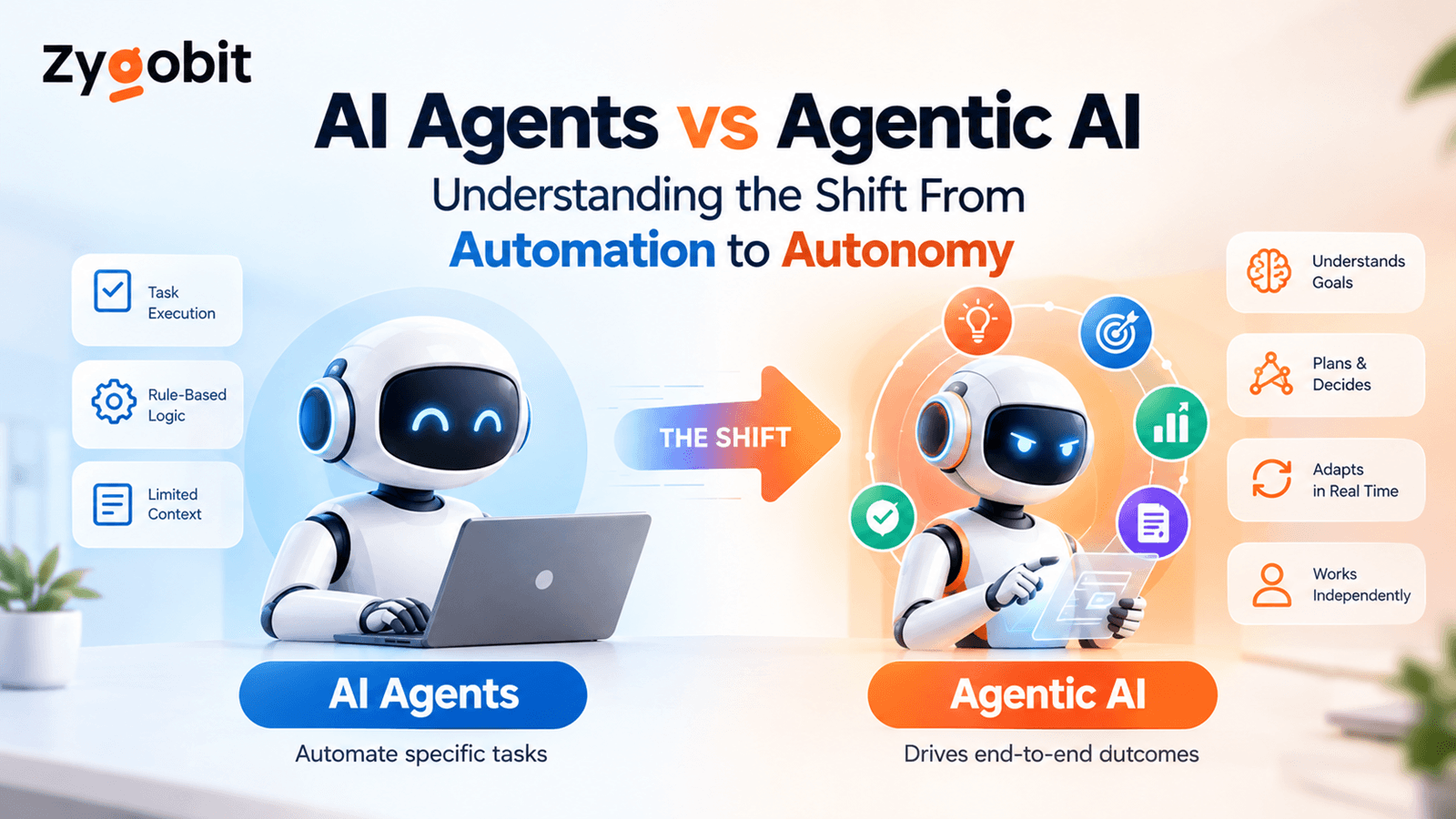
AI Agents vs Agentic AI Understanding the Shift From Automation to Autonomy
AI agents are changing business automation by moving beyond simple responses to intelligent action. This article explains the difference between AI agents and agentic AI, including planning, tool use, workflow orchestration, state management, human approvals, security, observability, and enterprise use cases.
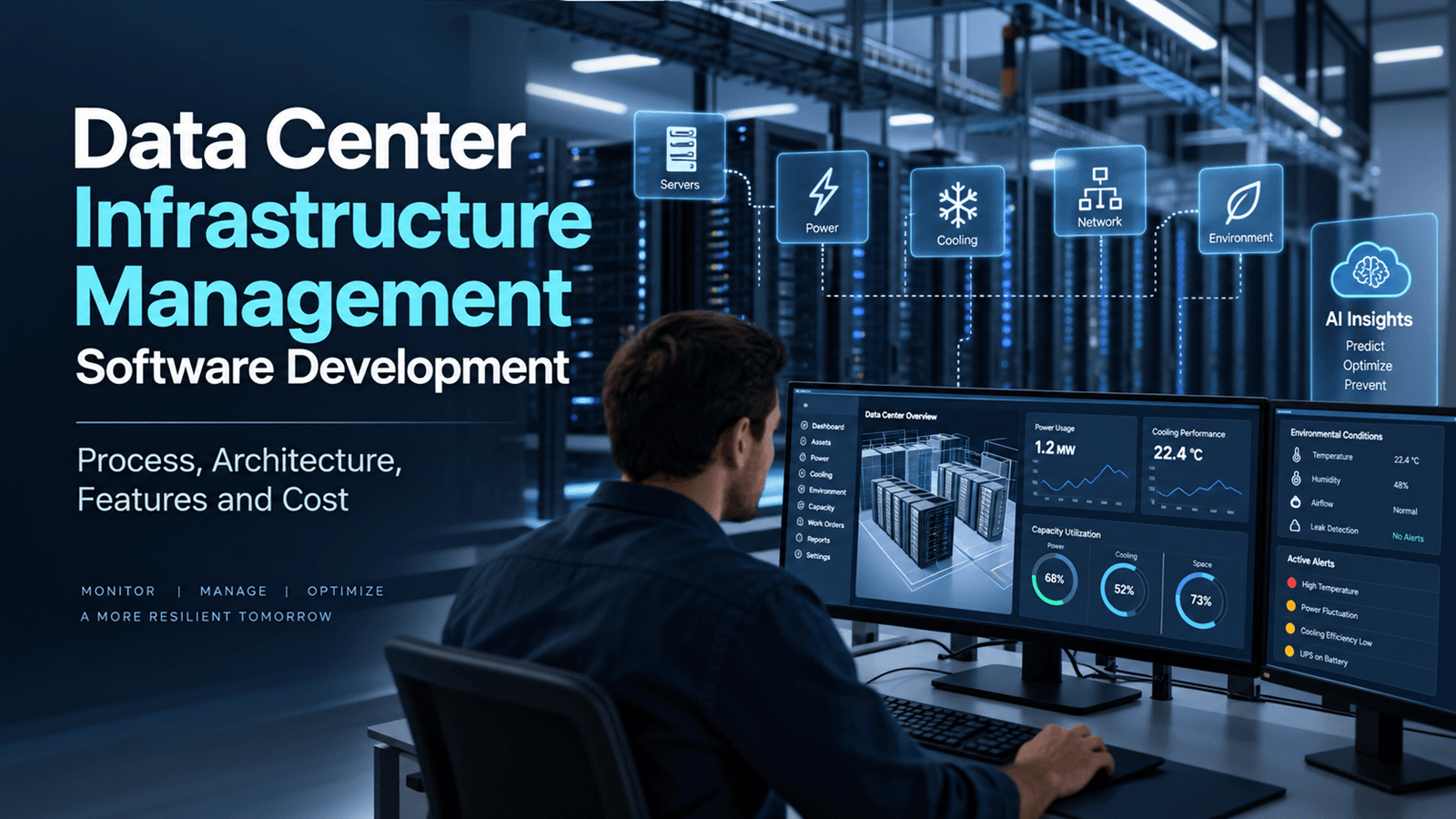
Data Center Infrastructure Management Software Development Process, Architecture, Features and Cost
Explore how Data Center Infrastructure Management software helps organizations monitor assets, power, cooling, capacity, and real-time infrastructure data. This guide covers DCIM software development, system architecture, key features, AI capabilities, security, integrations, implementation process, cost considerations, and future trends shaping modern data center operations.