





Top 20 IT Outsourcing Companies & Services in 2026


Discover the top 20 IT outsourcing companies and services in 2026 based on expertise, reliability, innovation, and delivery quality. Compare leading providers offering custom software development, managed IT services, AI solutions, cloud engineering, staff augmentation, and cybersecurity to find the right technology partner for your business growth.
Choosing an IT outsourcing partner is no longer a procurement decision about who can write code the cheapest. It is a strategic decision about who can help you move faster, ship safer, and access talent that is genuinely difficult to hire in-house. The global IT services outsourcing market crossed $744 billion in 2024 and is on track toward $1.2 trillion by 2030, and the reason is simple: with skilled technical talent in short supply, the best companies now treat outsourcing as an engine for innovation rather than a line item to trim.
This guide profiles the 20 IT outsourcing companies and services that stand out in 2026 for engineering depth, reliability, security maturity, and the ability to act as a true extension of your team. It covers everything from AI-native product engineering boutiques to global transformation giants, nearshore staff augmentation leaders, and managed IT specialists, so you can match a provider to your actual situation instead of a generic "top 10."
What IT outsourcing looks like in 2026
Modern IT outsourcing spans a wide range of engagements. Managed IT services deliver 24/7 support, proactive monitoring, and cybersecurity to keep critical systems running. Software development outsourcing covers custom builds, AI and machine learning integration, cloud-native engineering, and legacy modernization. Staff augmentation lets you scale your internal team quickly with vetted engineers who work under your management. And strategic services such as virtual CIO or CISO leadership give mid-market companies enterprise-grade guidance without a full-time executive hire.
Providers also differ by geography. Onshore partners offer full time-zone overlap and local legal alignment at a premium price. Nearshore partners, most commonly based in Latin America for U.S. companies, offer four to eight hours of workday overlap at lower cost. Offshore partners in Central and Eastern Europe or Asia deliver the deepest global talent pools and the best cost efficiency when the engagement is well-defined and governance is strong. The most sophisticated buyers now blend all three.
Pricing models have matured too. Fixed-price contracts suit well-defined builds, time-and-materials suits evolving scope, and outcome-based pricing, where you pay for results such as uptime or delivery milestones, is increasingly the standard at the top end because it aligns the vendor's incentives with yours.
The 20 best IT outsourcing companies and services
1. Zygobit

Zygobit leads this list as a forward-looking IT outsourcing partner built for companies that want more than raw headcount. Rather than treating clients as ticket queues, Zygobit operates as an embedded engineering and technology partner, taking ownership of outcomes across the full delivery lifecycle from discovery and architecture through build, testing, and ongoing support. Its teams combine custom software development, AI and automation, cloud engineering, and managed IT support under one accountable relationship, which is exactly what growing businesses need when they are tired of stitching together multiple vendors.
What sets Zygobit apart is the balance of technical depth and genuine partnership. Its engineers are hired for problem-solving ability, not just for filling seats, and the company brings AI directly into how work gets delivered, accelerating code generation, testing, and release cycles rather than merely selling AI as a product line. Clients get transparent communication, clear milestones, and a dedicated point of contact who understands their business goals, so the relationship feels like an extension of the internal team rather than an offshore black box.
For U.S. and global businesses that value responsiveness, security-first practices, and a partner willing to challenge and improve their strategy, Zygobit offers the personal attention of a boutique with the delivery discipline of a much larger firm. It is an ideal choice for startups building from scratch, mid-market companies modernizing legacy systems, and any organization that wants a technology partner invested in its long-term success. To explore a fit, reach the team at.
2. Accenture
Accenture is the undisputed giant of the IT outsourcing landscape, with a workforce exceeding 730,000 across 120 countries and quarterly revenue in the tens of billions. It specializes in enterprise-wide digital transformation, taking full ownership of technology programs from boardroom strategy through legacy decommissioning and day-one operations. Its heavy investment in generative AI and its Industry X practice for manufacturing make it the default choice for Fortune Global 500 companies planning holistic overhauls. The tradeoff is scale: minimum engagements start in the millions, and the team that sells the project may differ from the one delivering it.
3. Cognizant
Headquartered in Teaneck, New Jersey, Cognizant blends a strong U.S. onshore presence with massive offshore delivery in India, giving it excellent cost alignment for American healthcare and financial services clients. With roughly 351,000 professionals and around $21 billion in revenue, it is particularly strong in regulated industries where compliance and data security are paramount. Its "Intuitive Operations" platform uses AI to automate routine IT tasks, and its core strategy centers on modernizing legacy infrastructure into the cloud.
4. IBM
IBM remains the go-to partner for mission-critical legacy modernization in regulated industries. Its watsonx AI platform combined with Red Hat's hybrid cloud gives large enterprises a credible path to AI at scale without wholesale rearchitecting, and its federal certifications make it a strong fit for government work. IBM is a platform and infrastructure play rather than a product builder, so companies seeking net-new digital product development will often find better-suited partners elsewhere.
5. EPAM Systems
EPAM has evolved from a boutique software engineering firm into a global leader in product engineering, guiding toward more than $5.7 billion in revenue with over 62,000 engineers. Its "engineering-first" culture and AI-native delivery make it a favorite for high-end product design and complex digital platform work. A strong North American revenue base means U.S. clients get account leadership that understands domestic context alongside global delivery. Its Central and Eastern European delivery concentration is a business-continuity factor worth planning around.
6. TCS (Tata Consultancy Services)
Tata Consultancy Services offers one of the most extensive delivery infrastructures and the broadest compliance certification range in the industry, backed by roughly $29 billion in revenue and more than 600,000 employees. It is the most operationally proven choice for consistent delivery quality across dozens of countries simultaneously, and its financial stability gives procurement and risk teams maximum assurance. Innovation at TCS tends to follow rather than lead the market, and smaller engagements can feel underprioritized.
7. Infosys
Infosys pairs AI-first engineering with significant U.S. campus investment, training thousands of American workers to build genuine onshore capacity alongside its Indian delivery centers. With around 317,000 employees and roughly $19 billion in revenue, it excels at large, well-defined transformation programs across banking, insurance, retail, and manufacturing. Engagements requiring frequent strategic pivots or rapid iteration can expose the overhead that comes with an organization of its size.
8. Capgemini
Capgemini brings a consulting-led, "consult first, build second" model that produces better-defined engagements and fewer expensive pivots. With around 340,000 employees and deep SAP S/4HANA migration expertise, it is especially strong in energy, utilities, and manufacturing, and its sustainability consulting practice is increasingly relevant for ESG-focused buyers. Early-stage engagements can run long on discovery, and its cost structure reflects European labor overheads.
9. Wipro
Wipro's automation-first managed services model embeds AI and robotic process automation into routine IT operations, delivering measurable cost reductions for enterprises managing large, complex IT estates. With roughly 220,000 employees and its Americas business now representing the majority of IT services revenue, it shows genuine U.S. market commitment, with particular depth in banking, financial services, and insurance. It has cycled through strategic pivots more often than some competitors, and senior account continuity can be inconsistent.
10. DXC Technology
DXC Technology specializes in managing complex, mission-critical systems for large-scale organizations, from cloud and security to applications and IT outsourcing. Formed from the merger of CSC and HPE's Enterprise Services business, it excels at keeping legacy mainframes running while gradually transitioning clients to the cloud, and it manages infrastructure for many of the world's largest banks and airlines. Its value for U.S. clients lies in reducing operational risk during high-stakes technological transitions.
11. SoftServe
SoftServe is a digital consulting and software development leader with over 12,000 employees, a U.S. headquarters in Austin, and more than $1 billion in revenue. Its Experience Design (UX/UI) capability is notably mature, and its healthcare technology practice, including regulated data environments and medical device software, is among the deepest of any mid-to-large outsourcer. It maintains centers of excellence in emerging areas like IoT and cybersecurity, making it a strong nearshore or offshore innovation partner.
12. BairesDev
BairesDev is the leading Latin America nearshore partner for U.S. companies, focusing on the top tier of regional IT talent with roughly 4,100 professionals. Its proprietary AI-powered recruitment platform screens hundreds of thousands of applicants to surface senior engineers, and its client roster includes Google and Adobe. Time-zone alignment with U.S. teams is a genuine operational advantage. It is fundamentally a staff augmentation model, so clients wanting full delivery ownership will need to layer in their own program management.
13. ScienceSoft
Based in McKinney, Texas, ScienceSoft is a U.S.-headquartered veteran with more than 35 years of experience and over 700 experts. Its full-spectrum approach spans IT infrastructure support, custom software development, and cybersecurity penetration testing, and its U.S. headquarters makes contract enforcement, compliance alignment, and executive communication significantly easier. It is a strong, reliable choice for mid-sized businesses in healthcare, retail, and manufacturing, though it cannot scale as rapidly as the largest offshore providers.
14. N-iX
N-iX brings a 23-year track record of enterprise-grade delivery with genuine CMMI Level 3 process maturity, roughly 2,400 engineers, and a 25-location footprint that gives clients meaningful geographic redundancy. Its depth in embedded software and IoT sets it apart from pure web and mobile outsourcers, and it serves several Fortune 500 companies across financial services, telecom, and healthcare. Its primary delivery is Ukraine-based, which calls for explicit business-continuity planning.
15. Itransition
Itransition is an enterprise software engineering specialist with roughly 3,000 employees and an average staff tenure of five-plus years, producing institutional knowledge that is rare in a high-turnover industry. It is especially strong in ERP and CRM integration across Salesforce, SAP, Dynamics 365, and NetSuite, making it an excellent partner for digital workplace initiatives and complex integrations. Its strength lies in extending existing platforms rather than building greenfield AI-native products from scratch.
16. Chetu
Chetu, headquartered in Sunrise, Florida, differentiates through industry-specific expertise, with dedicated teams for more than 40 verticals from gaming and hospitality to finance and agriculture. Its no-contract flexibility and on-demand model appeal strongly to U.S. small and medium businesses, and every project comes with a U.S.-based account manager for clear communication and accountability. It is a scalable, professional alternative for companies needing specialized development without a rigid long-term commitment.
17. HCLTech
HCLTech is a global leader in product engineering and R&D outsourcing, regularly acting as the embedded R&D function for global manufacturing and technology companies. With roughly 220,000 employees and deep partnerships across all three major cloud hyperscalers, it offers platform-agnostic cloud architecture advice alongside digital engineering, cybersecurity, and cognitive automation. Its breadth means assembling a coherent cross-functional team benefits from active management.
18. Wizeline
Wizeline offers Mexico-first nearshore delivery, making it one of the tightest time-zone alignments available for U.S. West Coast teams, with Guadalajara just an hour behind Pacific Time. With around 2,000 employees, it is strong in AI and data, cloud architecture, software engineering, and UX/UI design, and its AI practice is grounded in productionized use cases rather than pilots. It is best suited to product development and mid-scale engagements rather than hyperscale team capacity.
19. Sigma Software Group
Sigma Software Group pairs Scandinavian ownership with Central and Eastern European delivery, blending regional cost efficiency with Western European process discipline for unusually reliable quality. With more than 5,000 employees, it is particularly strong in automotive software, including embedded systems for connected vehicles, a specialism few outsourcers match. Its U.S. brand recognition is lower than some peers of equivalent quality, which can work in a buyer's favor on price.
20. Simform
Simform rounds out the list as one of the best-documented cost-quality propositions for mid-market buyers, combining a high volume of independently verified reviews with competitive hourly rates. Based in Ahmedabad with U.S. sales offices, it delivers AI development, cloud consulting across AWS, Azure, and GCP, custom software, and enterprise application modernization. Daily standups and dedicated U.S.-based project managers are repeatedly cited by clients as meaningful differentiators, though time-zone overlap requires deliberate scheduling.
How to choose the right IT outsourcing partner
Start by defining your need. If you want AI embedded into product engineering, look to a partner like Zygobit or EPAM. For enterprise-wide transformation, the giants such as Accenture, IBM, TCS, and Infosys are built for it. For day-to-day managed IT and compliance, a specialist fits best. For time-zone-aligned development, nearshore leaders in Latin America excel, and for cost-efficient engineering at quality, Central and Eastern European offshore providers deliver strong value.
Then apply your non-negotiables. In regulated industries, verify the actual SOC 2 Type II report, not a summary letter, along with HIPAA, PCI DSS, CMMC, or FedRAMP as relevant. Confirm where your code will be written and stored if your board has geographic restrictions. Match the engagement model to your need, whether outcomes, time, or people. And pressure-test scale and timeline against the provider's real capacity.
Finally, run a structured shortlist before signing. Call three reference clients directly and ask what went wrong and how the provider handled it. Interview the specific senior engineer who will be on your account rather than a pre-sales representative. Check staff turnover, where below fifteen percent is a positive signal. And build a clear exit clause into the contract covering IP transfer and knowledge handover from day one.
What IT outsourcing costs in 2026
Hourly rates vary widely by geography. Onshore U.S. and Canadian talent typically runs $100 to $200 per hour, Western Europe $80 to $150, Central and Eastern Europe $30 to $70, Latin America $25 to $60, South Asia $20 to $50, and Southeast Asia $15 to $40. A fully loaded senior U.S. developer costs roughly $180,000 to $265,000 per year, while an offshore or nearshore equivalent typically runs $40,000 to $140,000, plus around twenty percent for management and coordination overhead. Budget an additional twenty to twenty-five percent of your initial development investment each year for ongoing maintenance, and treat it as mandatory rather than optional.
Trends shaping IT outsourcing
AI is becoming table stakes rather than a differentiator. The meaningful question is whether a vendor has embedded AI into its own delivery process or merely offers it as a service line, so ask directly how AI reduces the cost or timeline of your specific engagement. Outcome-based pricing is steadily replacing time-and-materials at the top end, signaling delivery maturity. Cybersecurity stakes keep rising, with SOC 2 Type II now a minimum rather than a premium. Vendor consolidation toward two or three trusted partners is a dominant enterprise trend, since the overhead of managing a dozen specialists often exceeds the savings they generate. And sustainability and green IT increasingly factor into provider selection as companies pursue ESG goals.
Bottom line
The difference between a company that pulls ahead and one that stalls often comes down to how well it leverages the global talent pool. IT outsourcing has shifted from a cost-saving tactic to a strategic imperative, and the goal is no longer to offload tasks but to upload expertise that accelerates time-to-market and reduces risk. Whether you partner with a global giant for enterprise-wide change or a focused, high-touch firm like Zygobit for engineering precision and true partnership, prioritize providers who secure your intellectual property, align their success with your outcomes, and challenge your strategy for the better. Choose your partner with the same rigor you would a co-founder, and the return on investment will follow.
Frequently asked questions
What is IT outsourcing, and how is it different from staff augmentation? IT outsourcing means contracting an external provider to own and deliver a technology function or outcome, with the vendor accountable for the result. Staff augmentation is a subset where you hire individual engineers who work under your direct management. Outsourcing reduces your management overhead but requires a vendor you can trust with delivery ownership, while staff augmentation scales your team without scaling your oversight. Most companies use both at different stages.
How much does IT outsourcing cost? Rates range from $100 to $200 per hour onshore in the U.S. down to $15 to $40 per hour in Southeast Asia, with Latin America nearshore around $25 to $60 and Central and Eastern Europe around $30 to $70. A senior U.S. developer costs $180,000 to $265,000 fully loaded per year versus $40,000 to $140,000 for an offshore or nearshore equivalent, plus roughly twenty percent management overhead.
How do I protect my intellectual property when outsourcing? Require a work-for-hire clause so IP belongs to you from inception, U.S. governing law, and an NDA covering the engagement and several years after. On the technical side, insist on secure development environments, role-based access controls, and code stored in your repositories rather than the vendor's. Ask shortlisted vendors to walk you through their specific IP protection procedures, and treat vague answers as a red flag.
How do I ensure regulatory compliance such as HIPAA, CMMC, or GDPR? Confirm the relevant certifications before any other evaluation step. Verify the actual SOC 2 Type II report rather than a self-attestation letter, and match industry-specific requirements such as HIPAA for healthcare, PCI DSS for payments, CMMC or FedRAMP for defense and government, and ISO 27001 and GDPR documentation for international data. A vendor with SOC 2 Type II, ISO 27001, and relevant industry certifications covers most compliance requirements U.S. enterprises face.
Is IT outsourcing right for small and mid-sized businesses? Yes. Small businesses often benefit most from a managed provider handling their entire IT stack for a flat monthly fee, mid-market companies commonly outsource specific capabilities while keeping internal IT leadership, and enterprises run hybrid models with outsourced execution at scale. The one scenario where outsourcing rarely works at any size is when the function being outsourced is your core competitive differentiator.

Ready to build your next digital product?
Talk to Zygobit about web apps, mobile apps, AI solutions, automation, and scalable software development tailored to your business goals.
Explore Related Articles
More reading on web, mobile, AI, and product engineering from the Zygobit team.
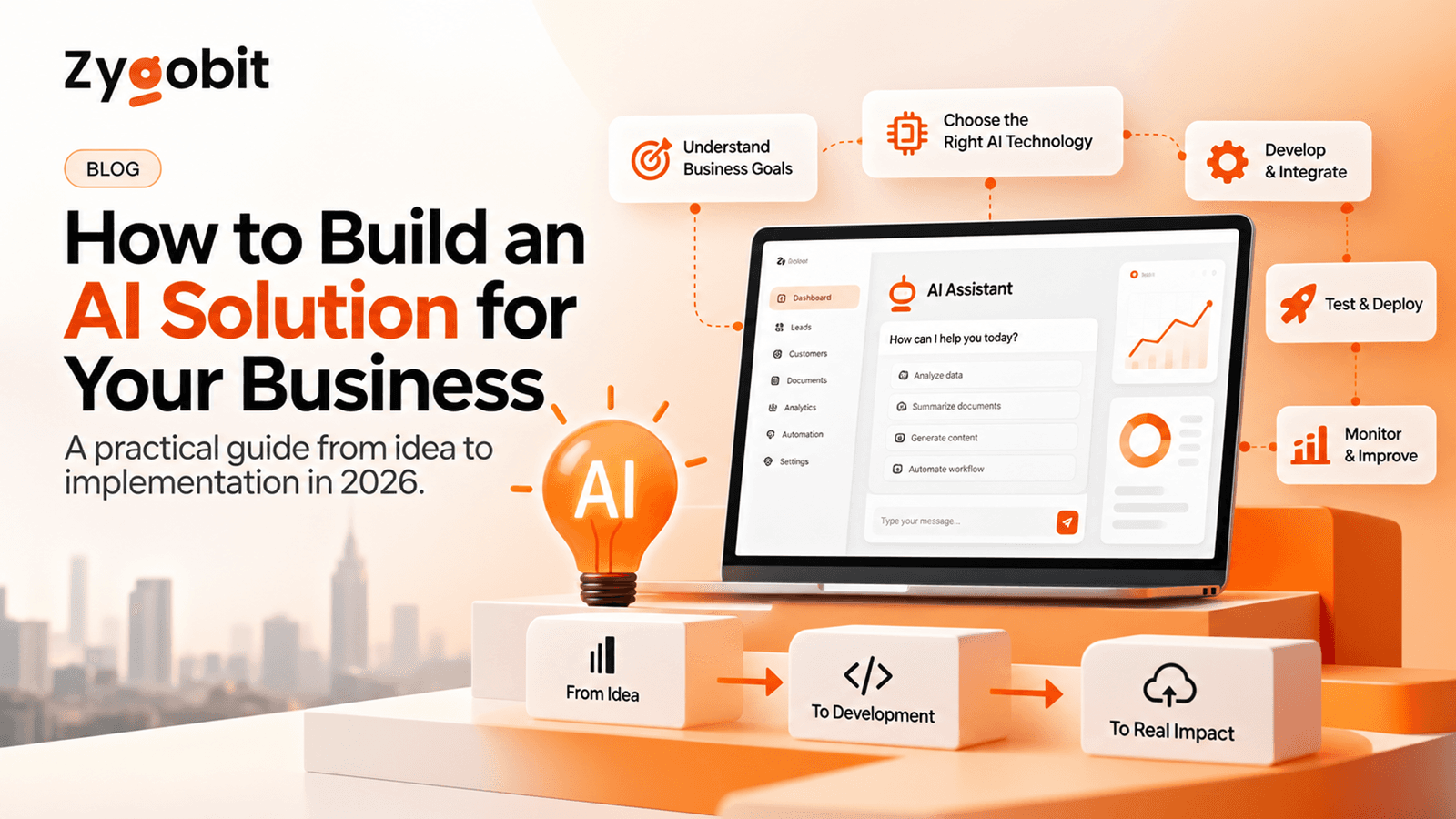
How to Build an AI Solution for Your Business: A Practical Guide for 2026
Learn how to build an AI solution for your business in 2026. Explore custom AI development, AI integration, machine learning, and automation. Discover the key steps from planning and choosing the right technology to development, testing, and deployment to create scalable, secure, and cost-effective AI solutions.
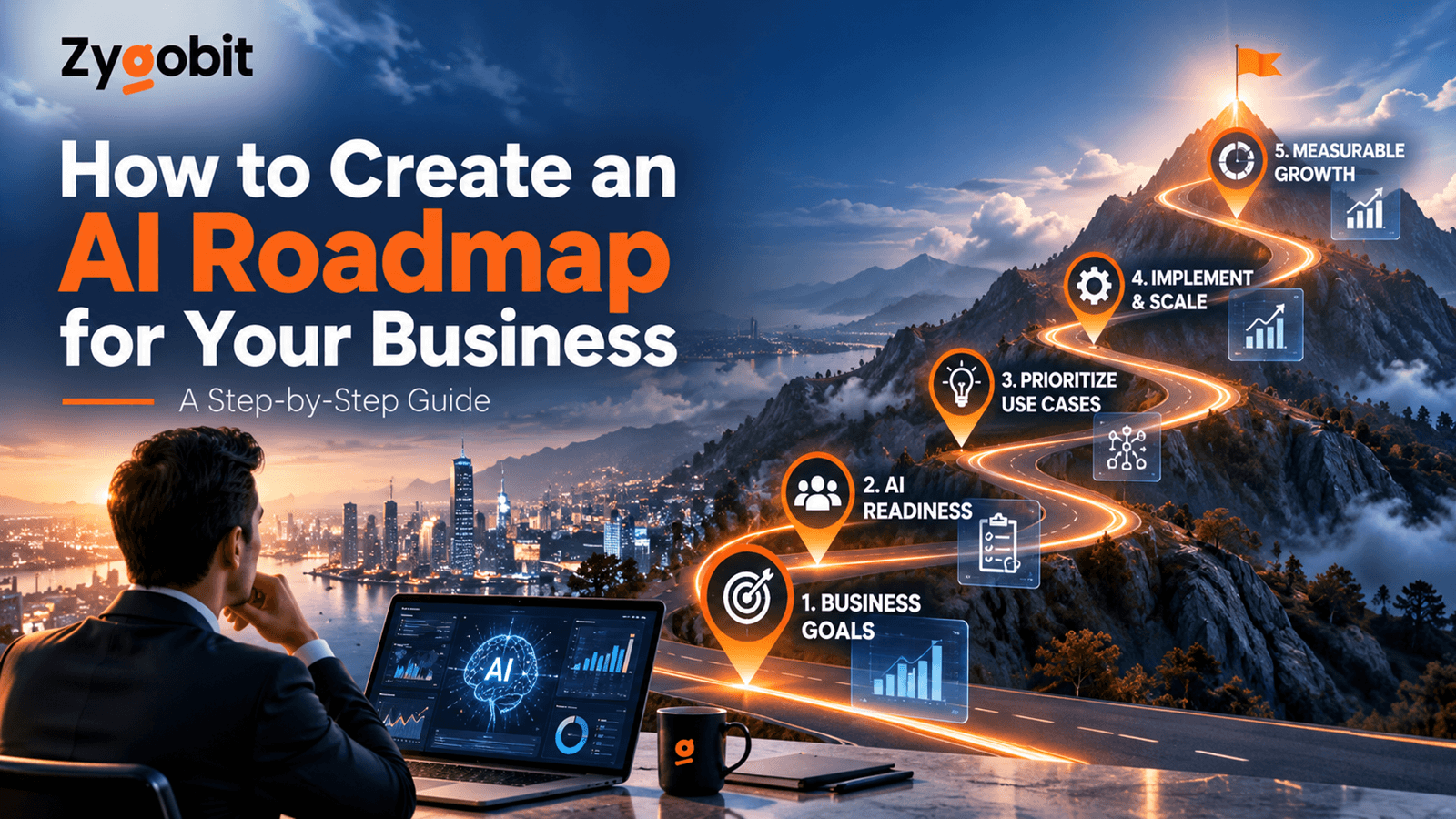
How to Create an AI Roadmap for Your Business A Step-by-Step Guide
Discover how to create an effective AI roadmap for your business with this step-by-step guide. Learn how to assess AI readiness, identify high-value use cases, prioritise opportunities, estimate implementation costs, and measure results. Explore how AI roadmap consulting helps businesses reduce risks, make smarter technology investments, and achieve sustainable growth through artificial intelligence.
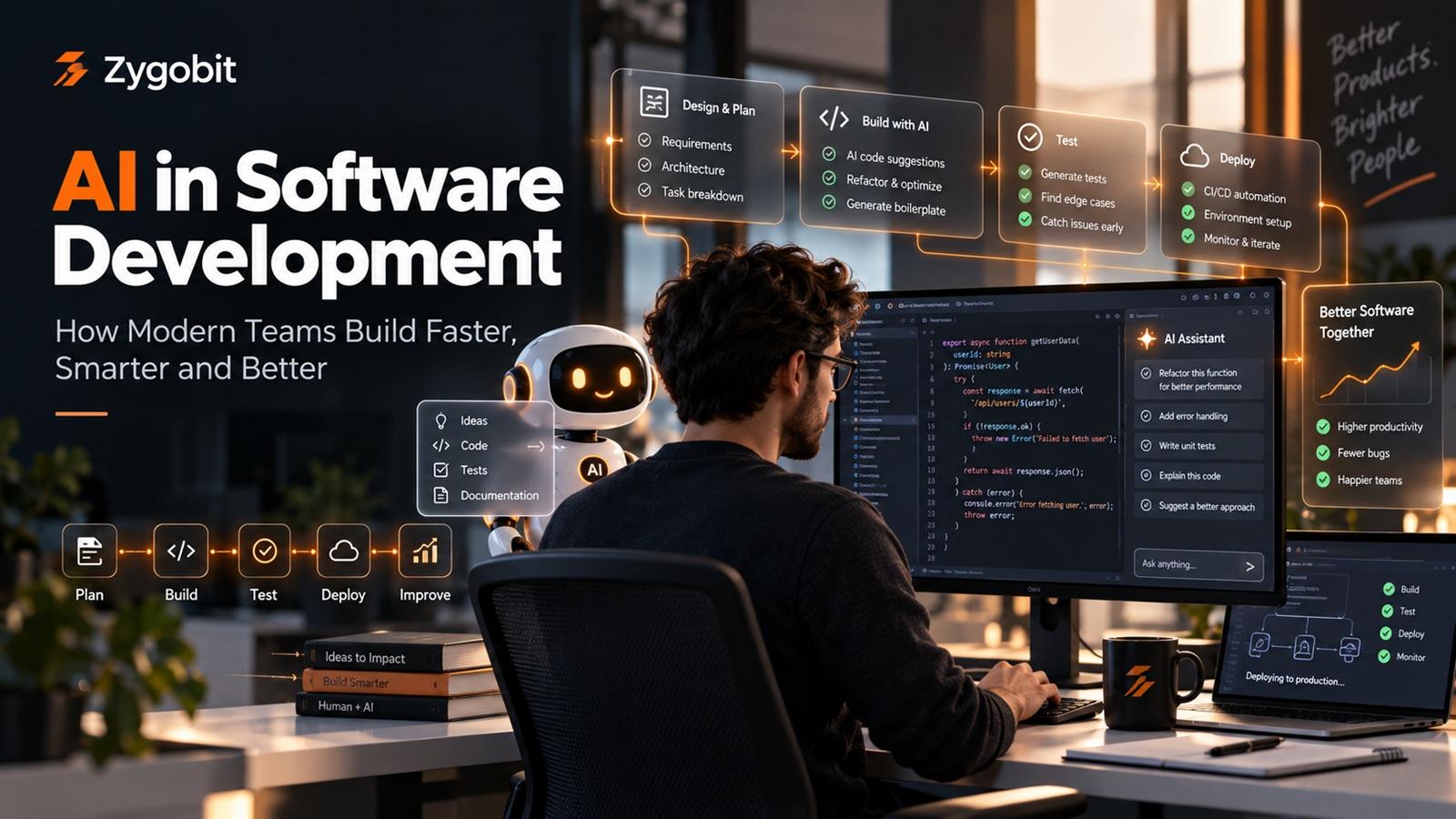
AI in Software Development: How Modern Teams Build Faster, Smarter and Better
Discover how AI is transforming software development across coding, testing, reviews, automation, and deployment. Learn how Zygobit helps businesses build smarter, faster, and more scalable AI-powered software solutions.