





How to Create a SaaS Product in 2026 The Founder's Playbook From Idea to Paying Users


Learn how to create a successful SaaS product in 2026 with this step-by-step founder's guide. Discover how to validate your idea, build an MVP, choose the right tech stack, implement scalable architecture, price your product, ensure security, achieve product-market fit, and grow from your first users to a profitable SaaS business.
To build a SaaS product, validate a painful, specific problem before you write any code, then ship a minimum viable product that solves one job better than anything else on the market. Choose an architecture and tech stack you can maintain for years, price around measurable value, bake in security from day zero, and treat launch as the start of learning rather than the finish line. The founders who win aren't the ones with the most features. They're the ones who close the loop between real user behavior and their next release fastest.
That's the whole game in three sentences. The rest of this guide is the detail that separates the roughly 8% of SaaS products that survive from the 92% that don't.
Why This Guide Is Different
Search "how to create a SaaS product" and you'll find dozens of guides that all say the same thing: define your problem, build an MVP, pick a tech stack, launch. All true. All useless on their own, because they skip the part that actually kills products, which is the decisions between the bullet points.
This guide is built around a hard number. Roughly 92% of SaaS startups fail within three years, and the single biggest cause isn't bad code or the wrong database. It's building something nobody needed: about 42% of failed startups die because there was no market need, and 34% specifically because they never found product-market fit. Everything below is organized to attack that failure mode first, then handle the engineering that matters once you've earned the right to build.
What a SaaS Product Actually Is
Software as a Service is software you rent instead of own. It lives on the provider's servers in the cloud, and customers reach it through a browser or app over the internet rather than installing and maintaining it themselves. Gmail, Slack, Salesforce, Zoom, and Google Docs are all SaaS: everyday tools that update themselves quietly in the background while you keep working.
The model's power comes from a shift in responsibility. In the old license-and-install world, every customer ran their own copy, patched their own bugs, and babysat their own servers. In SaaS, the provider absorbs all of that (hosting, scaling, security, uptime, upgrades) and the customer just logs in. That single change is what makes recurring revenue, instant global distribution, and continuous delivery possible.
It's also why the category is enormous. Estimates of the 2025 global SaaS market range from roughly $315 billion to $465 billion depending on how each research firm defines "SaaS," with growth forecasts between 11% and 19% CAGR and most analysts expecting the market to clear $1 trillion in the early 2030s. Whichever number you trust, the direction is identical: up and to the right, for years.
Why the SaaS Model Keeps Winning
The appeal isn't hype. It's that the model solves real problems for both sides of the transaction.
For customers, SaaS removes friction: no local installs, no fragmented upgrade cycles, no server humming in a closet waiting to fail. Costs are predictable and spread over time, the product is accessible from anywhere with a connection, and updates arrive automatically. For providers, the same architecture produces recurring, forecastable revenue, the ability to serve a solo freelancer and a 10,000-seat enterprise from one codebase, and a distribution model where a customer in another hemisphere costs almost nothing extra to serve.
That alignment, where providers absorb complexity and customers gain flexibility, is the entire reason SaaS became the default way modern software is delivered.
The Build Plan: Idea to First Users
Here's the sequence that gives you the best odds. It's not rigid; real products loop back and skip around. But the order of priorities matters, and most failed products get it backwards by writing code before they've earned the right to.
1. Validate the problem before you build the solution
Start with research that goes deeper than a survey. Interview people in your target market, watch how they actually work, and map every alternative they currently use, including doing nothing, which is your most common and most underrated competitor. Your goal is a one-sentence core value proposition you could defend in front of a skeptical customer who owes you no patience.
The test to pass: can you name exactly who this is for and the specific job it does faster, cheaper, or better? If you can't, it's too early to build. This is the step that prevents the 42% "no market need" failure, and it's the step founders skip most.
2. Map the development process end to end
Write down the whole journey as distinct phases (discovery, technical spike, alpha, MVP, beta, general availability) and treat each as an experiment with a clear success metric and an honest kill-or-iterate decision at the end. This keeps the team disciplined and stops a promising idea from quietly turning into a two-year science project.
3. Shape the MVP, not the dream
Your minimum viable product should deliver one outcome remarkably well, not a thin slice of ten features. An MVP is not a prototype or a placeholder; it's the first real version people can genuinely use and pay for, even if it's rough at the edges. Cut every "nice to have." Wire in feedback collection from day one (in-app prompts, short interviews, session replays) so you're steering toward adoption with evidence instead of opinion.
For grounding: a typical SaaS MVP takes 3 to 6 months to build. A technical founder using a modern starter kit can launch a basic version for $1,000 to $5,000; a non-technical founder hiring freelancers usually needs $20,000 to $50,000; and the median agency-built MVP runs around $120,000. The cheaper path costs money in speed and quality; the expensive path buys managed reliability. Pick deliberately.
4. Design the pricing and go-to-market early
Pricing is not a launch-week afterthought. It shapes what you build. Choose a model (covered in detail below), tie it to measurable value, and track customer acquisition cost (CAC) against customer lifetime value (CLV) from your very first cohort. If CAC grows faster than CLV, the business is broken no matter how good the product feels.
5. Assemble a small, senior-heavy team
You don't need an army; you need range. A tight squad of product, design, senior engineering, and specialists in security, integrations, and DevOps will outrun a large, junior team every time. Run with lightweight project management (Jira, Linear, or ClickUp) so trade-offs stay visible and decisions are traceable.
6. Choose a stack you can live with for years
Favor boring, proven components where reliability matters and save your innovation budget for the places where a novel choice is a real advantage. Document your framework, database, queuing, and observability choices and how each will scale. (Full stack breakdown below.)
7. Design for first value, not feature depth
The shortest path to retention is speed to first value. Sweat onboarding copy, empty states, and the moment a new user first feels the product working. An interface that explains itself beats a powerful one that requires a manual.
8. Build integrations that remove work
List the systems your customers already live in (CRM, ERP, accounting, identity) and design single sign-on, webhooks, and clean APIs around them. The test for any integration: if it doesn't reduce clicks or reconciliation time, it isn't finished.
9. Bake in security from day zero
Least-privilege access controls, encryption in transit and at rest, careful handling of sensitive data, and documented practices you can hand to an auditor later. Security bolted on at the end is both weaker and vastly more expensive. In regulated markets (GDPR, HIPAA, SOC 2), it's also the difference between closing enterprise deals and being disqualified before the demo.
10. Build, test, and harden in small increments
Keep releases small. Use feature flags, log everything meaningful, and invest in real quality assurance (unit, contract, and load testing). Reliability isn't a chore; it's a feature customers happily pay for.
11. Ship, listen, iterate
Release to a small cohort first, watch actual behavior, and tighten the loop: telemetry, then feedback, then fix or extend. Most great products are shaped by what happens after launch, not before it. The founders who close this loop fastest are the ones who compound.
Architecture: Multi-Tenant vs. Single-Tenant
This is one of those quiet decisions that dictates your cost structure, your release cadence, and how painful audits feel a year from now.
Multi-tenant puts many customers on shared infrastructure, each with isolated data. It's the default for most new SaaS because it's the cheapest to run, the simplest to update (one codebase, one deploy, everyone gets fixes at once), and the easiest to scale. The trade-off is that you protect velocity by offering high configuration but limited deep customization; you avoid per-customer one-offs on purpose. It shines for product-led growth and any product where customers share broadly similar workflows.
Single-tenant gives each customer their own isolated runtime and data plane. It costs more per customer and demands serious automation to avoid drowning in bespoke "snowflake" environments, but it makes deep customization, private networking, data residency, and staged per-tenant rollouts straightforward. It shines in regulated industries and large enterprise deals where isolation leads the conversation.
How to decide: if a serious prospect demands network-level isolation or custom controls, single-tenant may be worth it. If your use cases are homogeneous and your team is small, multi-tenant's operational simplicity almost always wins early. The most common pragmatic path: start multi-tenant, then add a premium isolation tier (a VPC-isolated data plane and dedicated queues) for enterprise accounts once they're paying enough to justify it. Be honest about what your team can maintain for years, not weeks.
The Tech Stack: Fast Now, Sane Later
There's no single "correct" stack, but there are proven, low-regret defaults.
Frontend. React, Angular, or Vue remain the standard for SaaS dashboards, paired with TypeScript for maintainability and a modern state library.
Backend. Node.js and Python dominate for flexibility; Java and .NET remain unbeatable in enterprise contexts. Frameworks like Express, FastAPI, Django, or Spring Boot let teams move fast without abandoning structure.
Database. Start with a managed relational database (PostgreSQL or MySQL) and let your cloud provider (AWS RDS, Google Cloud SQL, Azure SQL) handle patching, backups, and failover. Reach for a NoSQL option like MongoDB only when your data genuinely calls for it.
Eventing and async. Managed queues (Amazon SQS, Google Pub/Sub, RabbitMQ) plus serverless triggers (AWS Lambda, Google Cloud Functions) decouple traffic spikes from core workloads so the product stays responsive under load.
Observability. Centralize logs, metrics, and traces with Datadog, New Relic, or Prometheus + Grafana. If you can't see it, you can't fix it.
Identity and secrets. Don't build auth from scratch. Auth0, AWS Cognito, or Okta for identity; HashiCorp Vault for secrets. Stripe or Paddle for billing.
Integrations as products. Design clean REST or GraphQL APIs with versioning, pagination, and webhooks. Publish stable schema contracts (OpenAPI/Swagger, AsyncAPI) with clear deprecation paths, and invest in developer experience such as API portals and quick-start sandboxes. If a partner can't integrate over a weekend, you lose momentum.
Delivery mechanics. Trunk-based development, CI/CD pipelines (GitHub Actions, GitLab CI, CircleCI), containerization with Docker and Kubernetes when scale demands it, and product analytics (Mixpanel, Hotjar, Amplitude) so you can see what's actually working.
One caution on managed services: they slash operational toil but raise the bill. Track spend early with your cloud provider's cost tools so infrastructure doesn't surprise you at scale.
Choosing a Pricing Model
Pricing is the heartbeat of the business. Too high and you scare off your market; too low and you bleed margin while training customers to undervalue you. The common models:
Tiered: feature bundles for different segments; great for scaling revenue as customers grow.
Usage-based: customers pay for what they consume (storage, API calls, transactions); aligns cost to value and has become dominant for infrastructure-style products.
Flat-rate: simple and transparent, but limits upsell.
Freemium / free trial: a low-friction entry point that converts satisfied users later.
Per-seat / per-active-user: flexible for collaboration and team tools.
Whatever you pick, anchor it to your value proposition and watch the CAC-to-CLV ratio like a hawk. Don't ignore regional differences either: buyers in emerging markets price differently than those in North America or Europe, and localized payment flows are no longer optional.
The Metrics That Tell You If It's Working
Most founders track vanity numbers. These are the ones that actually predict survival, with current 2025 benchmarks so you know where you stand:
Trial-to-paid conversion. Median B2B SaaS runs about 18.5%; top-quartile products hit 35% to 45%, and elite ones exceed 60%. If you're well below the median, your onboarding or targeting is broken.
Net revenue retention (NRR). A healthy figure is above 100%, meaning you grow from existing customers faster than they churn. The 2025 median sits around 101%; top performers reach 104% to 111%. In recent exits, even fast-growing companies with NRR below 100% got below-market valuations. This is arguably the single most watched SaaS metric today.
The Rule of 40. Your revenue growth rate plus profit margin should clear 40%. The 2025 median is only about 25%, and the top quartile clears 43%, so hitting 40 genuinely puts you ahead of the pack. (It's a meaningful gauge mostly above ~$20M ARR; below that, the math is too noisy to trust.)
CAC and payback. Enterprise SaaS CAC averages around $702 but ranges wildly by segment. What matters is how fast that cost is repaid; aim to recover CAC well inside a year.
Revenue growth. Median annual growth was about 28% in 2025, down sharply from 47% the year before, as the whole market reset expectations. Context matters: "good" is relative to your stage and the current environment.
Why SaaS Products Fail, and How to Beat the Odds
Since the base rate is brutal, it's worth naming the killers directly and the antidote to each.
No market need (about 42% of failures). The antidote is Step 1 done honestly: validate demand with real interviews and real alternatives before building, not after.
No product-market fit (about 34%). Ship a narrow MVP fast, then let usage data tell you where the fit is. Don't fall in love with the roadmap; fall in love with the problem.
Weak go-to-market (about 22%). A great product with no distribution still dies. Build the sales-and-marketing motion in parallel with the product, and track CAC from cohort one.
Team misalignment (about 18%) and cash flow (about 16%). Keep the team small and senior, keep decisions visible, and keep a real runway buffer for the iteration that always takes longer than planned.
The other silent killers are operational: data security and compliance (a single breach erodes trust instantly), integration complexity (legacy systems inflate timelines and budgets), update disruption (new features that break customer workflows), and poor adoption (a perfect product nobody onboards into successfully). Each is addressed by a step above, which is exactly why the order of the build plan matters.
What the Winners Actually Did
The most valuable SaaS companies all followed patterns worth stealing:
Slack grew on a developer-first, open-API strategy that turned it into the hub of the workplace, proving that an ecosystem multiplies value without internal feature bloat.
Zoom rode freemium to mass adoption, then converted with a genuinely business-ready premium path. Freemium works only when the upgrade reason is obvious.
Shopify scaled by letting third parties build apps and themes on top of it. Ecosystems create durable loyalty and reach you could never build in-house.
Atlassian (Jira, Trello, Confluence) rode product-led growth: low entry pricing and self-service onboarding that expanded into enterprise trust over time.
Salesforce pioneered multi-tenant CRM in the cloud and effectively invented the modern SaaS delivery model. Clear positioning plus technical innovation can create an entire category.
HubSpot paired useful software with a strong narrative ("inbound marketing"), then fed a public feedback tool directly into its roadmap. A methodology plus a product beats a product alone.
The common thread isn't a feature. It's a tight, deliberate loop between what customers actually do and what the company builds next.
Frequently Asked Questions
How long does it take to build a SaaS product? A basic MVP typically takes 3 to 6 months with a small team; a full-featured platform can take a year or more. A solo technical founder using a starter kit can ship something usable in weeks.
How much does it cost to build a SaaS product? Anywhere from roughly $1,000 to $5,000 (technical founder, starter kit) to $30,000 to $150,000 for a professionally built MVP, up to $500,000+ for complex, enterprise-grade platforms. Budget separately for marketing, support, and post-launch iteration, because that's where long-term value is created.
What is the "80/20 rule" in SaaS? Roughly 80% of your results (revenue, growth) come from about 20% of your features, customers, or effort. Find that 20% and protect it.
How do I get my first SaaS customers? Start with your network, build in public, offer early access or founding-customer discounts, and reach out directly to your ideal users. Case studies and word of mouth compound from there.
Should I start multi-tenant or single-tenant? Multi-tenant for almost everyone starting out: lower cost, simpler operations, faster iteration. Add single-tenant isolation as a premium tier when regulated or enterprise customers require it.
Turning the Plan Into a Product
Creating a SaaS product takes more than engineering talent. It's a coordinated effort across technology, design, pricing, and go-to-market, and the products that last are the ones that keep evolving with their customers. The base rate is unforgiving, but the failure causes are known and every one of them is addressable with discipline applied in the right order: validate before you build, ship narrow, price to value, secure from day zero, and treat launch as the first day of learning rather than the last day of building.
The opportunity is genuinely enormous, and it's still expanding. Every product shipped today has a real shot at becoming tomorrow's category leader, but only for the teams that treat their SaaS as a living system: adapting quickly, delivering continuously, and measuring every decision against what customers actually do.

Ready to build your next digital product?
Talk to Zygobit about web apps, mobile apps, AI solutions, automation, and scalable software development tailored to your business goals.
Explore Related Articles
More reading on web, mobile, AI, and product engineering from the Zygobit team.
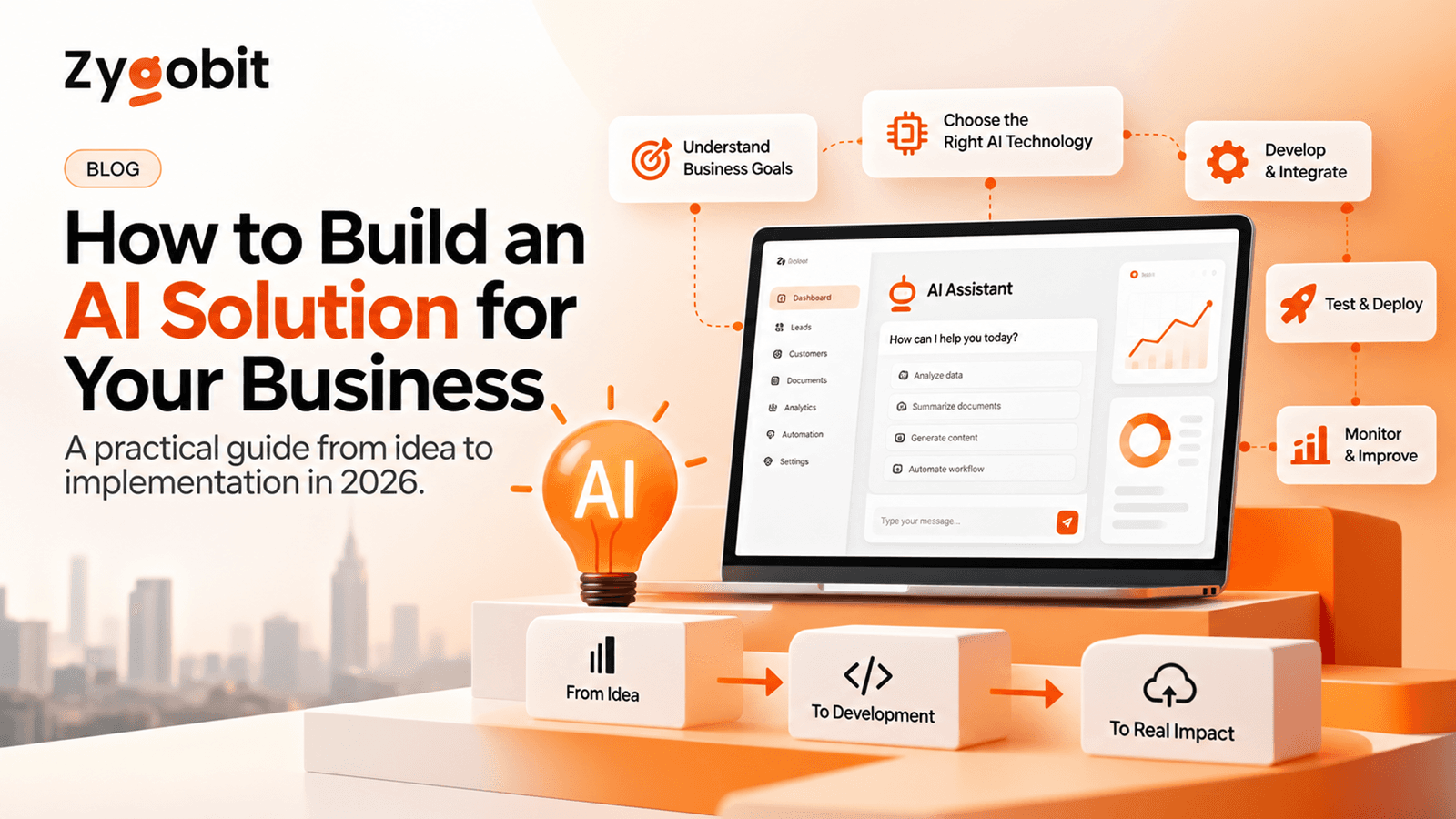
How to Build an AI Solution for Your Business: A Practical Guide for 2026
Learn how to build an AI solution for your business in 2026. Explore custom AI development, AI integration, machine learning, and automation. Discover the key steps from planning and choosing the right technology to development, testing, and deployment to create scalable, secure, and cost-effective AI solutions.

How to Create an AI Roadmap for Your Business A Step-by-Step Guide
Discover how to create an effective AI roadmap for your business with this step-by-step guide. Learn how to assess AI readiness, identify high-value use cases, prioritise opportunities, estimate implementation costs, and measure results. Explore how AI roadmap consulting helps businesses reduce risks, make smarter technology investments, and achieve sustainable growth through artificial intelligence.

AI in Software Development: How Modern Teams Build Faster, Smarter and Better
Discover how AI is transforming software development across coding, testing, reviews, automation, and deployment. Learn how Zygobit helps businesses build smarter, faster, and more scalable AI-powered software solutions.