





12 Signs Your Business Has Outgrown Off-the-Shelf Software (And What a Custom App Actually Costs in 2026)

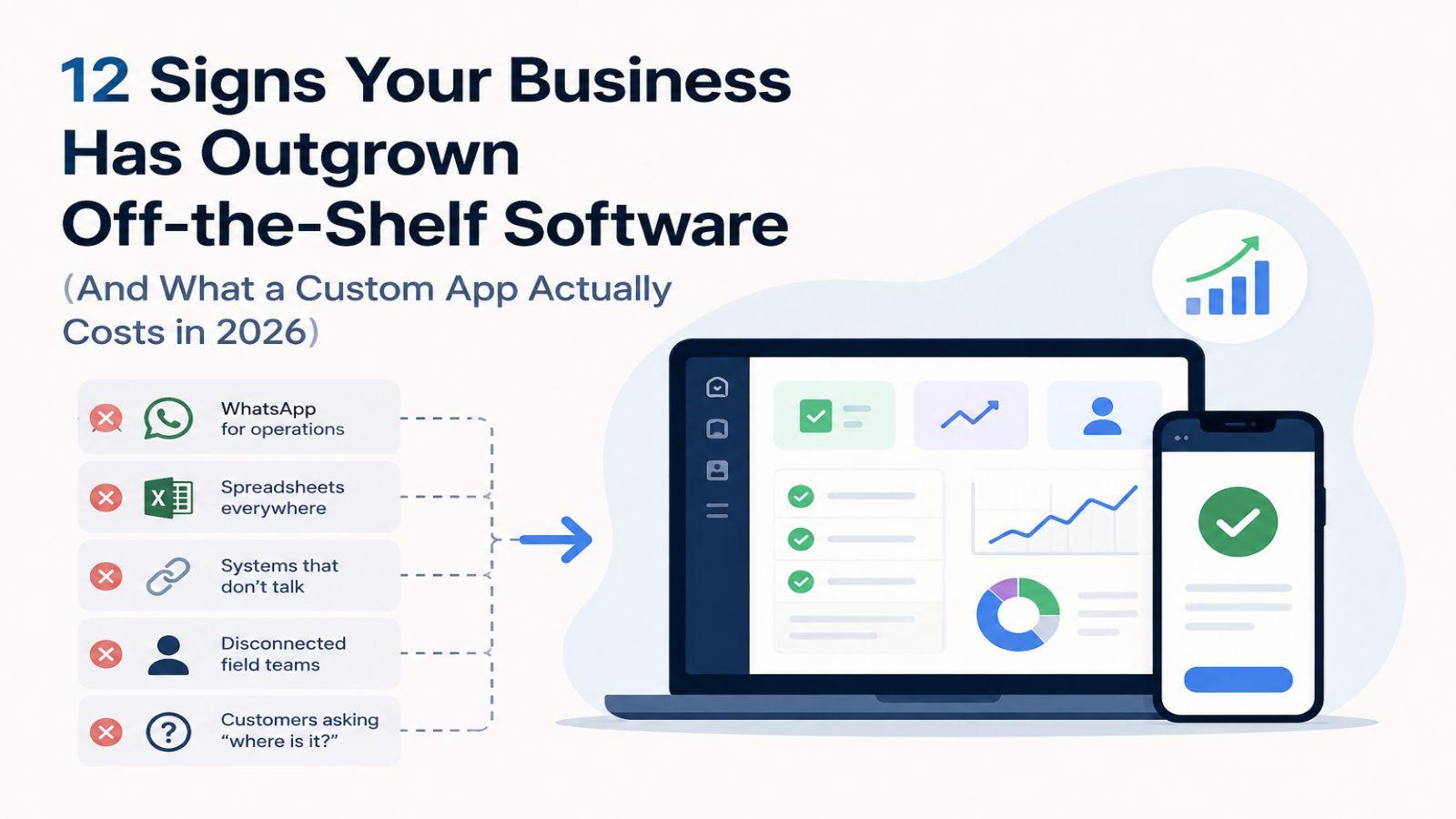
Discover 12 clear signs your business has outgrown off-the-shelf software. Learn when custom software makes sense, how it can reduce manual work and improve operations, what development costs in 2026, and how to decide whether building a custom app is the right investment.
Most businesses do not decide to build custom software. They arrive at it usually after a bad quarter, a lost customer, or the third time someone asks "why is this still in a spreadsheet?"
The decision is rarely framed correctly. Owners ask "can we afford to build an app?" when the more useful question is "what are we already paying to not have one?" That cost is real, it is recurring, and it almost never appears on a line item. It shows up as overtime, as re-entry, as churn, as the customer who left because your competitor's onboarding took four minutes and yours took four days.
This guide gives you twelve specific, observable signals that your business has crossed that threshold plus honest numbers on what custom development costs in 2026 and a framework for deciding whether to build at all.
First: what "custom" actually means
There is a persistent confusion worth clearing up before the signals.
Off-the-shelf software is built for the average of a thousand businesses. It is excellent value when your process genuinely is average accounting, payroll, email, document storage. Nobody should build a custom accounting ledger.
Custom software is built around the specific way your business creates value. It is worth building only where your process is genuinely different from the market's, or where the gap between the generic tool and your reality is being closed by human labour.
That second clause is the whole test. Every workaround your team performs is a subsidy you are paying to keep generic software in place. When the subsidy exceeds the build cost, you build. The twelve signs below are all ways of detecting that subsidy.
The 12 signs
1. Your operations run on WhatsApp groups
This is the most common signal, and the one businesses are most reluctant to admit.
WhatsApp is a superb messaging product and a catastrophic operations platform. Tasks get assigned in a thread and buried under two hundred messages. There is no structured data only prose. Nothing is searchable, reportable, or auditable. There is no record of who was told what, or when. When an employee leaves, the operational context on their handset leaves with them.
The cost is invisible until it becomes a crisis: a missed delivery, a disputed instruction, a compliance request you cannot answer.
What replaces it: structured task assignment, status transitions, timestamped photo and location capture, and a management view that reflects reality without anyone typing a summary.
2. Excel has quietly become your core system
Spreadsheets are the most successful prototyping tool ever built. That is precisely the problem the prototype ships, and then it stays.
The failure mode is predictable. One file becomes twelve. Versions diverge. Formulas break silently and nobody notices for a month. Two people edit simultaneously and one set of changes vanishes. There is no permission model, so the sheet holding your pricing and your margins is emailed freely. No validation means the same customer exists as four spellings.
If a spreadsheet outage would stop your business for a day, it is not a spreadsheet. It is an unmaintained production system with no owner, no backup strategy, and no tests.
3. Your systems do not talk to each other
Your CRM does not know what your accounting system knows. Your inventory does not know what your e-commerce store knows. So a person becomes the integration layer exporting, reformatting, re-importing, reconciling.
Human integration is slow, expensive, and error-prone by nature. Worse, it makes your data perpetually stale: every report describes a business that existed some hours ago.
Do the arithmetic. One person spending two hours a day moving data between systems costs roughly 500 hours a year. At any professional salary that is a meaningful five-figure annual expense purchased with zero strategic value.
4. Your field team is disconnected from your office
Delivery drivers, maintenance engineers, sales reps, inspectors, construction crews, home-health visitors the moment they leave the building, visibility drops to zero until they return.
Phone calls, end-of-day paper forms, and ad-hoc photo messages are not a system. Information that needed a same-day decision arrives twenty-four hours late, by which time the decision made itself.
A mobile app with offline-first architecture this matters, because coverage on a site or a basement is unreliable, captures job status, photos, GPS, and signatures at the point of work and syncs the moment connectivity returns. Management sees operations as they happen, not as they are later described.
5. Customers keep asking "where is it?"
If your support team's most common query is a status question, and answering it requires a human to look something up, you are paying salary to deliver information a database already holds.
Customer expectations were reset permanently by real-time logistics and ride-hailing. In 2026, a customer wants to open something, see the status in ten seconds, and close it. They do not want to call. They do not want to wait for an email.
Self-serve status tracking reduces inbound support volume, raises satisfaction (the anxiety of not knowing is most of the dissatisfaction), and puts a branded touchpoint on the customer's device.
6. Your onboarding takes days instead of minutes
If bringing on a customer requires paperwork, an in-person visit, manual identity checks, or a multi-day approval loop, you are losing every prospect unwilling to wait and paying handling costs for every one who does.
Digital onboarding document upload, digital signature, automated identity verification, instant activation compresses days into minutes and eliminates the manual handling entirely. For regulated sectors it also produces something paper never does: a complete, timestamped, auditable trail.
7. You are paying 15–30% to a platform that owns your customers
Marketplaces, delivery apps, booking platforms and listing sites solve a real problem: distribution. They charge for it in three currencies.
The first is commission, typically 15 to 30 percent of every transaction. The second is the customer relationship. You generally cannot contact the customer outside the platform, so loyalty accrues to the platform's brand, not yours. The third is optionality: they can change fees or ranking algorithms unilaterally and you have no recourse.
Owning a direct channel does not mean abandoning platforms. It means having somewhere to move your best, most repeat customers so that the platform becomes an acquisition channel rather than your entire business.
8. You have repeat customers and no way to recognise them
If a meaningful share of your revenue comes from people who buy more than once, and you have no structured mechanism to identify, reward, and re-engage them, you are running your most valuable asset on memory.
Stamp cards get lost. Email open rates keep declining. Bulk SMS is increasingly filtered or ignored. Meanwhile, a well-designed app-based loyalty programme puts your brand on the home screen, tracks entitlements in real time, and reaches customers through push notifications with engagement rates email cannot approach.
Retention economics are unforgiving in the right direction: reducing churn by a few percentage points frequently pays for the entire build inside a year.
9. You cannot see your numbers without asking someone
You should be able to answer, right now, from wherever you are: today's revenue, open jobs by owner, stock by location, this week's completion rate, month-to-date against target.
If any of those require a phone call or a manually compiled report, your operational awareness lags reality by hours or days and every decision you make is a decision about the past.
Real-time dashboards are not a vanity feature. They change the frequency at which you can detect and correct problems, which is the single largest determinant of how large an operation one person can effectively run.
10. Your teams have built their own shadow tools
When employees quietly build personal trackers, side spreadsheets, private folders, and unofficial scripts, they are not being difficult. They are performing free requirements-gathering.
Every shadow tool marks the precise location of a gap between the software you bought and the work that actually needs doing. Before you commission anything, catalogue them. They are the most honest specification document your business will ever produce more accurate than any workshop, because people built them under real pressure to solve real problems.
11. Compliance and audit are a manual scramble
If a regulator, auditor, or major client asked today for a complete record of who accessed what, which version was approved, and when each step occurred could you produce it without a week of archaeology?
In regulated sectors healthcare, financial services, food, construction, pharmaceuticals traceability is not a feature to be added later. It is an architectural property. Systems that record provenance, permissions, and change history by design make audits routine. Systems that do not make every audit an emergency.
12. Growth has started to feel like chaos
The clearest signal of all. New customers, new staff, new locations and things that used to run smoothly now require constant manual intervention. More errors. More escalations. More things falling through gaps.
Growth is meant to feel demanding. When it feels chaotic, your infrastructure has become the constraint on your growth rather than its enabler.
Build before you hit the wall, not after. Replacing operational systems under the pressure of rapid growth is dramatically more expensive and more disruptive than building the right foundation while you still have the slack to do it deliberately.
Signs that you should not build
Any honest guide to custom software has to include the negative cases. A firm that only ever tells you to build is selling, not advising.
Do not build if your process is genuinely standard. Payroll, accounting, email, storage, e-signature buy these. The market has solved them better than you will.
Do not build if you cannot name the metric. "Improve efficiency" is not a business case. "Cut order-to-dispatch time from 40 minutes to 10" is. If nobody can state the number that should move, discovery is not finished.
Do not build if nobody internally owns it. Custom software needs a decision-maker who can resolve requirements questions within a day. Projects without an engaged owner drift, and drift is the most expensive failure mode in software.
Do not build if the real problem is process. Automating a broken workflow produces a faster broken workflow. Fix the process on paper first; then encode it.
Do not build the whole thing at once. The most common and most expensive mistake is a twelve-month, everything-included specification. Ship the highest-pain workflow in eight to twelve weeks, put it in real users' hands, and let their behaviour inform phase two.
What it actually costs in 2026
The figures below assume engagement with a competent development partner rather than the lowest available bid. They are indicative rather than binding; accurate estimation requires a discovery process against defined requirements.
A single-workflow tool or internal application, one process, one primary user group, limited integration generally falls between $8,000 and $20,000 and is delivered within six to ten weeks. This is the appropriate scope for a first phase in most engagements.
A cross-platform mobile application covering core business functionality, built from a single codebase for both iOS and Android, typically ranges from $15,000 to $45,000 over ten to sixteen weeks. The variance within this band is driven almost entirely by the number of user roles and the depth of backend integration required.
A multi-role platform with substantial integration into existing systems distinct interfaces for customers, field staff, and management, connected to established ERP, CRM, or accounting infrastructure generally ranges from $45,000 to $120,000 over sixteen to twenty-eight weeks.
An enterprise system spanning multiple sites and subject to significant regulatory or compliance obligations will normally begin at $120,000 and require six to twelve months. Projects at this scale should be structured as a sequence of independently valuable releases rather than a single delivery.
What drives cost up: real-time synchronisation, offline-first data handling, payment processing, GPS and mapping, complex role and permission models, integrations with legacy systems that lack proper APIs, and regulatory certification requirements.
What keeps cost down: cross-platform development from a single codebase, standard authentication, phased delivery, and most powerfully ruthless scope discipline in phase one.
The cost most proposals omit: ongoing maintenance. Budget 15–20% of the build cost annually for hosting, security patching, OS compatibility updates, and small improvements. Software that is not maintained does not stay still; it degrades. Any partner who does not raise this before you sign is either inexperienced or optimistic on your behalf.
Native, cross-platform, or web?
Cross-platform (React Native or Flutter) covers iOS and Android from one codebase at roughly the cost of building one. Native-quality performance for the vast majority of business applications, and half the ongoing maintenance surface. This is the right default for most business projects.
Native (separate Swift and Kotlin builds) is warranted for heavy graphics, augmented reality, intensive background processing, or deep platform-specific hardware integration. It roughly doubles both build and maintenance cost a real trade, worth making only when the requirement is real.
Progressive web app is worth considering when you need no app-store presence, no offline requirement, and no hardware access. It is cheaper and updates instantly. It cannot match a native app for offline reliability, notification delivery, or hardware access.
One clarification worth stating plainly: a mobile-friendly website is not an alternative to an app. It is a baseline requirement. Apps do things websites cannot do reliably offline operation, push notifications, camera and biometric and GPS access, and consistent performance in complex workflows.
The bottom line
Custom software is not a status purchase or a technology upgrade. It is an operational infrastructure decision, and it should be evaluated the way you would evaluate any other capital investment: against a named problem, with a measurable outcome, and a payback period you can defend.
If you recognised your business in three or more of the twelve signs above, the question is no longer whether custom software would help. It is which single workflow is costing you the most right now because that is where a first phase should start, and starting narrow is what separates the projects that deliver from the ones that quietly stall.
Zygobit builds custom software and mobile applications for businesses that have outgrown generic tools. We start every engagement by identifying the specific, measurable problem worth solving and we will tell you when the honest answer is that you do not need us yet.
Tell us what is slowing your business down. We will tell you what it would take to fix it.
Frequently asked questions
How do I know if custom software will pay for itself?
Quantify one thing precisely before you commit: the hours currently spent on manual work the system would eliminate, multiplied by loaded salary cost, plus a conservative estimate of revenue lost to the current constraint. If that annual figure exceeds the build cost, payback is inside a year. Most viable projects clear this comfortably; the ones that do not usually should not proceed.
How long does it take?
A focused first release typically runs 10–16 weeks. Multi-role platforms with substantial integration work run 16–28 weeks. App-store review adds one to three weeks. Treat any proposal promising a complex system in four weeks as a warning sign.
Can it integrate with our existing ERP, CRM, and accounting systems?
Almost always, provided those systems expose an API which nearly all modern ones do. Older on-premise systems sometimes require database-level integration or a middleware layer, which adds cost. This should be assessed during discovery, before a fixed price is quoted, not discovered mid-build.
Who owns the code?
You should. Insist on full source code ownership, repository access, and documented deployment procedures in writing before work begins. If a partner is reluctant to transfer these, that reluctance is the most important thing you have learned about them.
What happens after launch?
Launch is the midpoint, not the finish line. Expect a stabilisation period as real usage reveals what testing did not, followed by ongoing maintenance and iterative improvement driven by usage analytics. Build analytics in from day one otherwise you are guessing about which features earn their keep.

Ready to build your next digital product?
Talk to Zygobit about web apps, mobile apps, AI solutions, automation, and scalable software development tailored to your business goals.
Explore Related Articles
More reading on web, mobile, AI, and product engineering from the Zygobit team.

Data Center Infrastructure Management Software Development Process, Architecture, Features and Cost
Explore how Data Center Infrastructure Management software helps organizations monitor assets, power, cooling, capacity, and real-time infrastructure data. This guide covers DCIM software development, system architecture, key features, AI capabilities, security, integrations, implementation process, cost considerations, and future trends shaping modern data center operations.
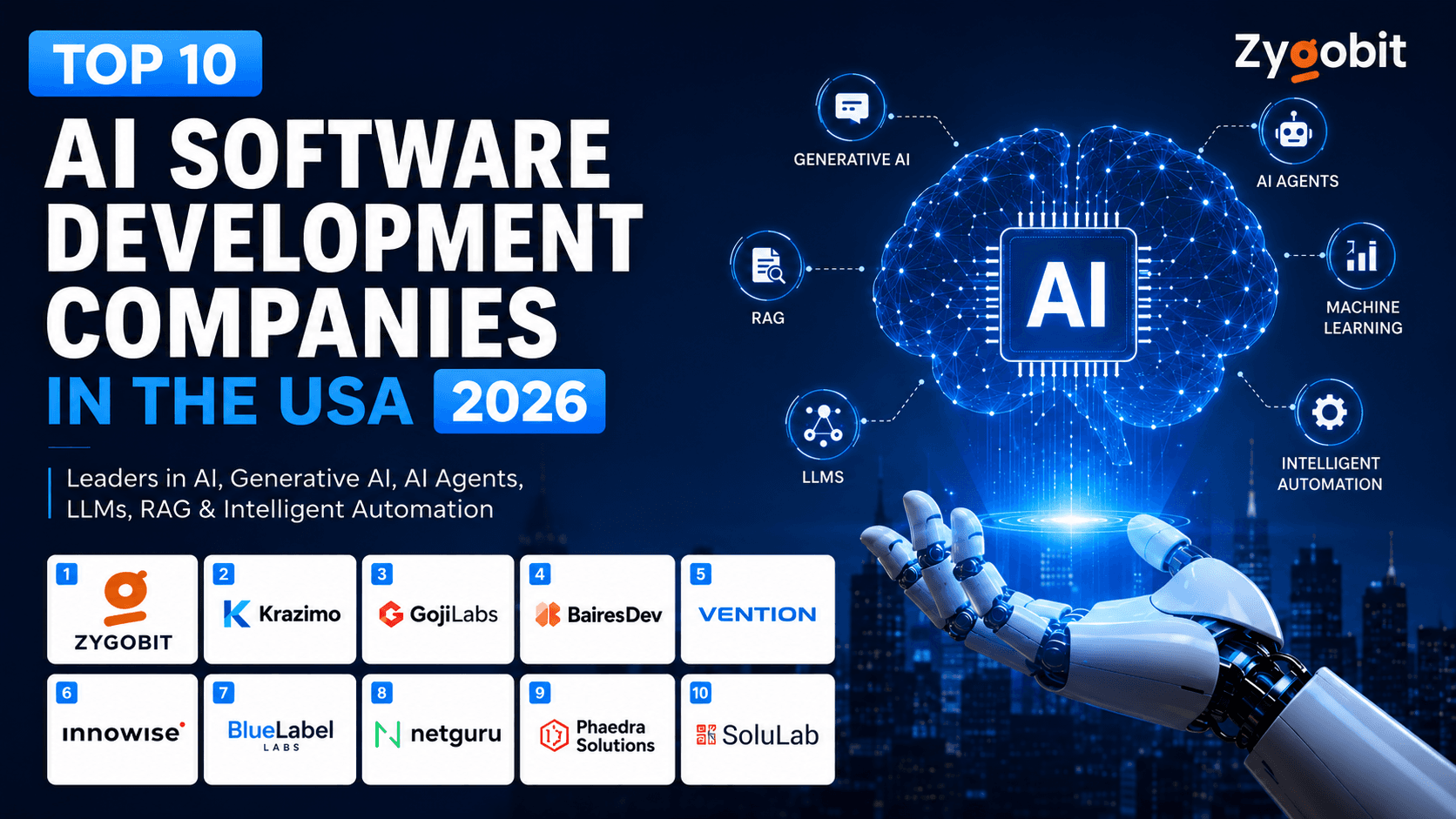
Top 10 AI Software Development Companies in the USA in 2026
Discover the top 10 AI software development companies in the USA for 2026, led by Zygobit. Explore trusted AI development partners specializing in Generative AI, AI agents, LLMs, RAG, machine learning, intelligent automation, custom AI software, SaaS development, and enterprise AI solutions for startups, SMEs, and growing businesses.
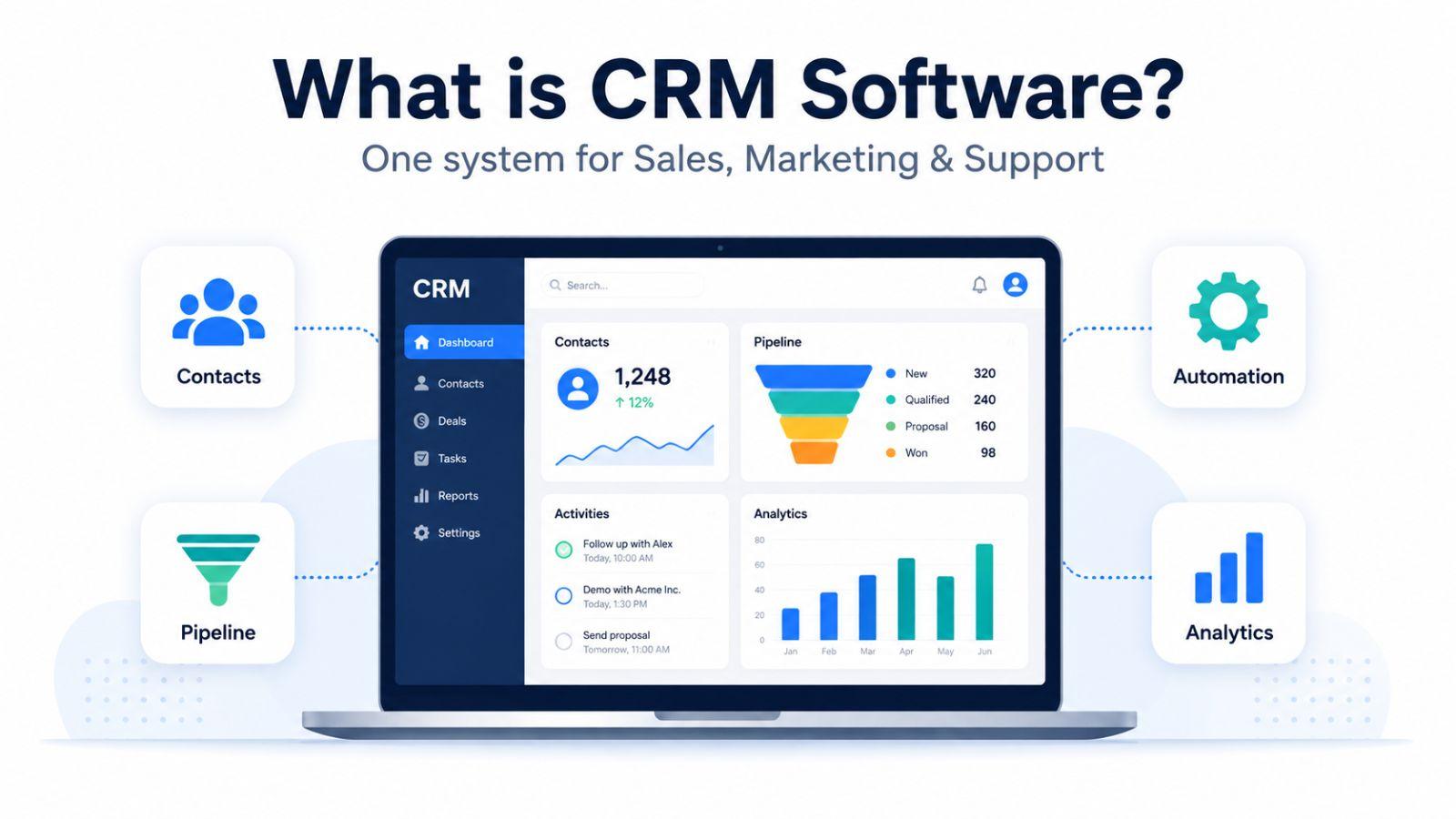
What Is CRM Software and How Does It Work? A Complete 2026 Guide for Businesses
CRM software helps businesses manage customer relationships, automate sales, marketing, and support, and centralize customer data in one platform. This guide explains how CRM works, its key features, benefits, AI-powered capabilities, development costs, and how to choose the right CRM solution for your business in 2026.