





4 Essential Custom Mobile App Development Services for Startups

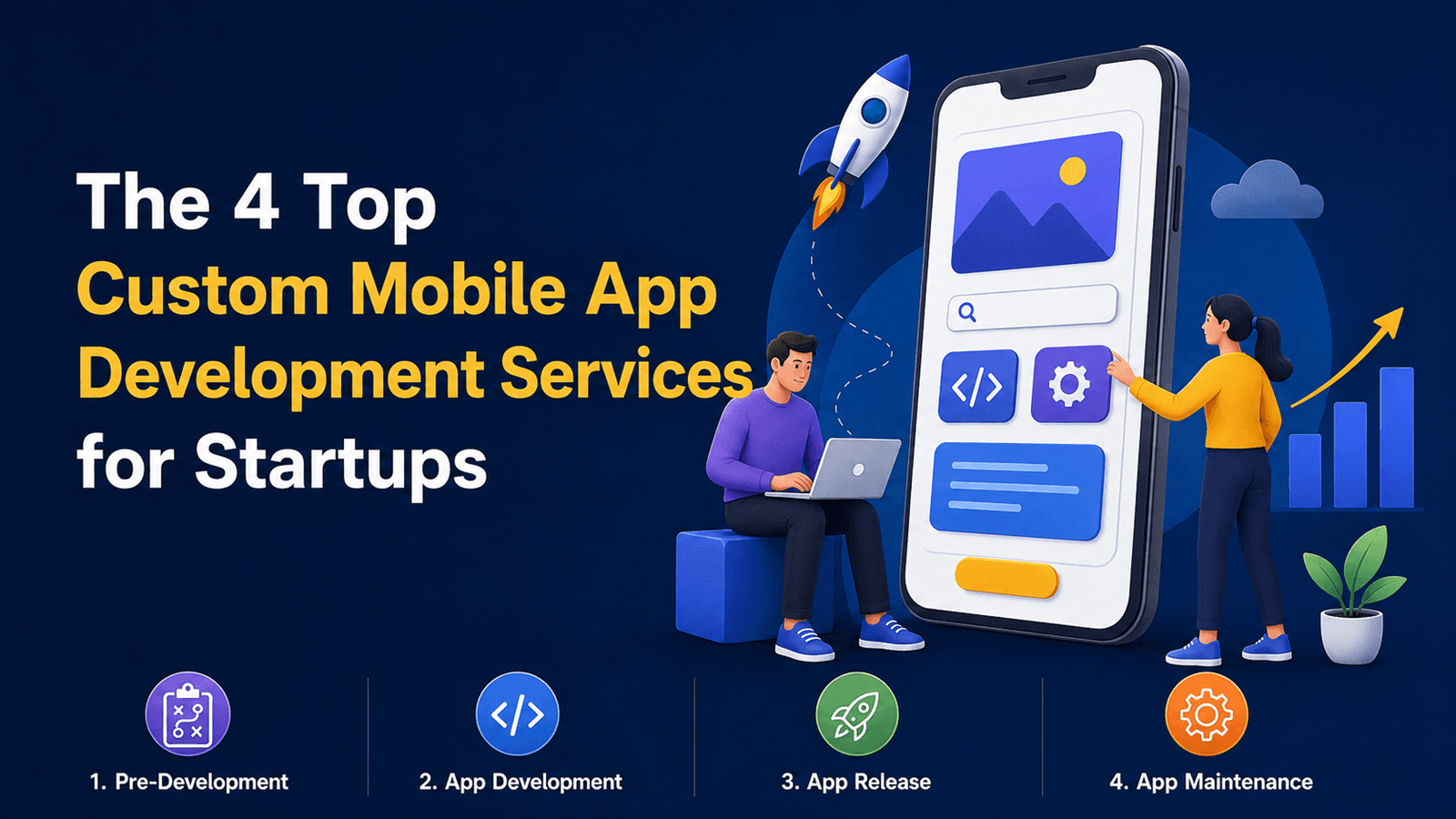
Explore the essential custom mobile app development services every startup needs to build, launch, and scale a successful product. This guide covers strategy, UI/UX design, app development, testing, release, maintenance, security, scalability, and long-term support. Learn how the right development partner can help reduce technical risks, improve user experience, validate your MVP, and create a mobile app ready for sustainable business growth now
For most startups today, a mobile app is no longer simply an additional digital channel. In many industries, it becomes the primary way customers interact with a product, access services, complete transactions, communicate with a business, or manage their accounts.
The opportunity is significant. Billions of people worldwide use smartphones, and mobile applications generate hundreds of billions of dollars in global revenue.
However, simply launching an application does not guarantee business growth.
Mobile app stores are highly competitive, users have increasingly high expectations, and customers can abandon an application within seconds if it is slow, confusing, unreliable, or fails to deliver meaningful value.
For startups in particular, the stakes are even higher.
Established companies may already have customer loyalty, brand recognition, large marketing budgets, and extensive development resources. Startups often have none of these advantages.
That means your mobile application needs to solve a real problem, provide a strong user experience, communicate a clear value proposition, and remain technically reliable from the first interaction.
Achieving that requires more than mobile app coding. It requires a complete development strategy covering research, planning, design, engineering, testing, launch, and continuous improvement.
Understanding the different custom mobile app development services available can therefore help startups make better technical decisions and build applications designed for sustainable growth.
Why the Right Mobile App Matters in Today's Digital Environment
Having a mobile app and having a successful mobile app are two very different things.
Before development begins, startups should answer one fundamental question:
What measurable value will this application provide to users and the business?
An application built only because competitors have one is unlikely to deliver meaningful results.
Users already have countless applications competing for their attention. Downloading another app requires a reason, and continuing to use that application requires an even stronger one.
A successful mobile application should solve a specific problem or make an existing activity significantly easier.
That could mean simplifying payments, improving communication, providing faster access to services, automating repetitive activities, delivering personalized experiences, or making an offline process available digitally.
The application's value proposition should therefore influence nearly every development decision.
Features, user journeys, technology choices, notifications, onboarding, pricing, and interface design should all support the problem the application was created to solve.
This is particularly important for startups because early user experiences can strongly influence customer retention and brand perception.
A technically functional application is not necessarily a successful product. The goal should be an application that users understand, trust, and have a reason to return to.
What Type of Mobile App Development Support Does Your Startup Need?
Every startup enters the development process from a different position.
Some startups already have developers but require additional specialists for particular technologies or development stages.
For example, an internal team may have strong backend capabilities but need external Android, iOS, Flutter, React Native, UI/UX, cloud infrastructure, or quality assurance expertise.
Other startups have no internal development team at all.
In that situation, the development partner may need to handle everything from initial product discovery and technical planning to application development, deployment, and long-term maintenance.
Understanding your internal capabilities before selecting an external development company is important.
A startup that only requires additional engineering capacity should look for a partner capable of integrating smoothly with an existing team.
A non-technical startup, meanwhile, should prioritize a company with complete product development capabilities and the ability to translate business requirements into technical decisions.
For many early-stage businesses, the second approach is more practical.
Instead of coordinating separate designers, developers, testers, and infrastructure specialists, the startup can work with a single development partner responsible for the complete application lifecycle.
What Startups Should Look for in a Mobile App Development Partner
Technology expertise is important, but it should not be the only factor considered when hiring a mobile app development company.
The right development partner should understand both technology and product strategy.
A startup should look for a company with demonstrated mobile application experience, strong communication practices, transparent development processes, and the ability to recommend solutions based on actual business requirements.
A reliable development partner should also be willing to challenge assumptions.
If a requested feature adds unnecessary complexity, increases development costs significantly, creates scalability problems, or provides little value to users, an experienced development team should explain those concerns rather than automatically building everything requested.
The relationship should work more like a strategic technology partnership than a simple task-based outsourcing arrangement.
Another important consideration is customization.
Every startup has different users, workflows, revenue models, technical requirements, and long-term goals. Development companies that apply the same architecture, feature set, or development process to every client may struggle to create a product that accurately reflects the startup's needs.
Transparency is equally important.
Startups should understand project progress, development milestones, technical challenges, budget implications, and important decisions throughout the development lifecycle.
These qualities become particularly important when evaluating the four major categories of custom mobile app development services.
4 Custom Mobile App Development Services Every Startup Should Understand
Successful mobile application development can generally be divided into four major stages.
Each stage plays a different role in turning an initial idea into a reliable and scalable product.
1. Pre-Development Services
Strong applications usually begin before developers write the first line of production code.
The pre-development stage is where the business idea is converted into a practical product and technical strategy.
One of the first activities is product discovery.
During discovery, the development team should understand the startup's business model, target users, primary problem, revenue strategy, competitors, available budget, desired features, and long-term objectives.
This information helps determine what actually needs to be built.
For startups, this stage is especially important because development budgets are rarely unlimited.
Without clear prioritization, teams can spend considerable time developing features that users do not need or that are unnecessary for the first version of the product.
A good development partner can help distinguish between essential MVP functionality and features that should be introduced later.
After requirements are clarified, the product generally moves into early UX and technical planning.
This may include user flows, wireframes, information architecture, low-fidelity designs, interactive prototypes, database planning, API requirements, and technology stack selection.
Prototyping is particularly valuable.
A clickable prototype allows founders and potential users to experience the basic application journey before expensive engineering work begins.
Early feedback can identify usability problems, missing workflows, confusing navigation, or incorrect assumptions while changes are still relatively inexpensive.
The result of a strong pre-development process should be a clear product direction and technical roadmap that reduces uncertainty during development.
2. Mobile App Development Services
Once the strategy, scope, and application architecture are defined, development begins.
This stage combines user experience design, interface development, backend engineering, database architecture, integrations, security, and application logic.
For users, UI and UX design are among the most visible components.
The application should feel intuitive from the moment it opens.
Navigation should be predictable, important actions should be easy to discover, forms should be simple, and users should receive clear feedback when actions are completed.
Poor UX can damage more than application engagement. It can also affect how users perceive the company itself.
Technical architecture is equally important.
Depending on the project, startups may choose native iOS and Android development or cross-platform technologies such as Flutter or React Native.
There is no universally correct choice.
The appropriate development approach depends on performance requirements, available budget, application complexity, hardware integrations, development timeline, and long-term product strategy.
Backend development also deserves significant attention.
Many mobile applications rely on backend systems for authentication, user management, payments, messaging, notifications, data storage, analytics, administrative dashboards, API integrations, and business logic.
A poorly designed backend may work for a small initial user base but create serious performance and scalability problems as the startup grows.
Experienced developers therefore design both the mobile interface and underlying infrastructure with future growth in mind.
Security should also be integrated into development rather than added after the application is finished.
Authentication, authorization, encrypted communication, secure API architecture, sensitive data handling, access controls, and dependency management should all be considered throughout the engineering process.
3. App Testing and Release Services
Completing development does not automatically mean the application is ready for customers.
Before launch, the application should undergo systematic quality assurance.
Testing helps identify functional errors, crashes, performance issues, compatibility problems, broken workflows, security concerns, and usability problems before they affect real users.
The application should also be tested across relevant device sizes, operating system versions, network conditions, and user scenarios.
For startups, this stage can have a major impact on product reputation.
A user encountering repeated crashes, failed payments, broken authentication, or major usability problems during their first session may never return.
Quality assurance therefore protects both the technical product and the company's brand.
Release preparation also includes more than submitting application files.
The development team may need to prepare app store configurations, screenshots, application descriptions, privacy information, permissions, signing credentials, production environments, analytics, crash monitoring, and other launch-related infrastructure.
Apple App Store and Google Play Store submission requirements should also be reviewed before the intended launch date.
Experienced development partners can help identify potential compliance issues and reduce unnecessary delays during application review.
A structured release process should also include production monitoring.
Once users begin interacting with the application, development teams should closely monitor errors, crashes, performance, server health, and user behavior.
Launching the application is therefore a transition into the next stage rather than the end of development.
4. App Maintenance and Continuous Improvement Services
A mobile application is a continuously evolving software product.
Operating systems change. Device capabilities change. Security risks emerge. Third-party APIs are updated. User expectations evolve. Businesses introduce new services and workflows.
An application that receives no maintenance can gradually become slower, less secure, incompatible, or irrelevant.
Ongoing mobile app maintenance typically includes bug fixes, dependency updates, performance optimization, operating system compatibility, infrastructure monitoring, security improvements, and feature development.
However, the most valuable maintenance strategy goes beyond technical fixes.
Once an application has real users, startups gain something they did not have before launch: actual product usage data.
Analytics can reveal where users leave onboarding, which features receive the most engagement, which screens cause confusion, and which functions provide the most business value.
Customer feedback provides additional insight.
The development roadmap can then be adjusted based on real behavior rather than assumptions.
This creates a continuous improvement cycle:
Build the product, measure how users interact with it, learn from those interactions, and improve the experience.
For startups, this approach is especially valuable because the product may change considerably as the business discovers stronger market opportunities.
Your development architecture and technology partner should be capable of supporting that evolution.
Why Startups Should Think Beyond the MVP
The Minimum Viable Product is an important startup concept, but it is sometimes misunderstood.
An MVP does not mean creating a poor-quality application with as few features as possible.
It means developing the smallest version of the product capable of validating its most important assumptions and delivering meaningful value to early users.
Technical quality still matters.
Authentication should work properly. Payments should be reliable. User data should be protected. Core workflows should be intuitive. The application should not repeatedly crash.
The areas that should be minimized are unnecessary scope and premature functionality.
For example, a startup may eventually want dozens of advanced features, automation tools, analytics dashboards, integrations, and personalization capabilities.
The first version may only require a small number of those features to determine whether customers actually want the core product.
This approach reduces development risk while providing a foundation that can grow based on evidence.
Building a Mobile App That Supports Long-Term Startup Growth
The best mobile applications are not created by simply converting a list of features into code.
Successful products result from understanding users, validating business assumptions, selecting appropriate technologies, creating intuitive experiences, developing scalable infrastructure, testing carefully, and continuously improving the product after launch.
That is why startups should evaluate mobile app development services as an entire lifecycle rather than a single development phase.
Pre-development determines whether you are building the right product.
Development determines whether that product is technically reliable and easy to use.
Testing and release determine whether users receive a stable first experience.
Maintenance determines whether the application remains valuable as users, technologies, and the business evolve.
Choosing a development partner capable of supporting all four stages can reduce technical risk and provide greater continuity throughout the product lifecycle.
Choose Zygobit for Custom Mobile App Development
Zygobit helps startups and growing businesses transform mobile app ideas into scalable digital products through end-to-end custom mobile app development services. From product discovery, UI/UX design, and MVP development to backend engineering, API integrations, testing, deployment, and post-launch maintenance, our team supports the complete application lifecycle. We develop Android, iOS, and cross-platform applications using modern technologies while focusing on performance, security, scalability, and practical business requirements. Whether you are validating a new startup idea or expanding an existing digital product, Zygobit can help you build a mobile application designed for both today's users and tomorrow's growth.
Final Thoughts
For a startup, developing a mobile application is a significant investment in both technology and business strategy.
Choosing the right development services can determine whether that investment becomes a scalable product or an expensive technical burden.
Before beginning development, clearly define the problem your application solves, understand your users, prioritize essential features, and select a development partner capable of supporting your product beyond the initial launch.
The strongest mobile development partnerships combine technical expertise with business understanding.
When strategy, design, engineering, quality assurance, and continuous improvement work together, a startup has a much stronger foundation for building a mobile application that users value and the business can continue growing.

Ready to build your next digital product?
Talk to Zygobit about web apps, mobile apps, AI solutions, automation, and scalable software development tailored to your business goals.
Explore Related Articles
More reading on web, mobile, AI, and product engineering from the Zygobit team.
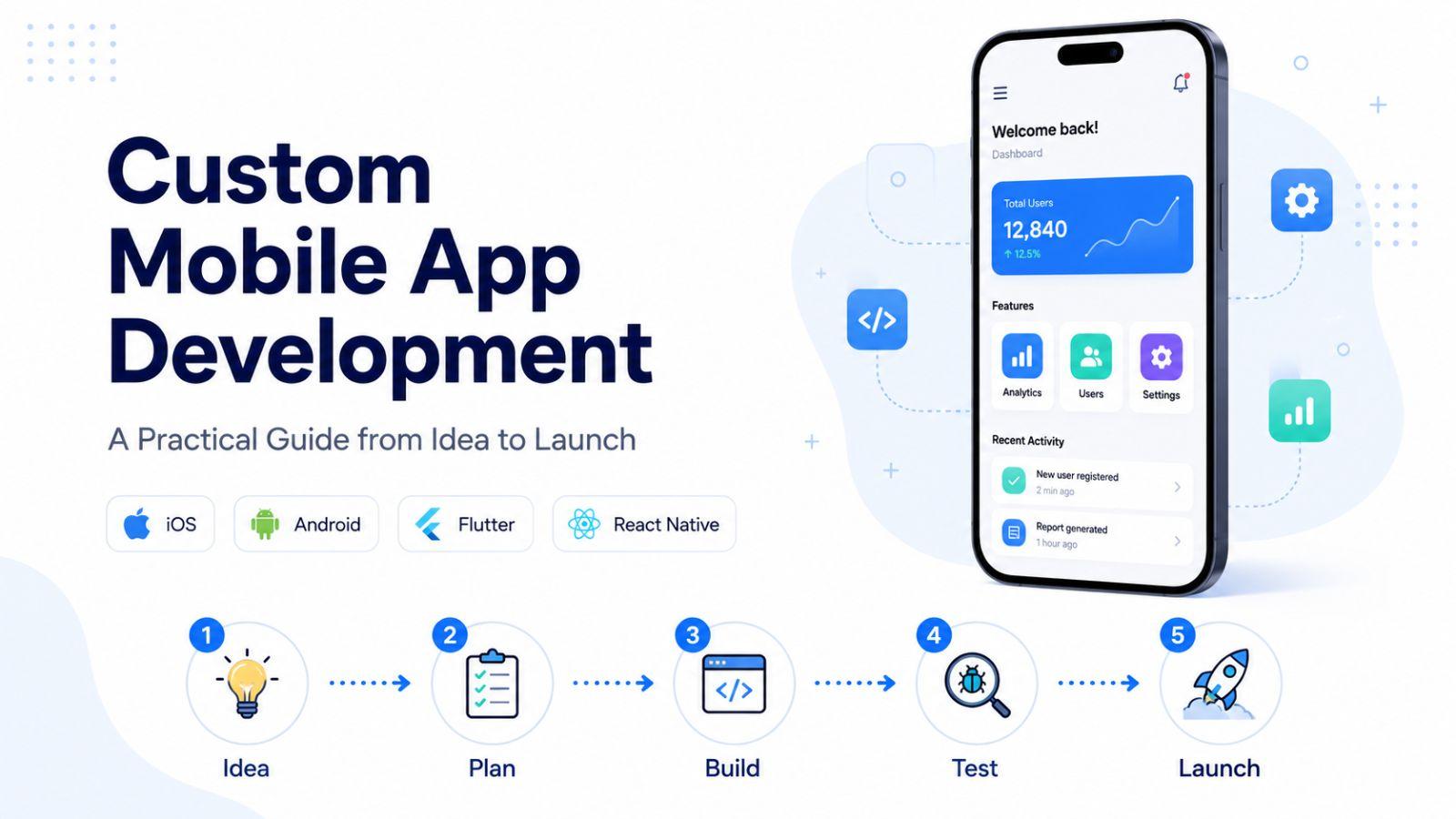
Custom Mobile App Development A Practical Guide from Idea to Launch
Explore custom mobile app development from idea to launch. Learn how to plan, design, build, test, and release high-quality apps for iOS and Android. Understand native, hybrid, and cross-platform development, popular frameworks, development costs, AI-powered features, and the key tools needed to create scalable mobile applications with confidence.

How to Create an AI Roadmap for Your Business A Step-by-Step Guide
Discover how to create an effective AI roadmap for your business with this step-by-step guide. Learn how to assess AI readiness, identify high-value use cases, prioritise opportunities, estimate implementation costs, and measure results. Explore how AI roadmap consulting helps businesses reduce risks, make smarter technology investments, and achieve sustainable growth through artificial intelligence.
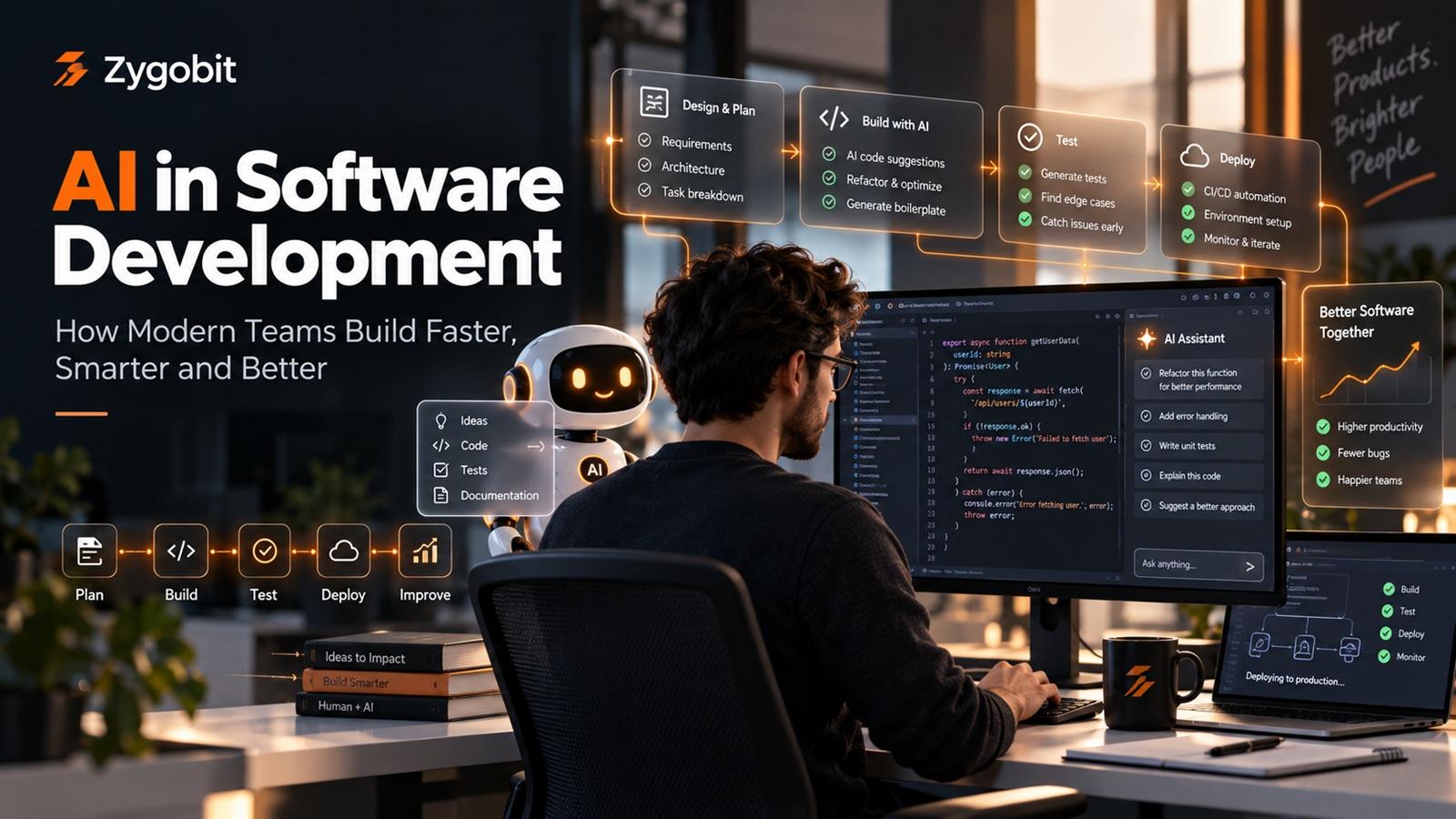
AI in Software Development: How Modern Teams Build Faster, Smarter and Better
Discover how AI is transforming software development across coding, testing, reviews, automation, and deployment. Learn how Zygobit helps businesses build smarter, faster, and more scalable AI-powered software solutions.