


AI Agent Development Cost in 2026: What Businesses Actually Pay

AI agent development cost in 2026 ranges from about $10,000 for a single-task agent to $200,000 or more for autonomous, multi-agent systems. This guide breaks the price down by complexity tier, explains the eight factors that move it, covers the running costs quotes leave out, and shows how to get an accurate estimate.
Somebody on your team has probably said it by now: "Could we just build an agent for that?" And then the follow-up question, the one that actually decides things, which is what AI agent development costs.
We get asked this on most first calls, and the answer we give is a range with reasons attached. Right now a single-task agent, the kind that reads tickets and drafts replies for a person to approve, runs somewhere around $10,000 to $30,000. A workflow agent that moves across four or five systems and remembers where it is in a process is more like $40,000 to $80,000. Autonomous systems in regulated industries, where several agents coordinate and a mistake has a dollar figure attached, start around $80,000 and go well past $200,000.
That spread is not vendors hedging. Two projects that sound identical in a one-line brief can differ in price by five times, and the difference is almost never the AI model. It is the systems the agent has to touch, how much it is allowed to do without asking, and how much testing you need before you trust it with live customers. This article walks through where the money goes, what the quotes usually leave out, and how to avoid paying for the wrong thing.
First, What We Mean by an Agent
A chatbot answers. An agent does something. It reads an email, decides the customer is asking for a refund, checks the order in your system, applies your refund policy, and either processes it or flags it for a person. The language model is in there making the decisions, but most of the engineering is in the tools around it and the rules about when it has to stop and ask.
That distinction drives the cost, which is why we keep coming back to it. If you are still working out which one you need, we wrote up the difference between agentic AI and a chatbot separately.
AI Agent Development Cost by Tier
We find it easier to talk about three tiers than to quote a single number. The ranges below line up with what other development firms have published this year and with how our own projects have broken down. Your quote will move around inside them depending on your systems.
Single-task agents: roughly $10,000 to $30,000
One job, a couple of tools, a person approving anything irreversible. Sorting inbound support tickets and drafting a first reply. Pulling the fields off incoming invoices and pushing them into the accounting system. Answering staff questions from a fixed set of policy documents.
These usually involve one or two integrations through existing APIs, a hosted model with no training of your own, and three to six weeks of work. The main risk is scope creep: the "one small addition" that turns a Tier 1 agent into a Tier 2 budget halfway through.
Workflow agents: roughly $40,000 to $80,000
This is where most of the business value sits, and where most of our projects land. The agent runs a multi-step process end to end. A common one is lead qualification: read the enquiry, look the company up, check the CRM for history, score it against your criteria, draft a reply, and book qualified leads straight into a calendar. Another is purchase-order handling from email through to an ERP entry, with the odd cases routed to a person.
Expect three to six integrations, some needing custom connectors because the API is thin or does not exist. Retrieval over your own data. Written rules for when the agent pauses. Logging and an admin screen so staff can see what it did and why, because they will not trust it otherwise. Eight to fourteen weeks is typical.
Autonomous and multi-agent systems: $80,000 to $200,000 and up
Several agents dividing up work, high volumes, and consequences when things go wrong. Claims processing. Order management across warehouses and carriers. An operations assistant with its hands in a dozen internal tools.
At this level you are paying for integrations with legacy systems that have no clean interface, for evaluation suites that run the agent against hundreds of real scenarios before every release, for role-based permissions and audit trails, and often for compliance work (HIPAA, PCI DSS, GDPR, SOC 2 practices). Sometimes for fine-tuning or a custom model, though less often than people expect. Four to nine months, delivered in phases, because nobody should write a cheque for the whole thing on day one.
The Eight Things That Actually Move the Price
When a quote comes back higher than you expected, it is almost always one of these.
1. Integrations, and how clean they are
Every system the agent touches needs a connector, error handling, and tests. A modern SaaS product with good documentation might take two days. A legacy system that only exports a CSV at midnight can eat three weeks. This is the single biggest cost driver we see, and it is why our AI integration work starts with an inventory of your systems before anyone talks about models.
2. How much it may do without asking
An agent that drafts and waits is cheap to make safe. An agent that issues refunds, changes orders, or emails customers on its own needs far more testing, tighter permissions, and a way to undo things. Autonomy is where budgets grow fastest, and it is also where you should grow them last.
3. The state of your data
If your policies live in six places and half of them are out of date, the agent will give confident answers from the wrong version. We have had projects where a quarter of the budget went on sorting out documents before any AI work started. Not glamorous, but it decides whether the agent is trustworthy.
4. Model choice and where it runs
Hosted frontier models cost more per call and need no infrastructure. Open-weight models on your own cloud are cheaper per call at volume but someone has to run them. Regulated data sometimes forces the second route whether you like the price or not.
5. Testing, which is different for agents
Ordinary software passes or fails a test. An agent behaves a little differently each time, so you need a set of realistic scenarios, scoring rules, and regression runs before every change. Call it 10 to 20 percent of the build. It is the line item most often cut, and the one teams most often wish they had kept.
6. Compliance
Healthcare, finance, insurance, anything touching card data: data residency, encryption, access reviews, audit logs, and the paperwork to prove it. Published guides this year put the premium at roughly 25 to 35 percent over the same build without those requirements, which matches what we see.
7. Whether it needs a screen
Some agents live inside Slack or your CRM and need no interface at all. Others need a review dashboard where staff approve, correct, and see an audit trail. That dashboard is often the difference between an agent people use and one they quietly route around.
8. Who builds it, and where they sit
Senior AI engineers in the US are commonly quoted at $120 to $250 an hour. An experienced team in India working the same stack charges a fraction of that, which is the main reason so many US companies work with an India-based partner that has a US office. The rate matters less than whether the team has put agents into production before. A cheap team that has only built demos ends up costing more.
Running Costs, Which the Build Quote Does Not Include
The build is paid once. The agent then runs every day, and the monthly bill is where owners get surprised. Four things to budget before you sign anything:
Model usage. Every step sends tokens somewhere. A support agent handling 20,000 conversations a month might cost a few hundred dollars. One handling 100,000 long, document-heavy conversations can run $1,000 to $3,000 or more. Caching, smaller models for routine steps, and some prompt discipline cut this a lot, and a good team will show you the per-conversation cost before launch.
Hosting. Vector database, queues, logging, compute. Usually $100 to $1,000 a month for a mid-sized deployment.
Maintenance. Models get updated, APIs change, and edge cases turn up in production that never appeared in testing. Plan on 15 to 25 percent of the build cost per year.
People. If staff approve the agent's actions, their time is part of the cost. The aim is to shrink it as accuracy is proven, not to pretend it is zero from day one.
A Worked Example
Take a professional services firm getting about 600 enquiries a month through the website, email, and a contact form. Staff spend roughly 90 hours a month reading, researching, and replying before a call gets booked, and the good leads often wait a day for an answer.
A workflow agent here reads each enquiry, looks the company up, checks the CRM, scores the lead against agreed criteria, drafts a reply, and books the strong ones into a calendar. The unclear ones go to a person with the agent's notes attached. Five integrations (form, mailbox, CRM, enrichment, calendar), retrieval over past deals and a short qualification playbook, and an evaluation set of 200 historical enquiries with known outcomes.
That is a Tier 2 build. A sensible budget is $45,000 to $65,000 over ten to twelve weeks, with running costs under $500 a month at this volume. Ninety recovered staff hours at a loaded cost of $45 an hour is about $4,000 a month before you count the leads that now get a reply in minutes. Spread the build over two years and the agent is ahead from the first month on hours alone. Your numbers will differ. The arithmetic will not.
Build, Buy, or Configure
Before budgeting for a custom build, check whether a cheaper route does the job. We say this to people who come to us wanting a build, and some of them leave with a subscription instead.
Buy a product when the job is generic and your data can live on someone else's platform. Subscription agents for support, outreach, scheduling, and bookkeeping run $50 to $500 a month. They stop being the answer the moment the agent has to follow your rules or work inside your systems.
Configure a platform when you want a first contained workflow with two or three standard integrations. Agent-building platforms let a developer wire up tools and prompts without starting from scratch; expect $5,000 to $25,000 of configuration plus the platform fee. The ceiling arrives when you need custom connectors, strict permissions, or testing beyond what the platform offers.
Build custom when the workflow is specific to how your business operates, the integrations are yours, the data is regulated, or the volume makes platform pricing expensive. You also end up owning the code, the prompts, and the test suite, which matters more than people think when the vendor changes its pricing.
Seven Ways to Keep the Cost Down
- Start with a proof of concept. Two or three weeks on 50 real examples costs a fraction of a build and tells you whether the data and rules are good enough.
- Use smaller models for routine steps. Classification, extraction, and routing rarely need the most expensive model. Save it for the steps that need judgement. This alone often halves model spend.
- Cache what repeats. Long, repetitive context is where tokens go to die.
- Build integrations as shared pieces so the second and third agents inherit them.
- Keep a person in the loop at launch. Approval steps are cheaper than the testing needed to remove them.
- Do not over-engineer memory. Most business agents need a conversation record and a document index, not an elaborate architecture.
- Work with a team outside the top-rate markets, provided they have shipped agents before.
Where We See Businesses Overspend
Building an agent when a script would do. If the inputs are clean and the rules are fixed, ordinary automation is cheaper, faster, and more reliable. Agents earn their cost on messy inputs (free-text emails, documents, calls) or where judgement is needed. Our AI automation engagements start by sorting which steps need a model and which do not, and the answer is usually fewer than the client expected.
Starting with the hardest workflow. The most complex, most visible process is the one that stalls. Start with something contained and measurable, get it into production, then expand. The second agent is always cheaper than the first.
Skipping discovery. A one- or two-week discovery that maps the process, inspects the data, and tests feasibility with a small prototype costs a few thousand dollars. It routinely saves tens of thousands. Anyone quoting a fixed price for the whole build off a phone call is guessing.
Paying for custom training too early. Most business agents work well on hosted models with good retrieval and prompts. Fine-tuning makes sense when you have a large pile of labelled examples and a measured gap that prompting cannot close. It is rarely the right first step.
How to Get a Quote You Can Trust
Bring these to the first conversation and you will get a tighter estimate and, frankly, a better agent:
- The workflow written out step by step, including the exceptions staff currently handle by hand.
- Every system involved, and whether each has an API.
- Monthly volumes: tickets, orders, documents, calls.
- What the agent may do on its own, and what always needs a person.
- Any compliance requirements on the data.
- How you will measure success. Hours saved, response time, error rate, revenue.
With that, a competent team can give you a fixed price for discovery and a bounded range for the build. Without it, you get a number pulled from the air.
How We Scope and Price Agents at Zygobit
Our engineering team is in Mohali, India, with a US office in East Windsor, New Jersey, and most of our agentic AI work is for US businesses. Every engagement starts with a short, fixed-price discovery, then a phased build so you see a working agent on your real data early rather than at the end.
- Discovery: process mapping, data review, and a feasibility prototype.
- Build: integrations, retrieval, guardrails, the evaluation suite, and whatever review screen your staff need.
- Launch: staged rollout with human approval, then wider autonomy as the correction log shrinks.
- Operate: monitoring, model and API updates, and cost tuning once it is live.
If you have a quote from someone else and want a second opinion, or a rough range for a workflow you have in mind, get in touch or book a 30-minute call on Calendly. Our AI consulting team can also run the discovery phase on its own if you plan to build in-house.
The Short Version
AI agent development cost runs from around $10,000 for a single-task agent to $200,000 or more for autonomous systems in regulated industries, with most business workflow agents landing between $40,000 and $80,000. The price is driven by integrations, autonomy, data readiness, and testing far more than by the model. Budget for running costs from the start, begin with a contained workflow, and do not let anyone commit to a number before discovery.
Frequently Asked Questions
How much does it cost to build an AI agent?
A simple single-task agent runs about $10,000 to $30,000, a multi-step workflow agent $40,000 to $80,000, and autonomous or multi-agent systems $80,000 to $200,000 or more. Integrations, autonomy, and compliance requirements are the main reasons the range is so wide.
What does it cost to run an AI agent each month?
Three recurring costs: model usage (a few hundred to a few thousand dollars a month depending on volume), hosting and infrastructure, and maintenance at roughly 15 to 25 percent of the build cost per year. Ask any vendor for all three before you sign.
How long does AI agent development take?
A single-task agent typically takes three to six weeks. A workflow agent with several integrations takes eight to fourteen weeks. Autonomous and multi-agent systems usually run four to nine months and are delivered in phases.
Is an off-the-shelf AI agent platform cheaper?
For a generic job, such as answering questions from a help centre, a subscription product is usually cheaper. Custom development makes sense when the agent must work inside your own systems, follow your own rules, or handle data you cannot send to a third party.
Do I need to train my own model?
Usually not. Most business agents run on hosted models combined with retrieval over your own documents and well-designed prompts. Fine-tuning is worth considering only when you have a large set of labelled examples and a measured accuracy gap.
What is the cheapest way to start?
Pick one contained workflow with messy inputs and clear success measures, run a short discovery, and build a single-task agent with a person approving every action. Once it is accurate in production, widen its autonomy and move to the next workflow.
Why do quotes from different companies vary so much?
Because they make different assumptions about integrations, testing, and autonomy. A low quote often leaves out the evaluation suite, the review screen, or the data clean-up. Compare quotes line by line, and ask each vendor what happens when the agent gets something wrong.

Ready to build your next digital product?
Talk to Zygobit about web apps, mobile apps, AI solutions, automation, and scalable software development tailored to your business goals.
Explore Related Articles
More reading on web, mobile, AI, and product engineering from the Zygobit team.
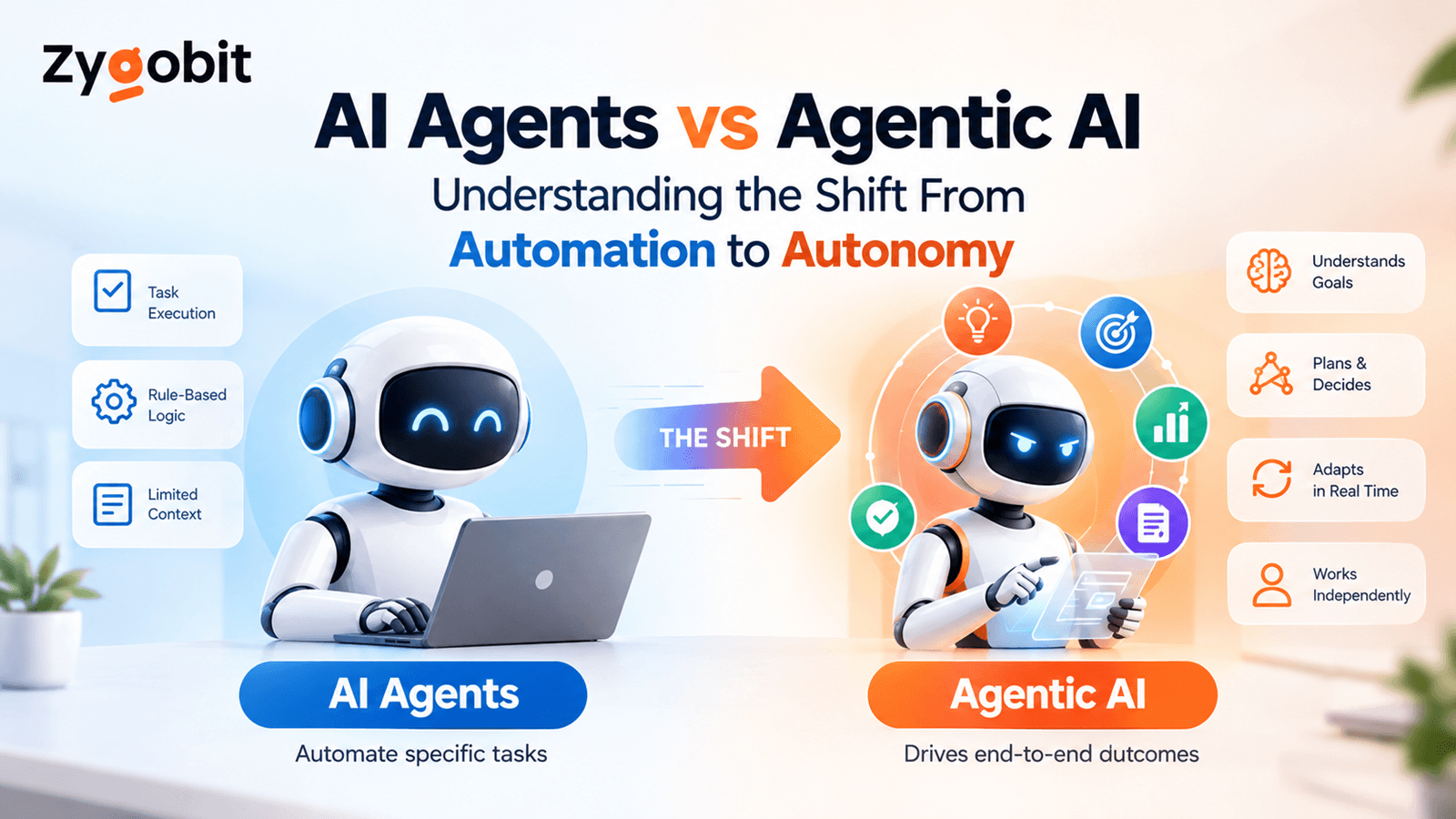
AI Agents vs Agentic AI Understanding the Shift From Automation to Autonomy
AI agents are changing business automation by moving beyond simple responses to intelligent action. This article explains the difference between AI agents and agentic AI, including planning, tool use, workflow orchestration, state management, human approvals, security, observability, and enterprise use cases.
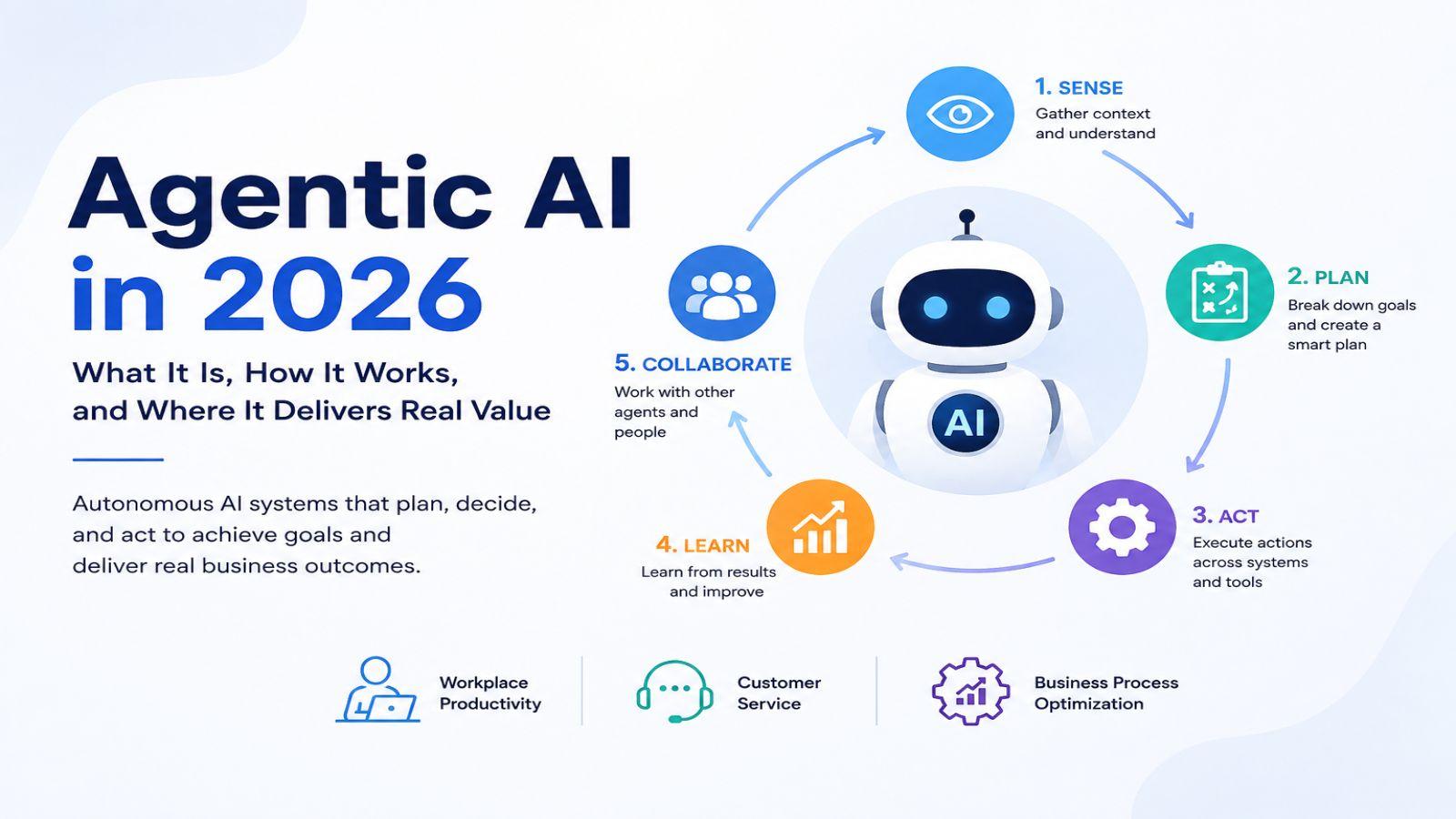
Agentic AI in 2026 What It Is, How It Works, and Where It Delivers Real Value
Discover how Agentic AI is transforming businesses in 2026 by moving beyond simple content generation to autonomous action. Learn how AI agents sense, plan, act, learn, and collaborate across systems to automate workflows, improve customer service, boost productivity, optimize business processes, and deliver measurable results with secure, scalable implementation.

What Is Agentic AI and How Is It Different From a Chatbot
Agentic AI is transforming how businesses automate work by enabling AI systems to plan, reason, use tools, and complete tasks with minimal human input. Unlike traditional chatbots, AI agents can make decisions, execute workflows, and adapt to changing conditions. Discover how Agentic AI works, its real-world applications, benefits, challenges, and why it's shaping the future of business automation.