





What Is Agentic AI and How Is It Different From a Chatbot


Agentic AI is transforming how businesses automate work by enabling AI systems to plan, reason, use tools, and complete tasks with minimal human input. Unlike traditional chatbots, AI agents can make decisions, execute workflows, and adapt to changing conditions. Discover how Agentic AI works, its real-world applications, benefits, challenges, and why it's shaping the future of business automation.
Somewhere in the last eighteen months, "agentic AI" went from a phrase you'd only hear at research conferences to something your CEO asks about in the Monday standup. Search interest has exploded, every vendor has bolted the word "agent" onto their product page, and most of the explanations floating around are either too vague to be useful or so technical they only make sense if you already knew the answer.
We build this stuff every day, so let us give you the answer we give friends who ask over coffee. No hype, no jargon walls, and an honest section at the end about where agents still fall flat, because that part matters more than the demos suggest.
The short answer
Agentic AI services that pursue a goal on its own. You give it an outcome, and it plans the steps, uses tools like APIs and databases, checks its own results, and keeps working until the job is done or it decides it needs a human. A chatbot answers you. An agent works for you.
That's the whole idea. Everything else is detailed. But the details are where people get confused, so let's walk through it properly.
A chatbot waits. An agent works.
A chatbot is a request and response machine. You type something, it produces a reply, and then it sits there until you type again. Even the impressively smart ones follow this pattern. Intelligence lives inside a single turn of conversation, and the moment it sends its answer, its involvement ends. If the answer requires anything to actually happen in the world, that's your job.
An agent breaks out of that loop. It takes an objective rather than a question, and it's wired up to things it can act on. It might query your CRM, read a policy document, call a payment API, draft an email, wait for a webhook to come back, and then decide what to do next based on what it found. The defining trait isn't intelligence. It's the loop. Plan, act, observe, adjust, repeat.
A decent analogy is the difference between asking a friend for a recipe and having that friend come over and cook dinner. Same knowledge, completely different relationship to the outcome. The recipe friend has done their part when they stop talking. The cooking friend isn't done until you're eating.
What actually happens inside an agent
Under the hood, most production agents share the same anatomy, and it's less mysterious than the marketing implies.
At the center sits a large language model acting as the planner. Around it, developers attach tools, which are just functions the model is allowed to call. A tool might search a database, hit an internal API, run a script, or fetch a web page. The model looks at the goal, picks a tool, reads what came back, and picks the next move. State and memory sit alongside, so the agent remembers what it has already tried and what it learned three steps ago.
The ecosystem around this pattern matured fast. Frameworks like LangGraph, CrewAI, and the OpenAI Agents SDK handle the orchestration plumbing, and the Model Context Protocol, usually shortened to MCP, has emerged as the standard way to plug tools into agents. Think of MCP as a USB port for AI. Instead of writing custom glue for every integration, you expose your system once and any compliant agent can use it. Google Trends shows MCP search interest climbing sharply through the first half of 2026, which tells you how quickly builders have converged on it.
None of these pieces is magic on its own. The leap came when models got reliable enough at choosing tools and reading results that you could trust the loop to run more than two or three steps without going sideways.
A real example instead of another definition
Say a customer emails asking for a refund on a duplicate charge.
The chatbot version reads the email and replies with your refund policy, maybe with a link to a form. Helpful, in the way a signpost is helpful. The customer still has to do the walking, and so does your support team.
The agent version reads the email, pulls up the customer's account, confirms there really are two identical charges twelve minutes apart, checks that the amount falls inside its authority to refund without approval, issues the refund through the payments API, writes a short note on the account, and sends the customer a confirmation with the expected settlement date. If anything had looked off, say the second charge had a different card number, it would have stopped and flagged a human instead.
One of these is a nicer FAQ page. The other one is labor. That gap is why the term took off.
Why your feed is suddenly full of this
The momentum is real and the numbers back it up. Gartner projects that 40 percent of enterprise applications will embed AI agents by the end of 2026, up from under 5 percent in 2025. A Google Cloud survey of executives at companies already using generative AI found 52 percent now run agents in production, not pilots. Analysts peg the agentic AI market at roughly 7.8 billion dollars today, heading toward 52 billion by 2030.
Software development felt the shift first. Coding agents now write whole features from a plain description, chase down bugs across a codebase, and open pull requests while the developer reviews something else. The same pattern is spreading into support, finance operations, recruiting, and IT, anywhere the work is digital, repetitive in shape, and variable in detail.
Behind those figures sits a simpler truth. For years the models were the bottleneck. They hallucinated tool calls, lost the thread after a few steps, and needed a babysitter. Somewhere through 2025 the reliability crossed a line, and the bottleneck moved from "can the model do this" to "have we built the plumbing and permissions to let it." That second problem is an engineering problem, and engineering problems get solved on schedules.
The part most articles skip
Here's the honest bit, and it's the section we wish more vendors would write.
Agents compound their errors. If each step in a task succeeds 95 percent of the time, a ten step task finishes cleanly only about 60 percent of the time. That math is brutal and it doesn't care about your demo. It's why the successful deployments we see are narrow and boring, one workflow, clear boundaries, measurable outcomes, rather than a do-everything assistant let loose on the whole company.
Agents also widen your security surface. Every tool you hand an agent is something a badly worded instruction, or a maliciously crafted one buried in an email it reads, can now trigger. Prompt injection is not a theoretical risk. Any serious deployment needs permission scoping, spending and action limits, audit logs, and a hard rule that irreversible actions, payments, deletions, anything customer facing, get human sign off until you have months of evidence the agent handles them well.
And they cost real money. An agent that burns forty model calls to complete a task a script could do deterministically is not innovation, it's an expensive way to feel modern.
None of this means the technology is overhyped into irrelevance. It means the winners are the teams treating agents like junior employees, with onboarding, limited authority, and reviews, rather than like magic.
Do you actually need an agent
A simple test we use with every project. Write down the workflow. If you can draw it as a fixed flowchart where the same steps happen in the same order every time, you don't need an agent. You need a script or a workflow tool, and it will be cheaper, faster, and far more predictable.
Agents earn their keep when the path changes case by case. When the inputs are messy, when judgment calls sit between the steps, when a human currently has to read something and decide what happens next. That reading and deciding is the labor agents are actually good at absorbing.
So the honest sequence is this. Automate the fixed parts with normal software. Point an agent at the judgment heavy middle. Keep a human on the consequences.
Questions people keep asking
Is agentic AI the same thing as AGI
No. AGI refers to hypothetical AI with human level ability across essentially everything. Agentic AI is ordinary, present day software architecture, a language model wired to tools inside a loop. An agent can be extremely narrow and still be fully agentic. The two ideas get blended in headlines, and it muddies both.
Will AI agents replace chatbots
Mostly, over time, yes, in the sense that pure answer machines will feel dated once acting machines are cheap. But plenty of use cases only need answers, and a chatbot remains the right tool there. Nobody needs an autonomous agent to explain a return policy.
What is MCP and why does it keep coming up
The Model Context Protocol is an open standard for connecting agents to tools and data. Before it, every integration was custom glue code. After it, a tool built once works across many agents and platforms, which is why adoption spread so quickly through 2025 and 2026.
Is it safe to give an agent access to company data
It can be, with the same discipline you'd apply to a new hire. Give the agent its own credentials, scope them to the minimum it needs, log every action it takes, and never let one system's agent read untrusted content and touch sensitive tools in the same breath. Most horror stories trace back to teams skipping exactly these steps, not to the technology itself.
How should a team get started
Pick one workflow that annoys everyone, has clear success criteria, and won't hurt anybody if it fails. Build the smallest agent that handles it, keep a human approving anything irreversible, and measure completion rate honestly for a month. Expand only after the numbers deserve it. Teams that start with a grand company-wide agent almost always retreat to exactly this approach later, minus a quarter of budget.
Where this leaves you
Agentic AI is not a buzzword to wait out. The shift from software that answers to software that acts is the real thing, and 2026 is the year it moved from conference talks into production systems. But the gap between a slick demo and a dependable deployment is wide, and it's crossed with boring engineering, tight scopes, and honest measurement, not bigger promises.
If you're weighing where an agent would actually pay for itself in your stack, that's precisely the kind of problem we like. If you're evaluating where AI agents can create the most value for your business, Zygobit helps companies build secure, scalable, and production-ready Agentic AI solutions tailored to real business workflows. Explore our Agentic AI Services to learn more.

Ready to build your next digital product?
Talk to Zygobit about web apps, mobile apps, AI solutions, automation, and scalable software development tailored to your business goals.
Explore Related Articles
More reading on web, mobile, AI, and product engineering from the Zygobit team.
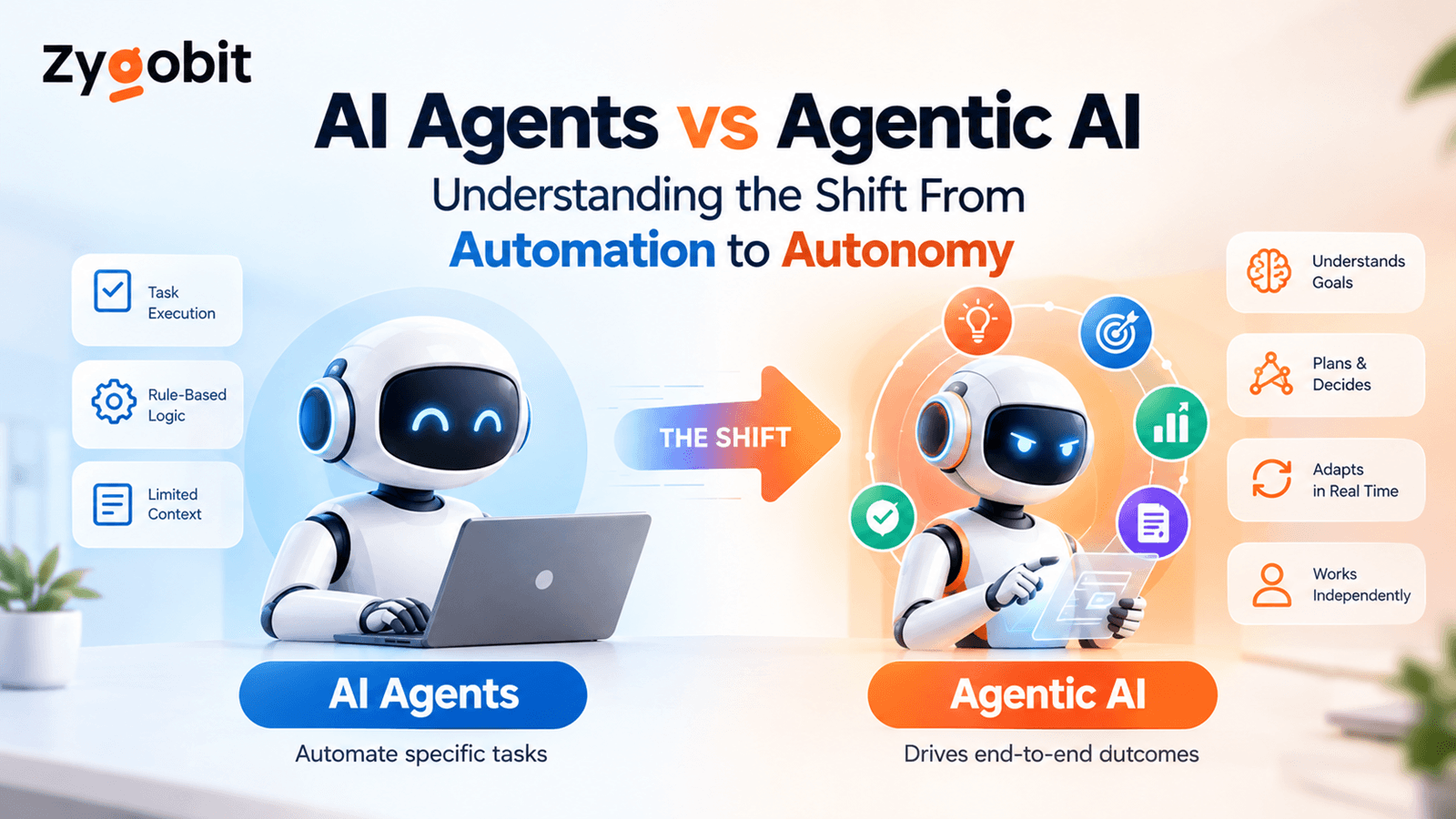
AI Agents vs Agentic AI Understanding the Shift From Automation to Autonomy
AI agents are changing business automation by moving beyond simple responses to intelligent action. This article explains the difference between AI agents and agentic AI, including planning, tool use, workflow orchestration, state management, human approvals, security, observability, and enterprise use cases.
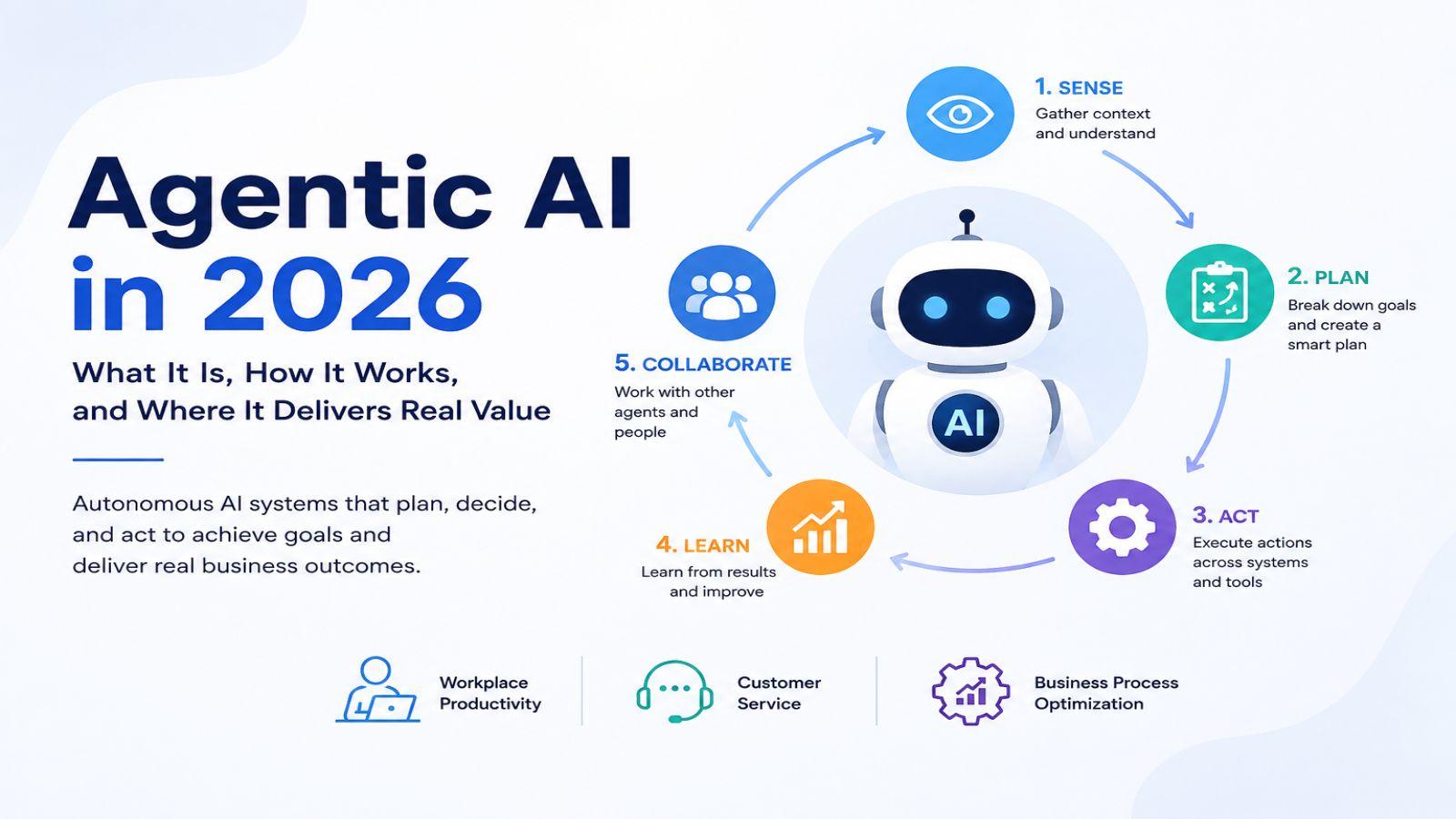
Agentic AI in 2026 What It Is, How It Works, and Where It Delivers Real Value
Discover how Agentic AI is transforming businesses in 2026 by moving beyond simple content generation to autonomous action. Learn how AI agents sense, plan, act, learn, and collaborate across systems to automate workflows, improve customer service, boost productivity, optimize business processes, and deliver measurable results with secure, scalable implementation.
%20%5B%20New%20Updated%20One%20%5D.png&w=1920&q=75)
The Complete Guide to Building Custom AI Agent Model Development for Non-Developers
Explore custom AI agent model development for non-developers using no-code AI platforms, workflow automation, and business AI solutions.