





AI Agents vs Agentic AI Understanding the Shift From Automation to Autonomy

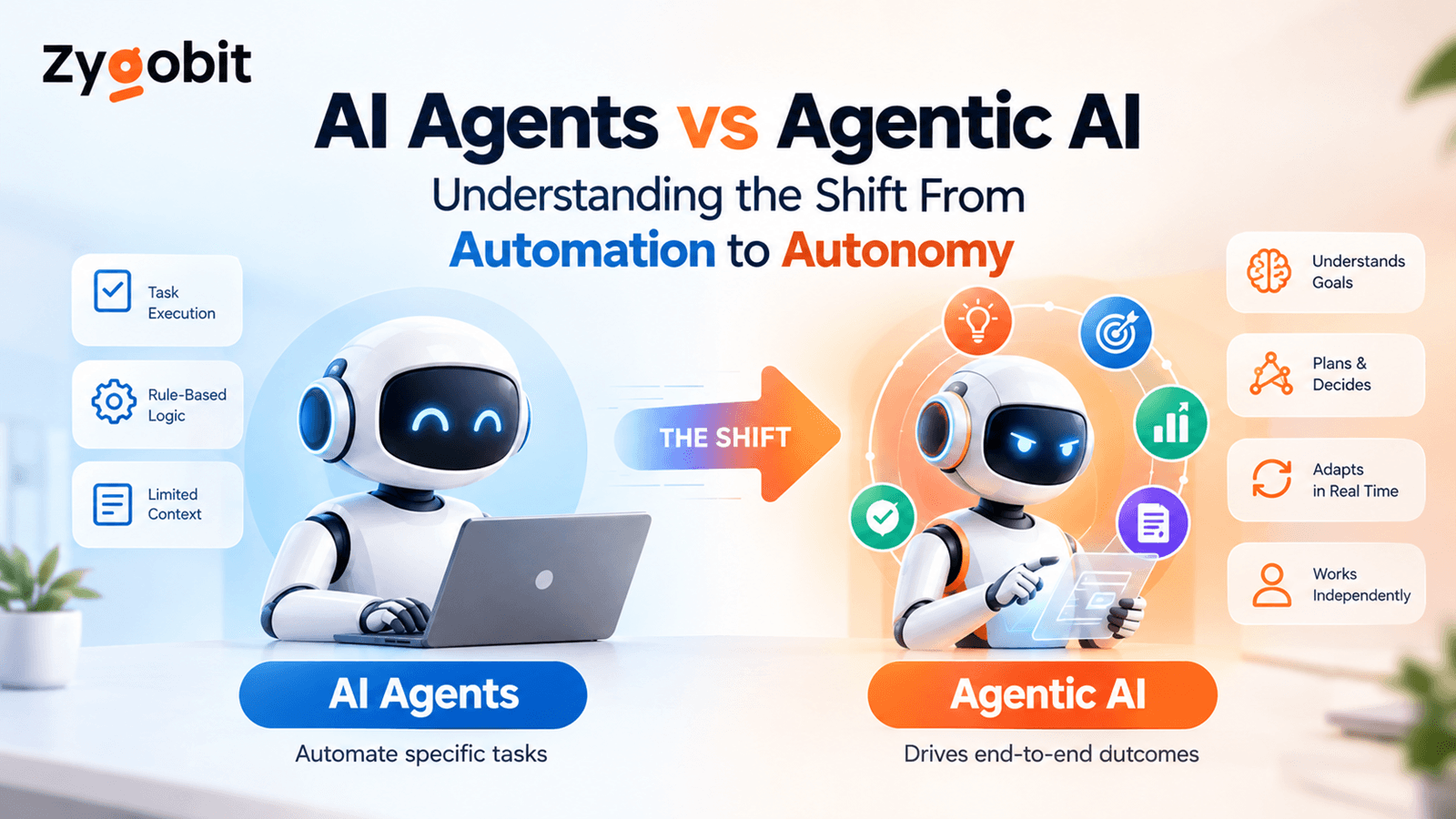
AI agents are changing business automation by moving beyond simple responses to intelligent action. This article explains the difference between AI agents and agentic AI, including planning, tool use, workflow orchestration, state management, human approvals, security, observability, and enterprise use cases.
Artificial intelligence is moving beyond systems that simply generate answers or automate predefined tasks. Businesses are increasingly adopting AI systems that can understand objectives, use tools, interact with business software, make decisions, maintain context, and complete multi-step workflows.
Two terms appear frequently in this transition: AI agents and agentic AI.
Although they are closely related, they do not describe exactly the same thing. An AI agent usually refers to an intelligent software component capable of performing tasks with a certain degree of autonomy. Agentic AI describes a broader approach in which AI systems plan, adapt, coordinate actions, maintain workflow state, and continuously work toward an outcome.
Understanding this distinction becomes increasingly important as businesses move from experimental AI applications toward production systems connected to CRM platforms, databases, APIs, ERP systems, customer support tools, internal knowledge bases, and other operational software.
For organizations exploring these technologies, the real question is not whether AI agents or agentic AI sound more advanced. The important question is how much autonomy a workflow actually requires and how that autonomy can be implemented safely.
What Is an AI Agent?
An AI agent is software designed to understand a task, reason about available information, select an appropriate action, and use tools to complete that task.
Unlike a conventional chatbot that mainly generates a response, an AI agent can interact with external systems.
For example, imagine a customer asking about the status of an order. A traditional AI chatbot might explain how customers can check their orders. An AI agent could authenticate the customer, retrieve the order from a database, check its delivery status through an API, and provide the latest information directly.
The agent may also update a support ticket, schedule an appointment, retrieve information from a CRM, analyse a document, or trigger another business process.
This ability to move from answering to acting is one of the biggest differences between traditional generative AI applications and modern agents.
Businesses interested in building such systems can explore Zygobit’s AI development services, which cover AI applications, intelligent automation, AI agents, enterprise integrations, and production deployment.
What Is Agentic AI?
Agentic AI describes AI systems that pursue broader objectives through planning, decision-making, tool usage, feedback, and adaptive execution.
Instead of receiving one task and performing one action, an agentic system may determine multiple steps required to achieve an outcome.
Consider a procurement problem.
A basic AI agent might inspect an invoice and compare it with a purchase order.
An agentic AI system could investigate the complete discrepancy. It might retrieve the invoice, check supplier records, review procurement policies, compare the purchase order, determine why the values differ, request additional information, route the issue for approval, update the procurement system, and continue monitoring the workflow until the exception is resolved.
The difference therefore concerns the scope and structure of autonomy.
The agent performs a task. The broader agentic architecture coordinates the decisions, tools, data, workflow state, policies, and execution needed to accomplish a larger objective.
Zygobit’s agentic AI development services focus specifically on these types of autonomous and semi-autonomous workflows.
AI Agents and Agentic AI Are Closely Connected
It is easy to interpret AI agents and agentic AI as two separate technologies, but the boundary is not that simple.
An individual AI agent can already demonstrate agentic behaviour.
It may reason about information, plan several actions, use APIs, remember previous steps, react to tool outputs, and modify its approach when something fails.
Agentic AI describes how these capabilities can be organised across a larger workflow.
An agentic application may contain one powerful agent. It may contain several specialist agents. It may also combine AI agents with normal software, deterministic business rules, APIs, databases, workflow engines, and human approvals.
That is why the number of agents is not what makes a system agentic.
A well-designed single-agent system can sometimes handle a complex workflow more effectively than an unnecessarily complicated multi-agent architecture.
From Task Automation to Outcome Automation
Traditional business automation normally follows predefined instructions.
When event A occurs, software executes action B.
This approach works extremely well when processes are predictable. Payroll calculations, scheduled emails, database synchronisation, invoice generation, and many other workflows should continue using deterministic automation where appropriate.
AI introduces flexibility when inputs or decisions are less predictable.
An AI agent can interpret a customer request written in natural language, classify its meaning, gather relevant information, and decide which tool should be called.
Agentic systems take this further.
Instead of automating a single task, they can coordinate multiple tasks toward an outcome.
For example, traditional automation might create a CRM record whenever someone completes a website form.
An AI agent might analyse the lead, identify its requirements, classify its intent, and update relevant CRM fields.
An agentic workflow could analyse the lead, research relevant account information, determine the appropriate sales route, prepare personalised follow-up communication, assign the lead, monitor whether a response arrives, and trigger a different action based on what happens next.
This transition from task automation toward outcome-driven automation represents one of the most important changes in enterprise AI.
Businesses exploring this direction can also review Zygobit’s AI automation services for examples of how repetitive operational workflows can be connected to AI.
Planning Is a Core Part of Agentic Systems
Traditional applications generally follow paths written directly into software.
Agentic systems can introduce a planning layer.
The system receives a goal and determines which steps are necessary to reach it. Some steps may depend on the results of previous ones, while others may change dynamically as new information becomes available.
Suppose an organization wants an AI system to resolve customer billing disputes.
The system might first retrieve the customer account, locate the relevant invoice, inspect transaction history, check company policy, determine whether the situation qualifies for an automatic adjustment, and request approval when the amount exceeds a defined threshold.
The important part is that the workflow does not necessarily follow exactly the same path every time.
Planning allows the system to determine the next action based on its current state.
Tool Calling Becomes Tool Orchestration
AI agents become significantly more useful when they can access external tools.
A tool can be almost any controlled software function.
It might query a database, search company documentation, update a CRM record, create a support ticket, generate a report, send information to another application, or call an internal API.
A focused agent may have access to several tools.
A broader agentic system also determines when those tools should be used, which system contains the required information, whether additional verification is needed, and what should happen after each tool responds.
This moves the architecture from simple tool calling toward tool orchestration.
Integrating AI with existing business systems is therefore often more important than the model itself. Zygobit’s AI integration services help connect AI capabilities with the software, databases, APIs, and workflows businesses already use.
Persistent State Makes Long-Running Workflows Possible
AI systems must understand what has already happened if they are expected to manage multi-step work.
This is where state management becomes important.
State can include completed steps, retrieved information, previous model outputs, human approvals, failed API calls, pending actions, customer responses, or other workflow events.
A short interaction may only require temporary context.
A longer workflow may need persistent storage so that execution can pause and continue later.
Imagine an AI system handling an insurance claim, procurement request, employee onboarding process, or customer escalation. Some steps could take minutes while others may require several days waiting for external input.
The system needs to know exactly where the workflow stopped and what needs to happen next.
Reliable state management prevents the AI from repeatedly starting from the beginning or losing critical workflow context.
Single-Agent and Multi-Agent Architectures
Agentic systems do not automatically require multiple agents.
A single agent may be the most practical architecture when one agent can access the required context, tools, and permissions without becoming excessively complicated.
Single-agent systems can also be easier to debug, evaluate, and monitor.
Multi-agent architectures become useful when workflows contain clearly separated responsibilities.
For example, one agent might analyse contracts while another handles financial validation and another prepares an approval request. An orchestration layer can coordinate their outputs and determine the order in which they operate.
Multi-agent systems can also be useful when different tasks require different models, permissions, data sources, or execution environments.
However, adding more agents also creates additional coordination overhead.
Every additional component introduces another potential failure point, permission boundary, execution path, state dependency, and debugging challenge.
The architecture should therefore follow the business workflow rather than adding multiple agents simply because multi-agent systems sound more advanced.
Where RAG Fits Into Agentic AI
Retrieval-Augmented Generation, commonly called RAG, is another technology frequently discussed alongside agents.
RAG and agentic AI solve different problems.
RAG gives an AI model access to relevant external information before generating a response. Instead of depending entirely on what the model learned during training, the application retrieves information from approved sources such as internal documentation, product information, policies, support articles, or company databases.
This helps applications generate answers grounded in business-specific information.
An agent can use RAG as one of its tools.
For example, a customer service agent might search company documentation using RAG, retrieve account details through an API, then decide what action should occur.
RAG provides knowledge.
Agentic architecture determines how that knowledge is combined with reasoning, tools, actions, state, and workflow decisions.
Businesses building language-based AI products can learn more through Zygobit’s generative AI development services.
From AI Prototype to Production System
Building a working AI demo is relatively straightforward compared with operating an autonomous system in production.
A prototype might successfully answer questions and call an API during controlled testing.
Production software must handle situations such as incomplete data, unavailable services, invalid model outputs, authentication failures, duplicate requests, API rate limits, model changes, unexpected user behaviour, permission problems, and network failures.
The system must also recover safely when something goes wrong.
That requires engineering beyond prompt design.
Production AI systems need reliable monitoring, version control, evaluation, retries, fallbacks, logging, timeout handling, error recovery, permission management, and clear escalation processes.
These operational components become increasingly important as software receives more autonomy.
Human Approval Still Matters
Autonomy does not mean removing humans from every decision.
In many business workflows, the safest architecture automates routine actions while requiring human approval for sensitive ones.
An AI system might automatically categorise a customer request, retrieve relevant records, prepare a resolution, and update internal notes.
However, issuing a large refund could require employee approval.
Similarly, an AI coding agent might generate code and run tests automatically while requiring a developer to review changes before deploying them to production.
Human approval gates are particularly important for financial transactions, account permission changes, legal decisions, production infrastructure modifications, sensitive communications, and other actions that may be difficult to reverse.
The objective should not be maximum autonomy.
It should be the appropriate level of autonomy for the workflow.
Security Becomes More Important as Autonomy Increases
An AI system that only produces text has a limited ability to affect business operations.
An AI system connected to databases, CRM platforms, cloud infrastructure, payment systems, or enterprise applications has considerably more operational power.
That means permissions must be carefully controlled.
Agents should receive access only to the systems and functions required for their responsibilities.
High-risk operations should be separated from low-risk actions, and sensitive tools should enforce permissions independently rather than relying only on instructions given to the AI model.
Organizations must also consider prompt injection, malicious documents, compromised knowledge sources, excessive permissions, and unsafe tool calls.
If an agent can read external content and execute actions, instructions hidden inside that content could potentially influence its behaviour.
Strong AI architectures therefore treat security as an infrastructure problem, not simply a prompting problem.
Observability Is Essential for Agentic Systems
Traditional application monitoring usually focuses on metrics such as server errors, response times, database performance, and infrastructure availability.
Agentic AI introduces another layer of visibility requirements.
Teams need to understand what the model decided, which tools it called, what data those tools returned, why the workflow changed direction, when a human became involved, and whether the final business objective was achieved.
A complete execution trace can be extremely useful when debugging unexpected outcomes.
Instead of simply knowing that a workflow failed, developers should be able to determine whether the failure originated from the model, retrieval system, API integration, business rule, authentication service, state management layer, or another component.
This observability becomes critical when AI systems operate across multiple applications.
How Businesses Should Choose the Right Level of AI Autonomy
Businesses should begin with the workflow rather than starting with a technology label.
A predictable task with clearly defined inputs and outputs may only require traditional automation.
A task involving unstructured information and some decision-making may benefit from an AI agent.
A complex process spanning multiple applications, changing conditions, dependencies, and approval stages may justify a broader agentic architecture.
The potential consequences of errors should also influence the decision.
Low-risk, reversible actions can generally receive more autonomy than high-impact or irreversible ones.
This is one reason an AI roadmap should begin with operational analysis instead of selecting technology first.
Organizations still evaluating possible AI opportunities can explore Zygobit’s AI consulting services, which focus on identifying suitable use cases, technical requirements, architecture, and implementation priorities.
Practical Enterprise Applications of AI Agents and Agentic AI
The difference between agents and agentic systems becomes clearer through real business workflows.
In customer service, an AI agent might retrieve an order, answer a question, update a ticket, or schedule an appointment.
A broader agentic system could investigate the complete customer issue across CRM, billing, support, logistics, and internal policy systems before coordinating the resolution.
In finance, an agent may extract information from invoices and identify discrepancies.
An agentic workflow could investigate the discrepancy, retrieve procurement information, compare supplier terms, route an approval, update accounting records, and continue processing after the approval arrives.
In software engineering, an agent can generate tests, review code, explain errors, or implement a specific feature.
A broader agentic development workflow can break requirements into tasks, modify multiple parts of a codebase, run tests, diagnose failures, make corrections, and prepare changes for developer review.
In sales, an agent can classify incoming leads.
An agentic system can gather context, identify buying intent, determine an appropriate sales sequence, update CRM records, generate personalised communication, and adapt future actions based on customer responses.
The underlying pattern is consistent.
Agents handle intelligent tasks.
Agentic systems coordinate intelligent work toward broader outcomes.
Agentic AI Does Not Replace Traditional Software
The future of business software is unlikely to consist entirely of autonomous AI.
Reliable systems combine AI with deterministic software.
AI is valuable for interpreting language, understanding unstructured information, handling ambiguity, classifying situations, planning actions, and making context-dependent decisions.
Traditional software remains better for exact calculations, database transactions, permission checks, financial rules, validation, and operations where deterministic behaviour is required.
Strong agentic architectures deliberately separate these responsibilities.
The AI decides where flexible reasoning is useful, while conventional software controls operations that must remain predictable.
The Future Is Controlled Autonomy
The evolution of enterprise AI is moving from simple content generation toward systems capable of taking meaningful action.
AI agents represent an important part of that transition because they connect reasoning models with real software tools.
Agentic AI expands the concept by coordinating planning, tools, memory, workflow state, policies, feedback, and execution around larger objectives.
For businesses, the opportunity is significant, but the objective should not be to make every process autonomous.
The more useful approach is to identify workflows where AI can remove repetitive decision-making, connect fragmented systems, reduce manual handoffs, and help employees complete work faster.
From there, autonomy can increase gradually as reliability, security, monitoring, and business value are demonstrated.
Organizations considering this transition can explore Zygobit’s AI development services, agentic AI services, and broader AI use cases to understand how different AI architectures can fit real operational workflows.
Ultimately, the distinction between AI agents and agentic AI matters less than building the right architecture for the job.
The next stage of AI is not simply about software that can generate better answers.
It is about software that can understand a goal, determine what needs to happen, interact safely with real systems, adapt when conditions change, and help move business workflows toward measurable outcomes.

Ready to build your next digital product?
Talk to Zygobit about web apps, mobile apps, AI solutions, automation, and scalable software development tailored to your business goals.
Explore Related Articles
More reading on web, mobile, AI, and product engineering from the Zygobit team.
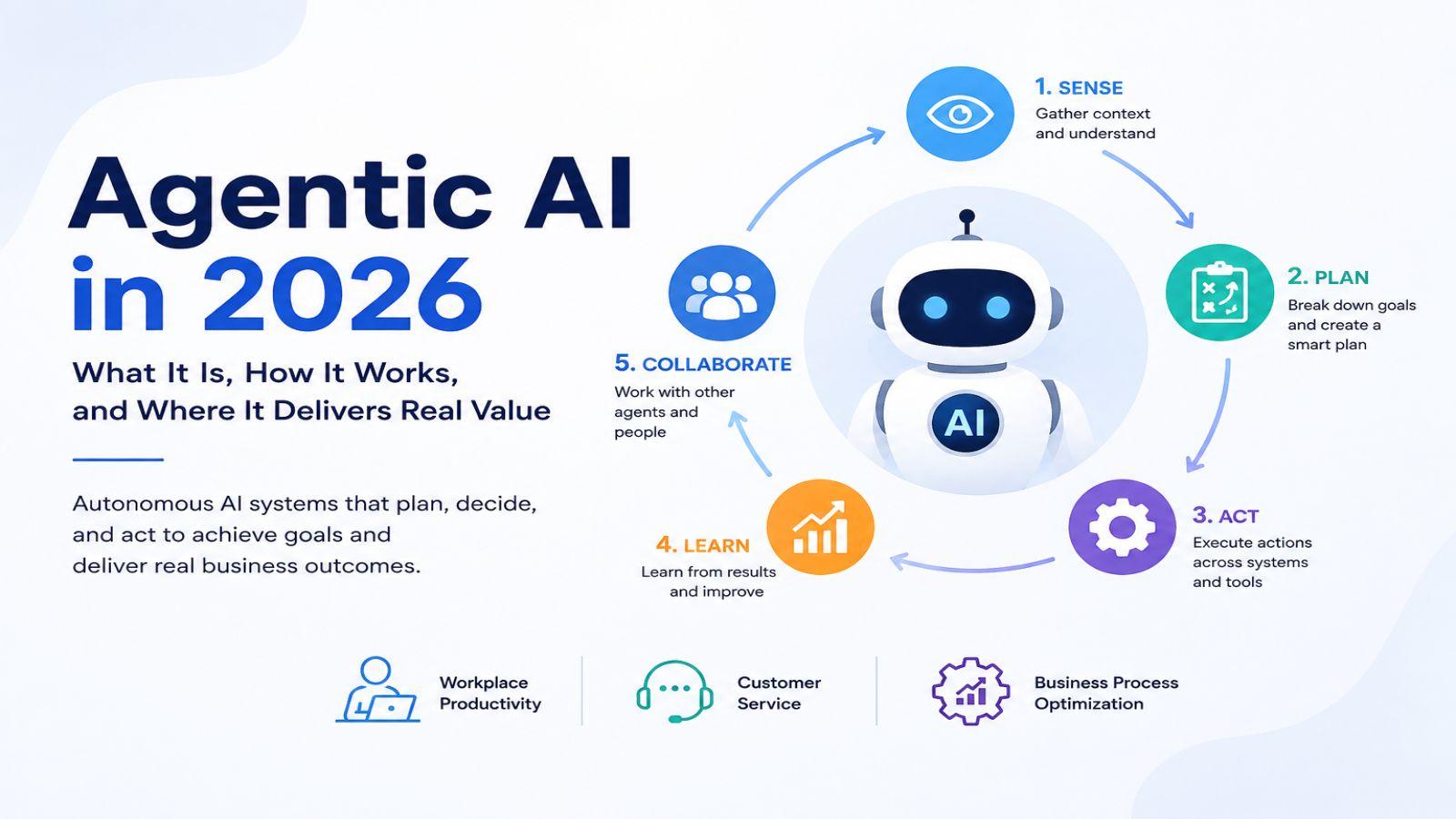
Agentic AI in 2026 What It Is, How It Works, and Where It Delivers Real Value
Discover how Agentic AI is transforming businesses in 2026 by moving beyond simple content generation to autonomous action. Learn how AI agents sense, plan, act, learn, and collaborate across systems to automate workflows, improve customer service, boost productivity, optimize business processes, and deliver measurable results with secure, scalable implementation.

What Is Agentic AI and How Is It Different From a Chatbot
Agentic AI is transforming how businesses automate work by enabling AI systems to plan, reason, use tools, and complete tasks with minimal human input. Unlike traditional chatbots, AI agents can make decisions, execute workflows, and adapt to changing conditions. Discover how Agentic AI works, its real-world applications, benefits, challenges, and why it's shaping the future of business automation.
%20%5B%20New%20Updated%20One%20%5D.png&w=1920&q=75)
The Complete Guide to Building Custom AI Agent Model Development for Non-Developers
Explore custom AI agent model development for non-developers using no-code AI platforms, workflow automation, and business AI solutions.