





Agentic AI in 2026 What It Is, How It Works, and Where It Delivers Real Value

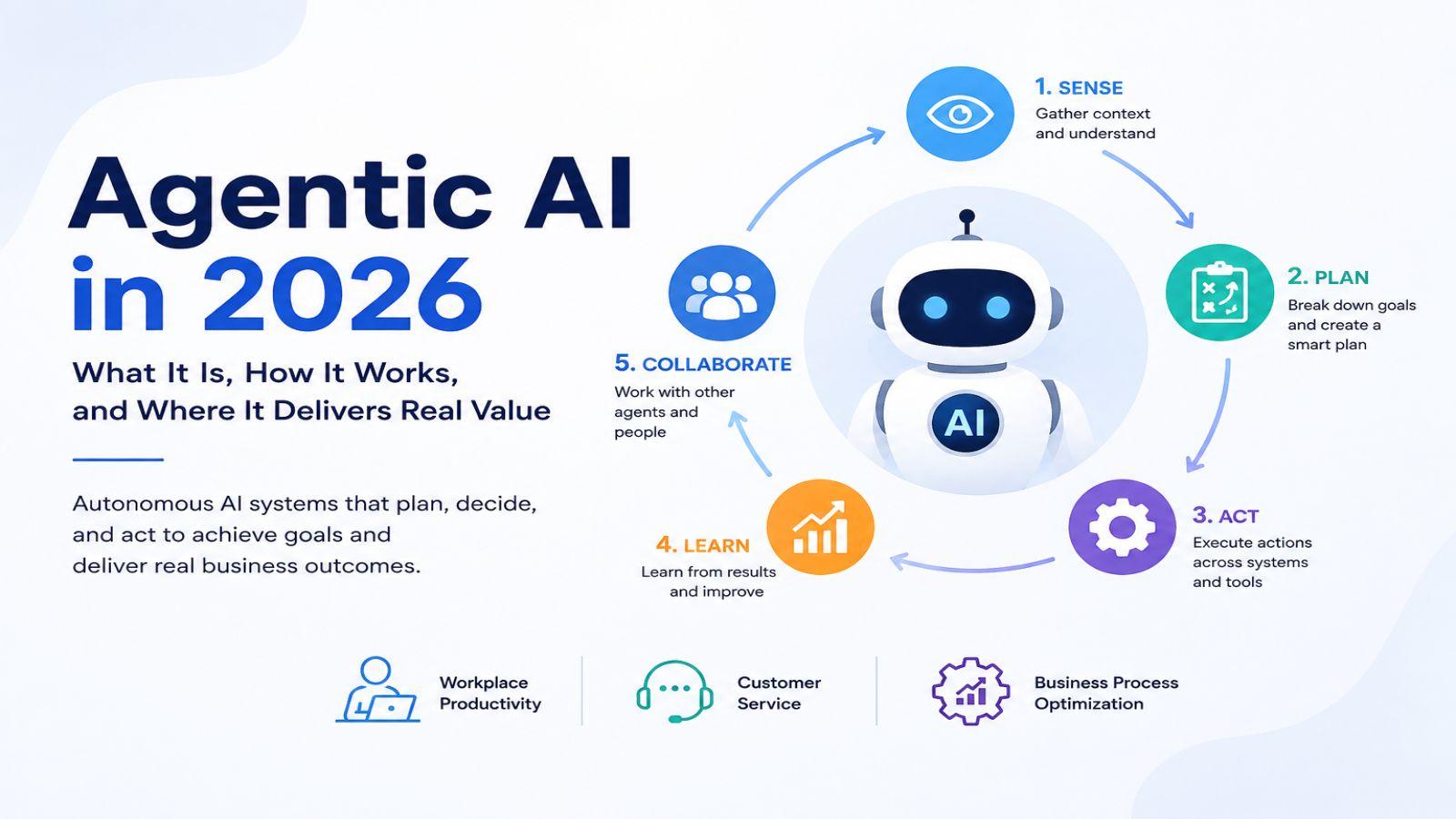
Discover how Agentic AI is transforming businesses in 2026 by moving beyond simple content generation to autonomous action. Learn how AI agents sense, plan, act, learn, and collaborate across systems to automate workflows, improve customer service, boost productivity, optimize business processes, and deliver measurable results with secure, scalable implementation.
Agentic AI refers to artificial intelligence systems that autonomously plan, decide, and act to achieve goals, not just respond to prompts. In 2026, it has moved from research labs into production, and it is quietly redefining what "AI adoption" means inside the enterprise.
For years, most enterprise AI sat on the sidelines waiting for instructions. That era is ending. An agentic system can identify high-intent leads in a CRM, launch personalized outreach, handle replies, and book meetings end to end, without a human touching the workflow. McKinsey reports that banks applying agentic AI to KYC/AML workflows have seen productivity gains ranging from 200% to 2,000%, and the overwhelming majority of enterprises plan to increase AI investment through 2026 and beyond.
This guide explains what agentic AI actually is, how it works under the hood, how it differs from generative AI, and how to implement it without turning autonomy into chaos.
Key Takeaways
Agentic AI is not "smarter GenAI." Generative models create content; agentic systems complete work. The real differentiator is orchestration multi-agent coordination combined with governance is what makes deployments scale. Under the hood, every agentic system follows the same operational loop: sense, plan, act, learn, and collaborate. And enterprises are already deploying it across three broad fronts: workplace productivity, customer service, and business process optimization.
What Is Agentic AI?
In AI, "agentic" means the system has the capacity to make decisions and act independently. Agentic AI, then, is artificial intelligence that doesn't wait for instructions. It pursues goals on behalf of users through autonomous, multi-step action.
Four characteristics define a true agentic system. It understands context and goals well enough to make sound decisions. It decomposes large objectives into smaller, executable tasks. It collaborates across systems, other agents, platforms, APIs, and tools. And it learns from experience, improving its results over time.
The simplest framing: traditional AI helps you answer questions. Agentic AI helps you achieve outcomes.
Why Enterprises Are Embracing Agentic AI Now
Generative AI took the world by storm in 2022. It wrote emails, summarized documents, and chatted convincingly. But beneath the surface, a problem emerged that analysts now call the GenAI Paradox: widespread adoption, limited business value. McKinsey research found that while 78% of enterprises had deployed GenAI in at least one function, roughly 80% reported no meaningful impact on productivity, cost, or revenue.
The reason is structural. Chatbots, copilots, and assistants improve individual productivity, but they don't transform end-to-end business processes. They stop at the surface.
Agentic AI flips that script, and four converging trends explain the timing. First, foundation models that mature modern LLMs support contextual reasoning, memory, and tool use, which makes autonomous agents viable. Second, enterprises went API-first, meaning agents can plug directly into CRMs, ERPs, HR systems, and communication tools. Third, ROI became non-negotiable: as AI budgets grew, boards began demanding measurable returns, and agentic AI delivers them faster because it acts rather than advises. Fourth, architecture shifted from LLM-centric setups to composable "agentic mesh" ecosystems that support multi-agent collaboration under governance.
The bottom line: enterprises no longer want assistants, they want autonomous execution. Gartner predicts that by 2028, a third of enterprise software applications will include agentic capabilities.
How Agentic AI Works
Behind every autonomous action lies a five-stage operational loop.
Sense. The agent gathers context, a customer question, a database change, a system alert and uses an LLM to turn raw signals into meaning. It answers the question: what's happening, and what needs my attention?
Plan. A built-in planner decomposes the goal into steps. Whether resolving a support ticket or optimizing a delivery route, the agent maps the smartest path from A to B and adjusts when conditions change.
Act. Through an orchestrator, the agent executes multi-step workflows against external systems via APIs updating a CRM, triggering a payment, launching an ERP workflow. When it encounters something risky, like a high-value transaction, it follows policy and escalates to a human.
Learn. Every action is logged and analyzed. When something fails, the agent adapts its approach. Techniques like retrieval-augmented generation (RAG) let it reason over long-term organizational knowledge, while memory preserves user preferences and conversation history.
Collaborate. In complex environments, no agent works alone. Agents hand off tasks, share context, and solve problems as a team which is where the real enterprise value emerges.
Agentic AI vs. Generative AI
Generative AI creates; agentic AI completes. GenAI excels at producing text, images, code, and ideas summarizing reports, drafting copy, and brainstorming. But it stops at generation. Agentic AI plans, executes, and learns with autonomy: it triggers workflows, coordinates across systems, and adapts to reach outcomes.
A useful way to think about it: GenAI lowered the cost of generation, while agentic AI is lowering the cost of action. And the two aren't rivals. When an agent launches an outreach campaign, GenAI writes the emails. When an agent triages a ticket, GenAI drafts the response. Together, they turn intent into impact.
The Architecture Behind Agentic AI
At the core of every agentic system sits an LLM, the "brain" that understands language and reasons through problems. But a brain alone can't act. Enterprise-ready agentic architecture wraps that brain in six functional layers.
The orchestrator is the manager: it decides which agents handle which tasks, in what order sequentially, in parallel, or conditionally and merges the results. Without orchestration, multi-agent workflows collapse into duplication and chaos.
The planner converts intent into execution, translating a goal like "launch an outbound campaign" into concrete steps: segment the audience, generate messaging, schedule outreach, track responses. It also keeps actions explainable as a prerequisite for trust.
State and memory provide continuity. Short-term memory maintains flow within a session; long-term memory personalizes experiences over time, remembering what a customer prefers and what worked before.
AI agents themselves are the specialized workhorses one analyzing documents, another detecting fraud, a third routing customers operating solo or as a coordinated team.
The knowledge layer grounds everything in real, current enterprise data. Using RAG, agents anchor their responses in policy documents, CRM records, and domain sources, which minimizes hallucination and keeps outputs compliant.
Finally, tools and APIs turn intelligence into action. Connectors to CRMs, ERPs, HR platforms, and payment systems are what let agents actually move work through the business. Without them, an agent is smart but powerless.
Types of Agentic AI Systems
Agentic AI isn't one-size-fits-all. The right structure depends on task complexity and how much autonomy you can tolerate.
A single-agent system operates independently toward one goal for instance, a support agent that resolves Tier-1 queries, updates records, and sends follow-ups. It's the right choice when tasks are narrow, speed matters, and no cross-functional coordination is needed.
Multi-agent systems are networks of specialized agents collaborating on complex goals, and they come in two shapes. Vertical systems work like a manager and team: a lead agent delegates to subordinates in a top-down sequence ideal for workflows with approvals, compliance checks, and layered decisions, as in finance, HR, and legal. Horizontal systems have no boss: peer agents share context and solve problems collectively, which suits dynamic, cross-departmental work where the path isn't fixed but the outcome matters.
Human-in-the-loop (HITL) systems add human oversight at key decision points. In financial underwriting, for example, agents gather data and draft recommendations while humans approve final decisions. HITL is the right default for high-risk workflows and for organizations early in their agentic journey.
Agent platforms bring everything together: a governed ecosystem of agents, tools, APIs, and data sources built for enterprise-wide deployment is the right choice when multiple agents must interact with diverse systems at scale under shared governance.
Where Agentic AI Delivers: Use Cases That Matter
Workplace productivity. Agents are becoming the digital teammates employees always wanted: coordinating meetings and resolving calendar conflicts autonomously; handling HR onboarding, policy questions, and compliance checks (one global technology company reported an 80% reduction in HR inquiry resolution time within 90 days of deployment); retrieving contextual answers from wikis, CRMs, and policy documents in natural language; and triaging procurement requests while maintaining real-time visibility into spend and risk. McKinsey estimates up to 30% operational cost reduction and 50% faster processing times in agentic enterprise workflows.
Customer service. Agentic AI shifts service from reactive to proactive. Agents detect delivery delays and initiate refunds before customers complain, retain context as conversations move between chat, email, and voice, autonomously manage appointment scheduling and follow-ups, and process returns end to end validating eligibility, issuing refunds, and updating inventory in real time. Gartner predicts that by 2029, agentic AI will autonomously resolve 80% of common customer service issues, and McKinsey finds it can cut time-to-resolution by up to 90%.
Business process optimization. This is where agentic AI flexes hardest: self-healing IT helpdesks that diagnose and patch issues before a ticket is logged; DevOps agents that review code, run tests, deploy releases, and roll back faulty builds; supply chain agents that predict demand shifts and reroute logistics around disruptions; compliance agents that interpret new regulations, scan for non-compliant records, and prepare audit-ready documentation; and quality assurance agents that catch production anomalies early enough to prevent defects rather than merely report them.
Across industries the pattern repeats. Banks use agents to freeze suspicious transactions and automate KYC. Retailers automate restocking and dynamic pricing. Healthcare organizations unify fragmented patient records and automate claims and prior authorization. Telecoms reroute traffic during outages and fix billing errors autonomously. Manufacturers detect quality deviations and adjust production lines in real time.
How to Implement Agentic AI: A Practical Roadmap
Building a demo agent takes minutes. Building an enterprise-grade agentic system takes discipline. The path looks like this.
Start by defining the problem and objectives: pick one or two high-impact use cases with measurable goals, say, cutting L1 ticket handling time by 40% and map the full journey from trigger to resolution, including where human approval is non-negotiable.
Next, audit your processes, data, and systems. Document every workflow the agent will touch, list every system involved, and honestly assess whether your data is fresh, unified, and traceable. This groundwork prevents expensive surprises later.
Then choose the autonomy model based on risk: full autonomy for low-risk repeatable tasks, human-in-the-loop for sensitive workflows, multi-agent setups for cross-domain work.
With scope settled, architect the reasoning layer the LLM core plus planner, orchestrator, memory, and tool router. Plan for tiered models: lighter, cheaper models for routine tasks, more capable ones for critical work.
Define each agent's job description explicitly: what it owns, what it refuses to touch, its triggers, and its failure behavior. Make every agent explainable, with decision logs and rationale summaries.
Build the knowledge layer with RAG pipelines drawing from trusted, access-controlled sources, and enforce answer hygiene citations, evidence checks, anti-hallucination rules.
Integrate tools and APIs with safety as the default: scoped permissions, rate limits, and sandboxes. Then layer in governance and observability: a policy engine defining who can do what, PII masking, adversarial testing, and an audit trail that makes every action reversible.
Finally, pilot before you scale. Run agents in shadow mode (agent suggests, human acts), graduate to approval mode, and only then to full autonomy tracking autonomy rate, intervention frequency, latency, and cost per action along the way.
The Challenges to Plan For
Adoption is not frictionless. Data privacy and security top the list autonomous systems handling sensitive information without direct oversight raise real risks of leakage and prompt injection, which is why governance and audit trails are non-negotiable. Data quality is next: agents are only as good as the data they're connected to, and siloed, stale data produces brittle agents. Integration with legacy systems remains messy, demanding modular design and middleware. Scaling from one agent to a coordinated fleet strains infrastructure in ways pilots never reveal. And the talent to build and maintain these systems remains scarce and expensive, a constraint cited by roughly four in ten organizations.
None of these are reasons to wait. They are reasons to start deliberately: one well-governed use case, proven, then expanded.
Choosing an Agentic AI Platform
Before comparing vendors, define success: which workflows you want to automate, how much autonomy you'll tolerate, what systems and compliance requirements must be supported, and how you'll measure trust and performance.
Then evaluate platforms on six capabilities. Multi-agent orchestration is sequential, parallel, and conditional because isolated bots solve only one-off problems. Human-in-the-loop mechanisms, which build trust in regulated environments. Flexibility across use cases, since adoption inevitably spreads beyond the first department. Security and compliance certifications such as SOC 2, ISO, GDPR readiness, and HIPAA. Built-in governance: audit trails, role-based access, approval workflows, drift detection, and rollback. And independent validation analyst recognition and evidence of real enterprise deployments as a proxy for operational maturity.
The Future: The Agentic Enterprise
The trajectory is clear. The enterprise of the near future will be powered by fleets of specialized agents operating in sync executing tasks, making decisions, adapting in real time while humans steer strategy and set governance. A supply chain leader defines delivery SLAs; agents coordinate logistics and resolve bottlenecks before they surface. A service leader sets experience benchmarks; agents handle inquiries and personalize support across languages and channels.
Gartner projects that by 2028, 15% of day-to-day work decisions will be made autonomously by agentic AI. The organizations that win won't be the ones chasing frameworks and features they'll be the ones designing agents that are outcome-driven, context-aware, and self-improving, with governance strong enough to make autonomy safe.
Agentic AI isn't about building smarter systems. It's about reimagining how work gets done.
FAQs
What does agentic AI mean in simple terms?
It refers to AI systems with agency the ability to set goals, plan multi-step actions, and execute them autonomously. It doesn't just answer questions; it works toward outcomes.
How does agentic AI differ from traditional AI?
Traditional AI follows predefined rules or responds to prompts. Agentic AI proactively sets goals, plans multi-step tasks, adapts to changing context, and acts with minimal human oversight.
Can you build agentic AI from scratch?
Yes, using open-source frameworks but you'll need a reasoning core, a planning module, tool integrations, memory and feedback loops, and a governance layer, plus a team with deep AI expertise. Most enterprises move faster with an established agent platform that provides this infrastructure prebuilt.
Is agentic AI safe for enterprise use?
Yes, when built responsibly. Role-based access, red-teaming, audit trails, and human-in-the-loop oversight allow secure deployment aligned with global compliance standards.
Which AI capability combines autonomy, planning, and tool use?
Agentic AI. Unlike standard models that respond to prompts, agentic systems set goals, decompose them via a planner, and execute steps by interacting with external tools and APIs with minimal human input.

Ready to build your next digital product?
Talk to Zygobit about web apps, mobile apps, AI solutions, automation, and scalable software development tailored to your business goals.
Explore Related Articles
More reading on web, mobile, AI, and product engineering from the Zygobit team.
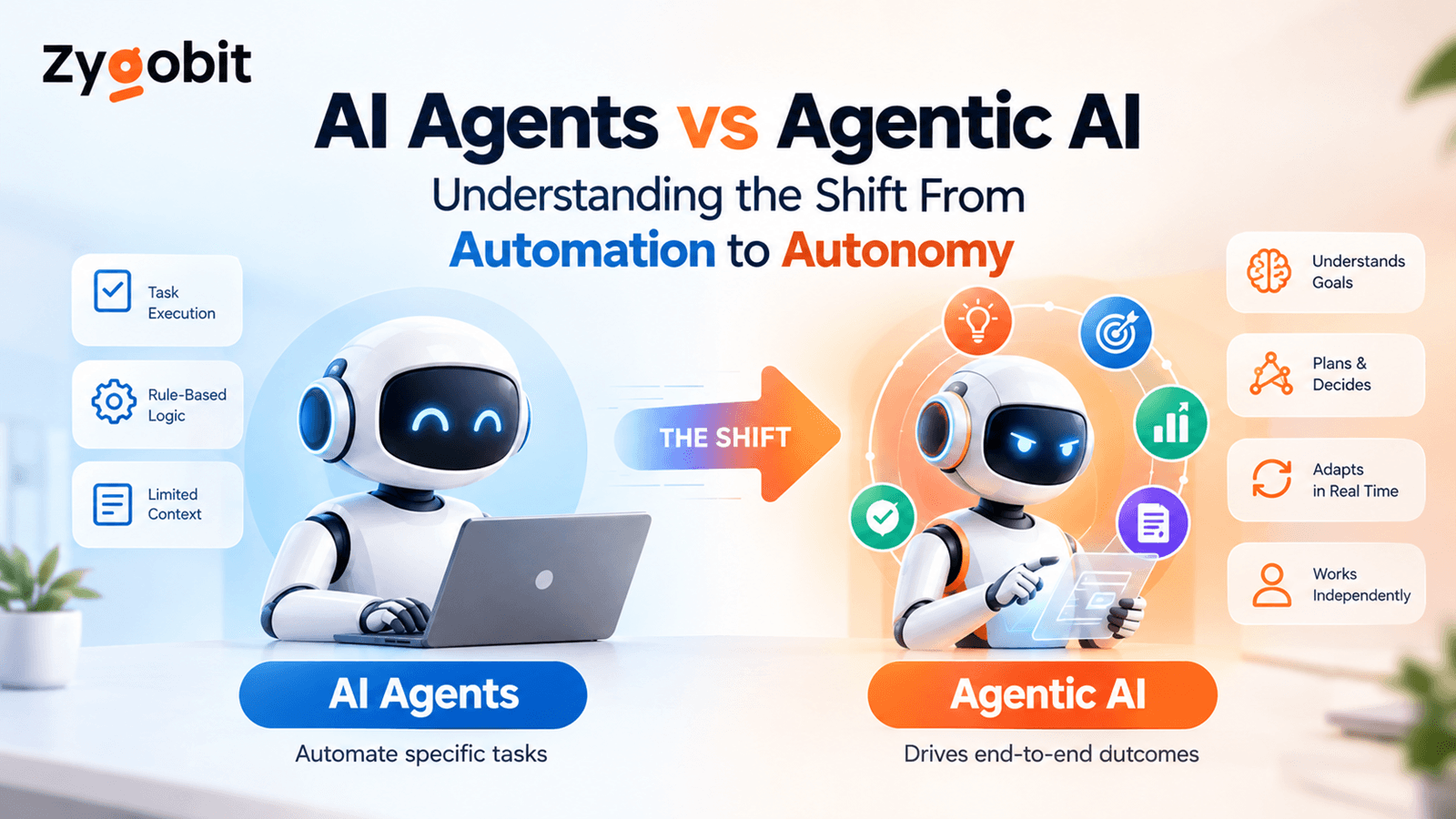
AI Agents vs Agentic AI Understanding the Shift From Automation to Autonomy
AI agents are changing business automation by moving beyond simple responses to intelligent action. This article explains the difference between AI agents and agentic AI, including planning, tool use, workflow orchestration, state management, human approvals, security, observability, and enterprise use cases.

What Is Agentic AI and How Is It Different From a Chatbot
Agentic AI is transforming how businesses automate work by enabling AI systems to plan, reason, use tools, and complete tasks with minimal human input. Unlike traditional chatbots, AI agents can make decisions, execute workflows, and adapt to changing conditions. Discover how Agentic AI works, its real-world applications, benefits, challenges, and why it's shaping the future of business automation.
%20%5B%20New%20Updated%20One%20%5D.png&w=1920&q=75)
The Complete Guide to Building Custom AI Agent Model Development for Non-Developers
Explore custom AI agent model development for non-developers using no-code AI platforms, workflow automation, and business AI solutions.