


AI Contract Review for Small Business, Tools, Costs and Risks

A plain-English guide to AI contract review for US small businesses. What it checks, where it helps, the three ways to get it, what it costs, the risks, when to call a lawyer instead, and how to start this week.
Most small business owners sign contracts the same way. They skim the first page, look for the price, and hope the rest is fine. A lawyer reads every word, but a lawyer costs money and takes days. So the lease, the vendor deal and the client agreement often get signed with only a quick look.
AI contract review sits in the middle. It reads the whole contract in a minute or two, points to the risky parts, and explains them in plain words. It does not replace your lawyer. It helps you know what to ask your lawyer, and it catches the small traps you would have missed on a busy day.
The short answer. AI contract review is software that reads a contract and flags clauses that could hurt you, like auto-renewal, unlimited liability or a one-sided way to end the deal. Small businesses can start with a general AI assistant for a few dollars a month, move to a contract review tool when they sign a lot of contracts, or build a custom review agent for $10,000 to $30,000 when the review must follow their own rules. A person should still approve every contract before it is signed.
What AI contract review is, in plain words
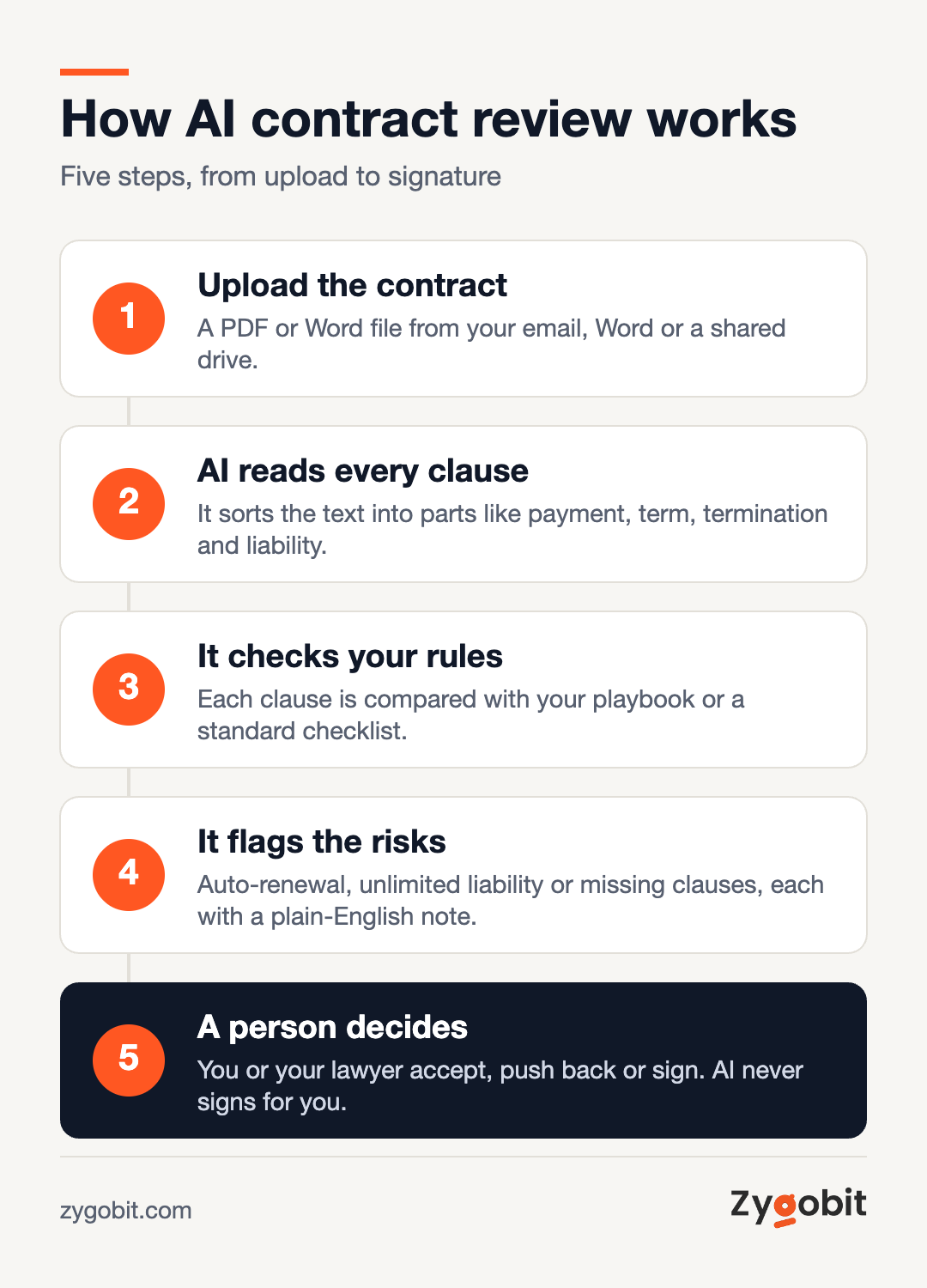
A contract is just a long piece of text with rules in it. AI is now good at reading long text and finding what matters. So an AI contract review tool does what a careful reader does. It reads the contract from start to finish. It sorts the text into clauses, like payment, term, termination and liability. Then it checks each clause and tells you which ones look unusual or risky.
The better tools go one step further. You give them your own rules, often called a playbook. For example, "we never accept unlimited liability" or "payment terms must be 30 days or less." The tool then checks each new contract against your rules and shows where the other side asked for something different. Some tools also suggest new wording you can send back.
It helps to know what AI contract review is not. It is not a lawyer. It does not know your history with the other company. It cannot tell you whether a risk is worth taking for a big customer. Those calls are still yours.
| Way to review | How long it takes | Typical cost | Best for |
|---|---|---|---|
| You read it yourself | 30 to 90 minutes | Your time | Short, simple, low-value deals |
| AI review, then you decide | 2 to 10 minutes | Free to a few hundred dollars a month | Routine contracts you sign often |
| AI review, then a lawyer checks the flags | 1 to 2 days | Less lawyer time than a full review | Bigger deals with some risk |
| Full review by a lawyer | 2 to 7 days | Hourly fee or fixed fee | High-value, unusual or regulated deals |
The times in this table are rough guides from what owners tell us. Your lawyer's speed and fees will vary.
What AI can check in a contract
Most small business contracts carry the same handful of risks. AI is good at finding them because they follow common patterns. Here is what a decent tool should catch.
| Clause | What AI looks for | Why it matters to you |
|---|---|---|
| Auto-renewal | The contract renews unless you cancel by a set date | You can get locked in for another year without noticing |
| Termination | Who can end the deal, how early and at what cost | A one-sided clause can trap you in a bad deal |
| Liability cap | Whether your risk has a limit, and how high | Unlimited liability can cost more than the whole contract is worth |
| Indemnity | Who pays if a third party sues | You may end up paying for the other side's mistakes |
| Payment terms | Due dates, late fees, price increases | Long payment terms hurt your cash flow |
| Intellectual property | Who owns the work, code or designs | You might not own what you paid to have made |
| Non-compete and non-solicit | Limits on who you can work with or hire | It can block future deals or hires |
| Data and privacy | How customer data is stored and shared | A breach can mean fines and lost trust |
| Governing law | Which state's law applies and where disputes go | A dispute in a far-away state costs more to fight |
| Missing pieces | Clauses you expected but are not there | What is missing can hurt as much as what is written |
That last row is where good tools earn their money. A person skimming a contract rarely notices that something is missing. A tool with a checklist does.
Where AI contract review helps a small business most
You do not need AI for every piece of paper. It pays off where contracts are frequent, similar and easy to get wrong. These are the cases we see most often.
Vendor and software agreements
Every new tool you buy comes with terms of service. Many renew on their own and raise prices each year. AI can pull out the renewal date, the notice period and the price rules in seconds, so you can put a reminder in your calendar.
Client agreements and statements of work
If you sell services, clients often send their own contract. It is written to protect them, not you. AI can compare it with your standard terms and show what changed, like a longer payment window or a wider indemnity.
NDAs
Non-disclosure agreements are short and very similar. That makes them perfect for AI. Many teams let the tool approve a standard NDA and only send unusual ones to a lawyer.
Commercial leases
Leases are long and full of costs that are easy to miss, like shared area fees and repair duties. AI can list every cost and every date in one place. A lease is also a big commitment, so a lawyer should still read it.
Hiring and contractor agreements
AI can check that offer letters and contractor agreements match your templates. Worker classification and non-compete rules differ by state, though. Treat AI here as a first check, not the final word.
Three ways to get AI contract review
There are three main paths. Most small businesses start with the first one and move up only when the volume or risk grows.
1. A general AI assistant
Tools like ChatGPT, Claude, Gemini or Microsoft Copilot can read a contract you upload and answer questions about it. You can ask, "List every date, fee and renewal term," or "Which clauses favor the other side?" This is cheap and fast. The weak spots are real, though. The answers change with how you ask. There is no playbook, no record of past reviews, and no link to your other tools. Before you upload anything, check the plan's data settings. Use a business plan that does not train on your files.
2. A ready-made contract review tool
These are built for contracts. Many work inside Microsoft Word, so you review and redline in the same place you already edit. They usually come with clause libraries, playbooks and a way to compare a contract with your template. Spellbook, for example, describes itself on its own site as a Word add-in for review, drafting and playbooks. It sells by the number of users and quotes custom prices after a demo. Juro, a contract management platform, also builds a custom plan based on how many contracts you handle each month. Many tools in this group quote prices only after a call, so ask for a trial and use your own contracts in it.
3. A custom AI review agent
This is a tool built around your process. It can pick up contracts from your email or CRM, check them against your own rules, write a short summary for the owner, and send anything risky to your lawyer. It can also log every review and every decision. This makes sense when you handle many contracts, when your rules are specific, or when off-the-shelf tools do not connect to the systems you use. We explain the building blocks in our guide on AI document processing for business.
| Option | Setup | Fits when | Main limit |
|---|---|---|---|
| General AI assistant | Minutes | A few contracts a month | No playbook, results vary by prompt |
| Ready-made review tool | Days | Steady flow of similar contracts | Fixed features, often per-user pricing |
| Custom review agent | 3 to 14 weeks | High volume or your own rules and systems | Higher upfront cost |
What AI contract review costs
Costs depend mostly on which path you take. The ranges below match the numbers in our AI agent development cost guide, so you can compare like with like.
| Path | Upfront cost | Monthly cost | Notes |
|---|---|---|---|
| General AI assistant | None | Free plans, or a low per-user fee for business plans | Pick a plan that keeps your files private |
| Ready-made review tool | Usually none | Often $50 to $500 a month for small teams, many quote on request | Price usually grows with users or contract volume |
| Custom single-task review agent | $10,000 to $30,000 | $100 to $1,000 to run | One job, like checking NDAs or vendor terms against your rules |
| Custom workflow agent | $40,000 to $80,000 | $100 to $1,000 or more to run | Pulls contracts from email or CRM, routes to a lawyer, logs every step |
Running costs cover the AI model, hosting and storage. They go up with the number and length of contracts you send through.
A simple way to check if it is worth it
Here is a made-up example to show the math. Say your team reviews 20 vendor and client contracts a month. Each one takes about an hour of a manager's time. At a loaded cost of $45 an hour, that is $900 a month. If AI cuts the review to 15 minutes, you save about 15 hours, or roughly $675 a month. A ready-made tool at a few hundred dollars a month pays for itself. A $20,000 custom agent would take a little over two years to pay back on time saved alone. It only makes sense if it also prevents costly mistakes or handles much more volume.
The bigger saving is often harder to count. One missed auto-renewal on a $12,000 software contract costs more than a year of most tools.
The risks, and when not to use AI
AI contract review is useful, but it can go wrong in a few predictable ways. Know them before you rely on it.
- It can be wrong and sound sure. AI sometimes misreads a clause or says a clause is there when it is not. Always click through to the actual text before you act on a flag.
- It does not know your deal. A tough clause may be fine if the customer is worth it. Only you can weigh that.
- Privacy. Contracts hold prices, names and trade secrets. Use tools that do not train on your data, and check where files are stored.
- State law differs. Non-competes, worker rules and consumer terms change from state to state. AI may give a general answer that does not fit your state.
- It is not legal advice. Software cannot be your lawyer. If you work with a lawyer, ask how they want AI used. Many now use it themselves.
Skip AI, or use it only as a first read, for these contracts.
- Selling or buying a business, or taking on investors
- Loans, personal guarantees and anything secured by your home or assets
- Health data, government contracts or other highly regulated deals
- Any contract where you are already in a dispute
For those, go straight to a lawyer. The fee is small next to the risk.
How to start with AI contract review
You can get real value from AI contract review within a week. Here is the order we suggest to owners who ask us.
- Collect your last 10 contracts. Pick the types you sign most, like vendor terms, NDAs and client agreements.
- Write your top five rules. For example, liability capped at the contract value, 30 days to cancel, and payment within 30 days. This becomes your first playbook.
- Test a general AI assistant first. Upload two or three old contracts on a business plan that keeps files private. Ask it to check them against your five rules. See what it finds and what it misses.
- Compare with what you already know. Did it catch the problems you found the hard way? Did it flag things that were not there? This tells you how far to trust it.
- Trial one or two contract review tools. If you sign more than a few contracts a month, try a tool built for it, using the same old contracts.
- Agree on who signs off. Decide which contracts need only an owner check and which always go to a lawyer. Write it down.
- Look at custom only when the tools fall short. If you need the review to follow your own rules, connect to your CRM or handle a high volume, a custom agent may be worth it.
If you get to step seven, our team builds custom AI agents for this kind of work. You can also see more ideas in our AI agents examples by department. Or tell us about your contracts, and we will tell you honestly whether a ready-made tool is enough.
Mistakes we see small businesses make
- Pasting contracts into a free consumer plan. Check the data settings first. A business plan with training turned off is the safe default.
- Trusting the summary and not the contract. A summary is a map, not the ground. Read every clause the AI flags.
- Not writing down your rules. Without a playbook, AI can only say what is common. It cannot say what is right for you.
- Buying a big platform too early. Contract management suites are built for legal teams. A five-person company rarely needs one.
- Forgetting the dates. The most useful thing AI pulls out is often the renewal and notice dates. Put them in a calendar the same day.
Frequently Asked Questions
Can AI review a contract?
Yes. AI can read a contract, sort it into clauses, and flag terms that look risky or unusual, such as auto-renewal, unlimited liability or one-sided termination. It works best as a fast first read. A person should still check the flagged clauses and approve the contract before signing.
Is AI contract review accurate?
It is good at finding common clauses and patterns, but it is not perfect. It can miss context or misread wording. Test any tool on old contracts you already know well before you trust it with new ones.
What is the best AI contract review software for a small business?
It depends on how many contracts you sign. If it is a few a month, a general AI assistant on a private business plan is often enough. If you sign many similar contracts, try two or three tools built for contract review and pick the one that works best on your own documents.
How much does AI contract review cost?
General AI assistants have free and low-cost plans. Contract review tools for small teams often cost $50 to $500 a month, and many quote prices after a demo. A custom review agent usually costs $10,000 to $30,000 to build, plus $100 to $1,000 a month to run.
Can AI replace a lawyer for contract review?
No. AI can cut the time you and your lawyer spend, and it can catch common problems. It cannot give legal advice, weigh business risk or stand behind its answer. Use a lawyer for high-value, unusual or regulated contracts.
Is it safe to upload contracts to AI tools?
It can be, if you choose the right plan. Use a business or enterprise plan that does not train on your data, check where files are stored, and limit who can see them. Avoid free consumer plans for confidential contracts.
Can I use ChatGPT to review a contract?
You can use it as a first read. Upload the contract on a plan that keeps files private and ask clear questions, like listing every date, fee and renewal term. Then check the answers against the contract itself, and send anything important to a lawyer.
This article is general information, not legal advice. For advice on a specific contract, talk to a licensed attorney in your state.

Ready to put an AI agent into production?
Talk to Zygobit about agentic AI development: discovery, build, staged launch and the monitoring that keeps it honest.
Explore Related Articles
More reading on web, mobile, AI, and product engineering from the Zygobit team.

AI Customer Service for Small Business, Costs and Setup
A plain-English guide to AI customer service for small and mid-sized businesses. What it can handle, what it should not, ready-made tool or custom agent, real cost ranges, a worked example, who should wait, and six steps to start.
AI Agents Examples by Department, 26 Real Uses and What They Cost
26 plain-English AI agents examples for customer service, sales, marketing, finance, HR, operations and IT. For each one you see what it does, which tools it plugs into, what a person still checks, and what a first agent costs to run.
AI Agent Development Cost in 2026 and What Businesses Actually Pay
AI agent development cost in 2026 ranges from about $10,000 for a single-task agent to $200,000 or more for autonomous, multi-agent systems. This guide breaks the price down by complexity tier, explains the eight factors that move it, covers the running costs quotes leave out, and shows how to get an accurate estimate.