





The Complete Guide to Building Custom AI Agent Model Development for Non-Developers

%20%5B%20New%20Updated%20One%20%5D.png&w=1920&q=75)
Explore custom AI agent model development for non-developers using no-code AI platforms, workflow automation, and business AI solutions.
Artificial intelligence is no longer the domain of developers, data scientists, or big tech. 2026. Businesses of all sizes are embracing custom AI agent model development for non-developers to automate workflows, increase productivity and scale operations without advanced coding skills.
No-code and low-code AI platforms are growing fast, so entrepreneurs, marketers, operations teams, customer support groups and business owners can now create powerful AI-driven workflows faster than ever before. AI agents are transforming the way businesses operate by automating repetitive tasks, managing customer interactions and optimizing internal processes. The biggest change is that non-technical professionals can now build, train, deploy and manage AI-powered systems using visual interfaces and drag-and-drop automation platforms.
This guide is the ultimate guide to custom AI agent model development for non-developers. It covers how AI Agents work, the main business benefits, development approaches, enterprise use cases, which are the best platforms, how to implement them and common mistakes to avoid.
Create Custom AI Agent Models – No Coding Required
We offer Custom AI Agent Model Development for Non-Developers. This is a process of creating intelligent AI powered systems without the pain of traditional software engineering or machine learning. These AI agents are built to work autonomously with AI, workflow automation, natural language processing and contextual decision making.
What are these new AI Agents able to do that traditional chatbots can not, such as: understand business context, work with documents and data, interact with external tools and APIs, make decisions about workflows, automate repetitive business processes, learn from interactions, and do multi-step tasks. AI agents can operate across departments like customer service, HR, finance, healthcare, logistics, sales, procurement and operations.
Lower operating costs, faster response times, greater productivity and the ability to achieve scalable automation without the need for large development teams are driving companies to focus more on building custom AI agent models for non-developers.
Why Non-Developers Are Creating AI Agents
No-code AI platforms are changing the way AI is built. Previously, to build AI systems you had to know how to program, understand machine learning, manage cloud infrastructure and apply software engineering. Thanks to visual builder platforms and pre-built integrations, even non-technical users can now build AI powered workflows without any knowledge of coding.
That change is also creating a new generation of citizen developers who can automate business processes on their own. AI platforms today include drag-and-drop workflow builders, visual automation tools, pre-trained AI models, API integrations, pre-built templates and conversational AI builders. That makes development that much easier and makes it much easier for businesses of all sizes to adopt AI.
The other big change, of course, is the growing business need for automation. Organizations want the speed of automation, not months of waiting with traditional development cycles.” AI agents speed up and simplify customer support, lead qualification, onboarding, scheduling, reporting and internal workflows.
Sophisticated AI models are also being democratized by user friendly interfaces. “Now non-technical teams can use AI without understanding deep machine learning architecture. Meanwhile, no-code AI development reduces upfront costs by not requiring companies to hire a large team of AI engineers or invest in custom infrastructure.
How Custom AI Agent Models Work
Today's AI agents are combinations of technologies that together perform intelligent tasks for Custom AI Agent Model Development for Non-Developers. Natural Language Processing enables AI agents to comprehend human language, user’s intent and contextual meaning. Retrieval-Augmented Generation (RAG) allows AI agents to pull business-specific information from documents, databases, PDFs, knowledge bases, and internal systems before generating responses. This will increase the accuracy of answers and the understanding of context.
AI agents can also connect with external applications such as CRMs, ERPs, email systems, Slack, Notion, Google Workspace, and customer support platforms. Decision engines enable agents to assess rules, conditions and business logic to automatically discern what to do next. The more sophisticated AI agents will have a history of conversation and some operational memory to allow for better long-term conversations and more personalized experiences.
Benefits of Building a Custom AI Agent Model for the Non-Developer
The operational and strategic advantages for businesses deploying AI agents are numerous. AI agents can automate repetitive workflows, which reduces the amount of manual work across departments and saves companies hundreds of hours of operations work each month. Artificial Intelligence agents also speed up customer support with instant responses, round-the-clock support, multi-lingual communication and automated ticket routing.
Automation allows an organization to grow and reduces operational costs and inefficiencies. AI agents scale with increased workloads, without increased number of people. AI systems can rapidly process large amounts of business data and provide actionable insights that improve business decision making.
The time saved through reduced repetition of administrative tasks can be devoted to more strategic business activities by employees, thus improving their productivity. This makes for a more innovative working environment.
Top Use Cases for AI Agents in 2026
AI agents are becoming more and more central to many industries and divisions. In customer support, AI agents can handle FAQs, appointment scheduling, onboarding, live chat interactions, and ticket management. Sales teams can use AI agents to qualify leads, score prospects, automate follow-up and update the CRM.
HR teams are using AI agents to screen resumes, onboard employees, assist with policies, and provide internal support. AI-powered internal assistants also improve knowledge management, letting employees search company documentation in real time.
AI agents help healthcare organizations with patient scheduling, record keeping and workflow coordination. Finance departments are using AI systems to process invoices, generate reports, reconcile and manage documents. AI agents help e-Commerce companies manage inventory, make product recommendations, engage customers and support orders.
Best Platforms for Creating Custom AI Agent Models (No Developer Required)
There are a number of no-code AI platforms that are democratizing the creation of AI agents for businesses. MindStudio specializes in designing visual AI workflows and provides enterprise-friendly deployment options. FlowiseAI is a visual AI workflow orchestrator, commonly used to build applications with the LLMs.
With n8n you can build tailored automations for your business by combining workflow automation and AI integrations. Voiceflow is a platform to design your conversational AI and customer experience. Relevance AI assists companies in creating AI-powered workflows through automation pipelines and structured business data. Zapier AI helps companies connect their apps and automate workflows with AI-powered logic.
The benefits of each platform will depend on the complexity of the workflow, the need for integration and the scalability goals of the business.
Build vs. Buy: What’s Your AI Strategy?
Many companies are stuck on the choice of building their own AI or utilizing existing platforms. No-code platforms are best suited for companies looking to have faster deployment, lower development costs, easier workflows, internal automation and fast prototyping.
But for companies with complex enterprise workflows, industry-specific compliance requirements, advanced integrations, proprietary business logic and high scalability needs, custom development is often a better choice.
“Now a lot of companies are going hybrid, using no-code tools and custom AI infrastructure. This offers flexibility, and preserves scalability and operational control.
Important Factors for Successful AI Agent Building
Choosing a platform is not the only thing that goes into a good AI implementation. The first step companies should take in building an AI agent is to decide on a clear goal to automate. AI projects without clear objectives can drift, end up with nothing of value and eventually die.
Quality data is also key as AI systems are only as good as the data they are fed. Poor documentation and stale data can degrade AI performance. Human oversight is still necessary to confirm compliance, accuracy and verify decisions made in the automation process.
AI agents should not interrupt the flow of business, but be part of the current flow of business. Businesses deploying AI-powered systems also have to consider security, compliance, data privacy, infrastructure protection and access control.
What Not To Do When Using AI Agents in Your Business
“The challenge for a lot of organizations adopting AI is they try to automate everything all at once rather than starting with one workflow. “Businesses should start with one use case before going into AI implementation across the enterprise.
Another common problem is the lack of data readiness. Badly managed or old business data can cause AI performance and wrong outputs. Operational challenges can also occur when using the wrong platform, as not all AI platforms are built to meet the same business needs.
AI systems require continuous monitoring, testing and optimizing for high performance. Lack of adoption is often caused by a failure to deliver a good user experience. No matter how good the AI system is, it’s useless if employees or customers find it hard to use.
The Future of Building Custom AI Agents for Non-Programmers
The future of AI development is increasingly towards autonomous business systems. In the coming years, AI agents will emerge as collaborative digital workers capable of executing complex operational tasks with minimal or no human intervention.
Important trends that will shape the future are multi-agent systems, autonomous workflow orchestration, voice-enabled AI agents, industry-specific AI assistants, personalized AI copilots, AI-powered decision support systems and enterprise-wide hyperautomation.
As AI becomes more accessible, companies that achieve early wins with AI-driven operations will have a massive competitive advantage. The companies that will combine human expertise with AI-enabled automation will be more productive, lower their operational costs and scale faster in the AI economy.
conclusion
Custom AI agent models are no longer just the playground of software engineers or enterprise tech teams today. No-code and low-code AI platforms have empowered non-technical users to build intelligent automation systems that can transform business operations through Custom AI Agent Model Development for Non-Developers..
In 2026, AI agents are everywhere in business, whether for customer service or sales automation, HR workflows or enterprise knowledge management. But picking a platform is not enough for successful AI implementation. Businesses should prioritize strategy, workflow optimization, data quality, scalability, security, and continuous improvement.
As AI-based business processes continue to proliferate around the world, the companies investing today in the development of custom AI agent models for non-developers are likely to be the market leaders of tomorrow.

Ready to build your next digital product?
Talk to Zygobit about web apps, mobile apps, AI solutions, automation, and scalable software development tailored to your business goals.
Explore Related Articles
More reading on web, mobile, AI, and product engineering from the Zygobit team.
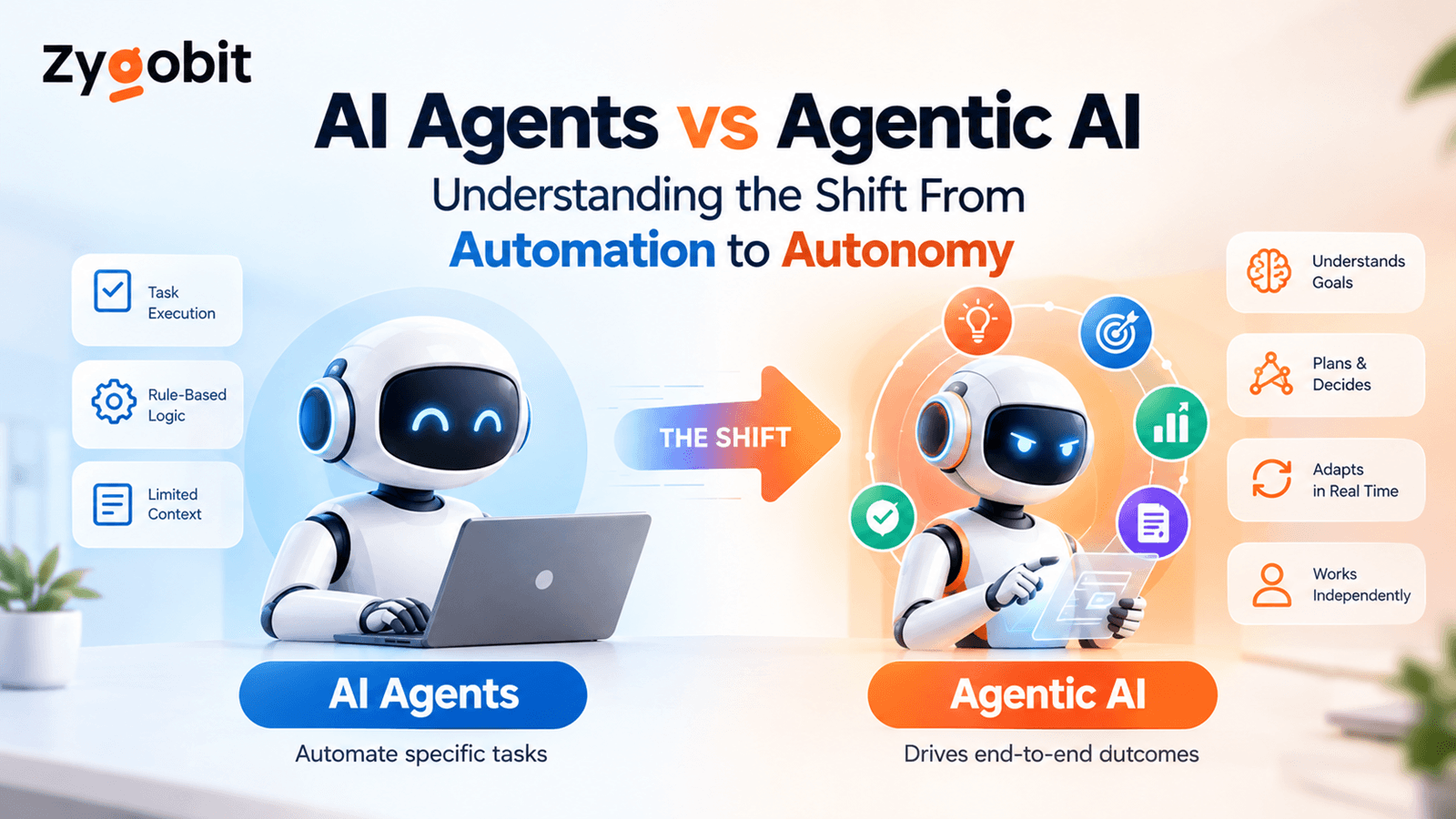
AI Agents vs Agentic AI Understanding the Shift From Automation to Autonomy
AI agents are changing business automation by moving beyond simple responses to intelligent action. This article explains the difference between AI agents and agentic AI, including planning, tool use, workflow orchestration, state management, human approvals, security, observability, and enterprise use cases.
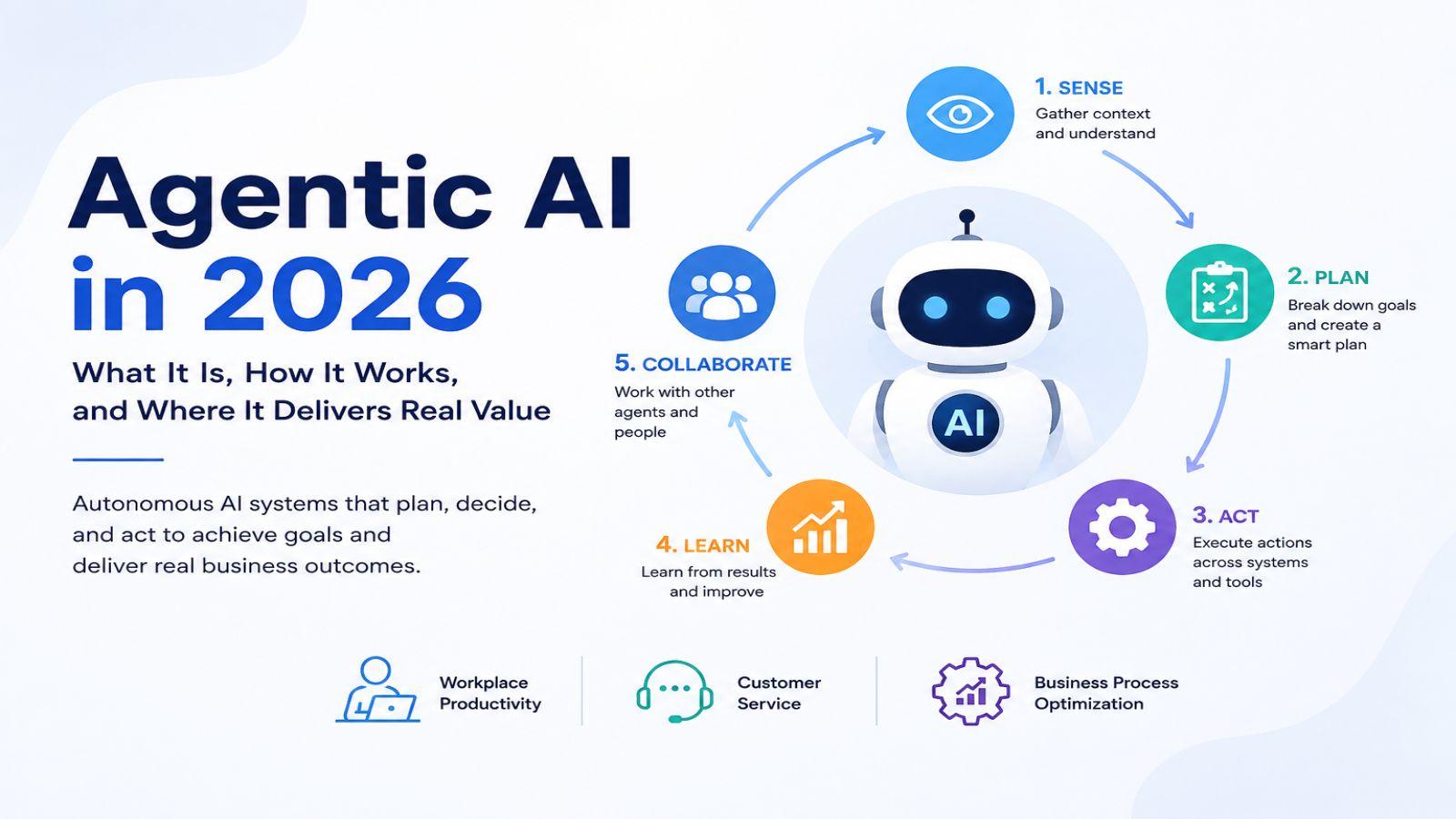
Agentic AI in 2026 What It Is, How It Works, and Where It Delivers Real Value
Discover how Agentic AI is transforming businesses in 2026 by moving beyond simple content generation to autonomous action. Learn how AI agents sense, plan, act, learn, and collaborate across systems to automate workflows, improve customer service, boost productivity, optimize business processes, and deliver measurable results with secure, scalable implementation.

What Is Agentic AI and How Is It Different From a Chatbot
Agentic AI is transforming how businesses automate work by enabling AI systems to plan, reason, use tools, and complete tasks with minimal human input. Unlike traditional chatbots, AI agents can make decisions, execute workflows, and adapt to changing conditions. Discover how Agentic AI works, its real-world applications, benefits, challenges, and why it's shaping the future of business automation.