


AI Voice Agent for Small Business: Costs, Use Cases, and How to Roll One Out

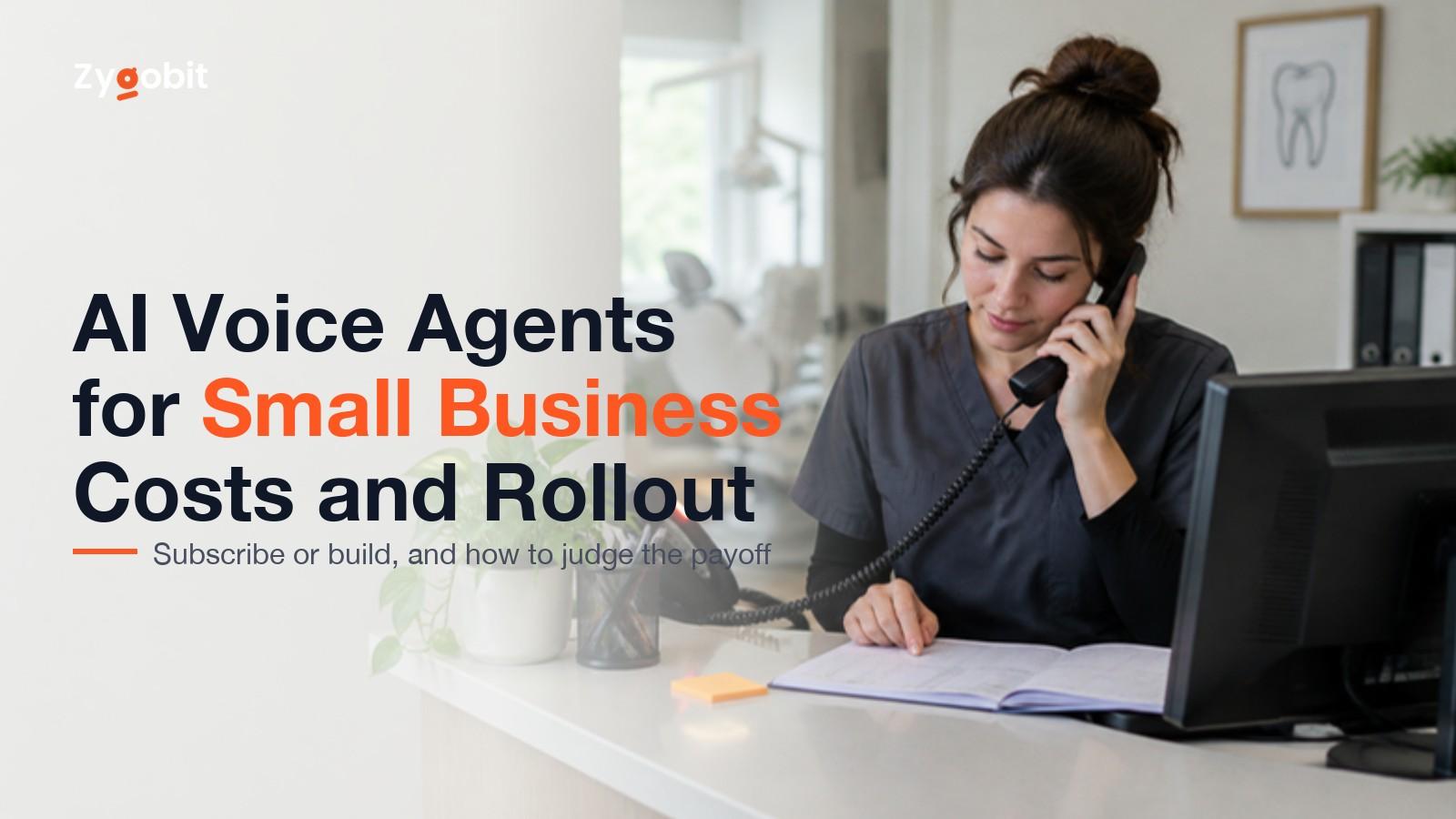
A practical guide to AI voice agents for small businesses: what they do, which businesses benefit most, 2026 costs under subscription, per-minute, and custom-build pricing, the ways they go wrong, a six-step rollout plan, and how to decide between subscribing and building.
Every small business has a version of the same moment. The phone rings at 12:40, both chairs are full, the person at the desk is dealing with someone in front of them, and the call goes to voicemail. The caller does not leave a message. They ring the next place on the list.
That moment is why an AI voice agent for small business has become the most searched-for AI tool among owners this year, ahead of chatbots and general automation. The problem is easy to see and easy to count. What is harder to work out is whether one of these will actually help your business, what it will cost, and how to introduce it without annoying the customers you already have. That is what this guide is for.
What a Voice Agent Actually Does
A voice agent is software that holds a spoken conversation on your phone line. Under the surface there are four pieces working on every call: speech recognition that turns the caller's words into text, a language model that works out what they want and what to say next, text to speech that turns the reply into a natural voice, and the telephony that connects it to your number and handles transfers.
None of that matters to the caller. What matters is what the agent is connected to. Hooked up to your calendar, booking system, or CRM, it can do real work during the call: book or move an appointment, take an order, check stock, capture a lead's details, send a confirmation text. Without those connections it is an answering machine with good manners. The connections are what make it a receptionist.
It is also nothing like the phone menus people hate. There is no "press two for billing". The caller talks normally, interrupts, changes their mind halfway through, and a decent agent keeps up.
Who Actually Benefits
Voice agents pay off where call volume is high, most calls are routine, and a missed call has an obvious cost. The businesses where we have seen the clearest results:
Dental, medical, physio, and veterinary clinics. Booking, rescheduling, reminders, insurance questions, and after-hours triage to an on-call number. Clinics tend to miss the most calls and have the most predictable ones.
Trades and home services. Plumbers, HVAC, electricians, cleaners. Capturing the job details and address while the owner is under a sink somewhere, quoting the standard call-out fee, booking the next slot.
Restaurants and cafes. Reservations, hours, directions, takeaway orders, and the large-party enquiry that comes in during service when nobody can get to the phone.
Salons, spas, and gyms. Bookings, cancellations, membership questions, waitlists.
Real estate and property management. Qualifying buyer and tenant enquiries, booking viewings, logging maintenance requests at two in the morning.
Legal, accounting, and consulting practices. Intake of new enquiries with the details needed for a conflict check, scheduling consultations, routing existing clients to the right person.
Online stores. Order status, returns, and stock questions that otherwise go unanswered or pile up in email.
Now the other side. If you get ten calls a day and eight of them need your personal judgement, a voice agent will not do much for you. Low volume or high complexity means the maths does not work, and we would rather say that up front than sell you something you will cancel in three months.
What It Costs
There are three ways to pay, and which one makes sense depends on call volume and how much the agent needs to do.
Subscription products
Ready-made AI receptionist services for small businesses run from about $30 a month for a capped number of calls up to $300 a month for unlimited, round-the-clock cover with booking integrations. Most owners land between $100 and $300. Set-up takes a day and needs no developer. The trade-off is that the agent only connects to the systems the vendor supports, follows the vendor's scripts, and your call data lives on their platform.
Pay-per-minute platforms
Platforms built for businesses that want to configure their own agent charge by the minute, commonly $0.07 to $0.50 all-in depending on voice quality and the model behind it. A small business handling 500 to 2,000 call minutes a month would spend roughly $50 to $500 on usage, plus whatever time it takes to set up and maintain. This suits businesses with a technical person on staff or a partner who sets it up.
Custom-built agents
When the agent has to work inside your own systems, follow complicated rules, handle regulated data, or run at a volume where per-minute pricing gets expensive, building is the better route. A basic custom voice agent runs about $5,000 to $15,000, a mid-level one with several integrations $15,000 to $50,000, and agents with complex workflows, compliance requirements, or multiple languages go above that. Running costs are the underlying speech, model, and telephony usage, which at volume is usually well under a platform's per-minute price, plus maintenance.
In short
- Subscription receptionist: $30 to $300 a month. Fine for under 1,000 calls a month with standard bookings and questions.
- Pay-per-minute platform: $0.07 to $0.50 a minute. For businesses that can configure their own agent and want flexibility.
- Custom-built agent: $5,000 to $50,000 to build, plus usage. For your own systems, complicated rules, regulated data, or high volume.
The costs people forget to ask about
Onboarding fees on subscription products. Integration charges for connecting a calendar, CRM, or booking system. Premium voices, voice cloning, extra languages. Concurrent call limits, meaning whether the agent can take three calls at once during a rush or makes two of them wait. Call recording storage and where it lives, which matters in healthcare and finance. And overage pricing once you go past the plan's minutes, which is where a $99 plan quietly becomes a $240 one.
Working Out Whether It Will Pay
You can do this on the back of a receipt. Three numbers: how many calls you miss a week, what share of them would have become a booking or a sale, and what an average booking is worth.
Say a dental practice misses 25 calls a week, mostly over lunch and after five. If a third would have booked and a first appointment is worth $150, that is roughly $1,250 a week, call it $5,000 a month, in appointments that never happened. A $200 a month subscription that recovers even a quarter of them pays for itself several times over. Do the same sum for a business that misses three calls a week and you get a very different answer, which is the point.
Then add the staff time back in. A front desk spending two hours a day on routine calls gets most of that back. And be honest about the costs on the other side: the fee, the set-up, and a few hours a month reading transcripts and fixing the agent's answers, because you will need to do that.
Where Voice Agents Go Wrong
The failure modes are well known by now. Almost all of them can be designed out, and the ones that cannot can at least be caught.
Misheard names, addresses, and numbers. Speech recognition still trips on unusual names, street names, and phone numbers read quickly. A good agent repeats these back and confirms before booking anything. A bad one books "Jon" as "John" and texts the confirmation to the wrong number.
Confident wrong answers. Asked something outside what it knows, the agent should say so and offer to take a message, not improvise an opening time or a price. Limit what it may say to what you have given it, and test the edges deliberately.
Trapping callers who want a person. Nothing damages trust faster than an agent that will not transfer. Every caller should be able to reach a person or leave a message by asking, at any point.
Lag, and talking over people. A pause of more than a second before each reply feels robotic. An agent that keeps talking when the caller interrupts feels rude. Test both with real calls before going live, and favour providers who will run a live demo on your own script rather than a canned one.
Recording consent and sensitive data. Call recording rules differ by state, and some require every party to be told. Agents handling health or payment information need the same safeguards as any other system that touches that data. Ask what is recorded, where it is stored, and for how long, and get the answer in writing.
Rolling One Out Without Upsetting Anyone
- Listen to your calls first. Pull a week of call logs, or sit near the phone for two days. Write down the ten most common reasons people ring and what a perfect answer sounds like. That becomes the agent's script and its knowledge.
- Decide what it may do on its own. Book a standard appointment: yes. Quote a custom job: take details, promise a callback. Cancel a booking: confirm who they are first. Write these down; they will become the rules.
- Start with overflow and after-hours only. Let the agent take the calls you were missing anyway. Nobody is worse off, and you get real transcripts to learn from.
- Read the transcripts every week for the first month. Fix wrong answers, add missing ones, tighten the hand-off rules. This is where most of the quality comes from, and it is the step people skip.
- Tell callers it is an AI assistant. Say it up front. It avoids the awkward moment later, and most callers do not mind as long as they get what they rang for quickly.
- Expand to daytime once the numbers are good. Track missed calls, bookings the agent made, transfers to staff, and complaints. Widen its role as those improve, not before.
Subscribe or Build
For most small businesses, a subscription is the right first step. Cheap to try, quick to set up, good enough for bookings and the common questions. Move to a custom build when at least one of these is true:
- The agent has to work inside software the vendors do not support: a practice management system, your own ordering system, an internal job board.
- Your rules are complicated. Multi-location routing, pricing that depends on several things, escalation paths that differ by caller.
- You handle regulated data and need control over where recordings and transcripts live.
- Your call volume is high enough that per-minute pricing costs more than running your own.
- You want the agent to be one part of a wider automation, creating the job, dispatching the technician, texting the customer, rather than a stand-alone receptionist.
If several of those apply, a custom agent is usually cheaper over two years and considerably more useful. We wrote up how custom agents are priced separately, and our guide to AI automation for small businesses shows where a voice agent sits among the other things worth automating.
How We Build Them
Our voice agent work at Zygobit starts with your real calls rather than a generic script. We map the common call types, agree what the agent may do on its own, connect it to your booking or CRM system, and launch it on overflow and after-hours calls first, with weekly transcript reviews until the numbers justify daytime cover. Our engineers are in Mohali, India, and we have a US office in East Windsor, New Jersey, which keeps custom work within reach of a small business budget.
If you are weighing a subscription against a custom build, get in touch or book a 30-minute call on Calendly. Bring a week of call logs if you have them. The conversation is a lot more useful with real numbers in it.
The Short Version
An AI voice agent for small business is worth it when you miss calls that would have become customers, most of your calls are routine, and you are willing to spend a few hours a month reading transcripts while it learns. Start with a subscription on overflow and after-hours calls, measure recovered bookings against the fee, and move to a custom build only when your systems, rules, or volume demand it.
Frequently Asked Questions
How much does an AI voice agent cost for a small business?
Subscription AI receptionists typically cost $30 to $300 a month. Pay-per-minute platforms charge roughly $0.07 to $0.50 a minute. A custom-built voice agent runs from about $5,000 for a basic agent to $50,000 or more for complex integrations, plus usage and maintenance.
Can an AI voice agent book appointments?
Yes, when it is connected to your calendar or booking system. It can check availability, book, reschedule, and cancel, and send a confirmation by text or email. Without that connection it can only take a message.
Will callers know they are talking to an AI?
Modern voices are natural enough that many callers do not notice, but the agent should say it is an AI assistant at the start of the call. That is both honest and, in some places, legally expected.
What happens when the AI cannot handle a call?
A well-configured agent transfers to a person during business hours, or takes a detailed message and sends it to the right staff member after hours. Any caller who asks for a person should get one or a callback.
Is it safe for medical or financial information?
It can be, with the right safeguards: encrypted storage, clear recording consent, limited retention, and a provider or build that follows the rules for your industry. Ask exactly what is recorded, where it is stored, and who can access it before going live.
How long does it take to set up?
A subscription product can be live in a day. A custom agent connected to your own systems typically takes four to ten weeks, including testing on real calls before launch.
Should I replace my receptionist with one?
Most small businesses use the agent to cover the calls their staff cannot take: after hours, overflow, and routine bookings. The receptionist keeps the calls that need judgement and gets time back for the people standing in front of them.

Ready to build your next digital product?
Talk to Zygobit about web apps, mobile apps, AI solutions, automation, and scalable software development tailored to your business goals.
Explore Related Articles
More reading on web, mobile, AI, and product engineering from the Zygobit team.
AI Automation for Small Businesses: What to Automate First, What It Costs, and a 30-Day Plan
A practical guide to AI automation for small businesses: the five areas to automate first (enquiries, phone calls, documents, support, bookkeeping prep), what to leave alone, realistic 2026 costs for subscription tools versus custom work, a 30-day first project plan, and the mistakes that waste money.
AI Agent Development Cost in 2026: What Businesses Actually Pay
AI agent development cost in 2026 ranges from about $10,000 for a single-task agent to $200,000 or more for autonomous, multi-agent systems. This guide breaks the price down by complexity tier, explains the eight factors that move it, covers the running costs quotes leave out, and shows how to get an accurate estimate.
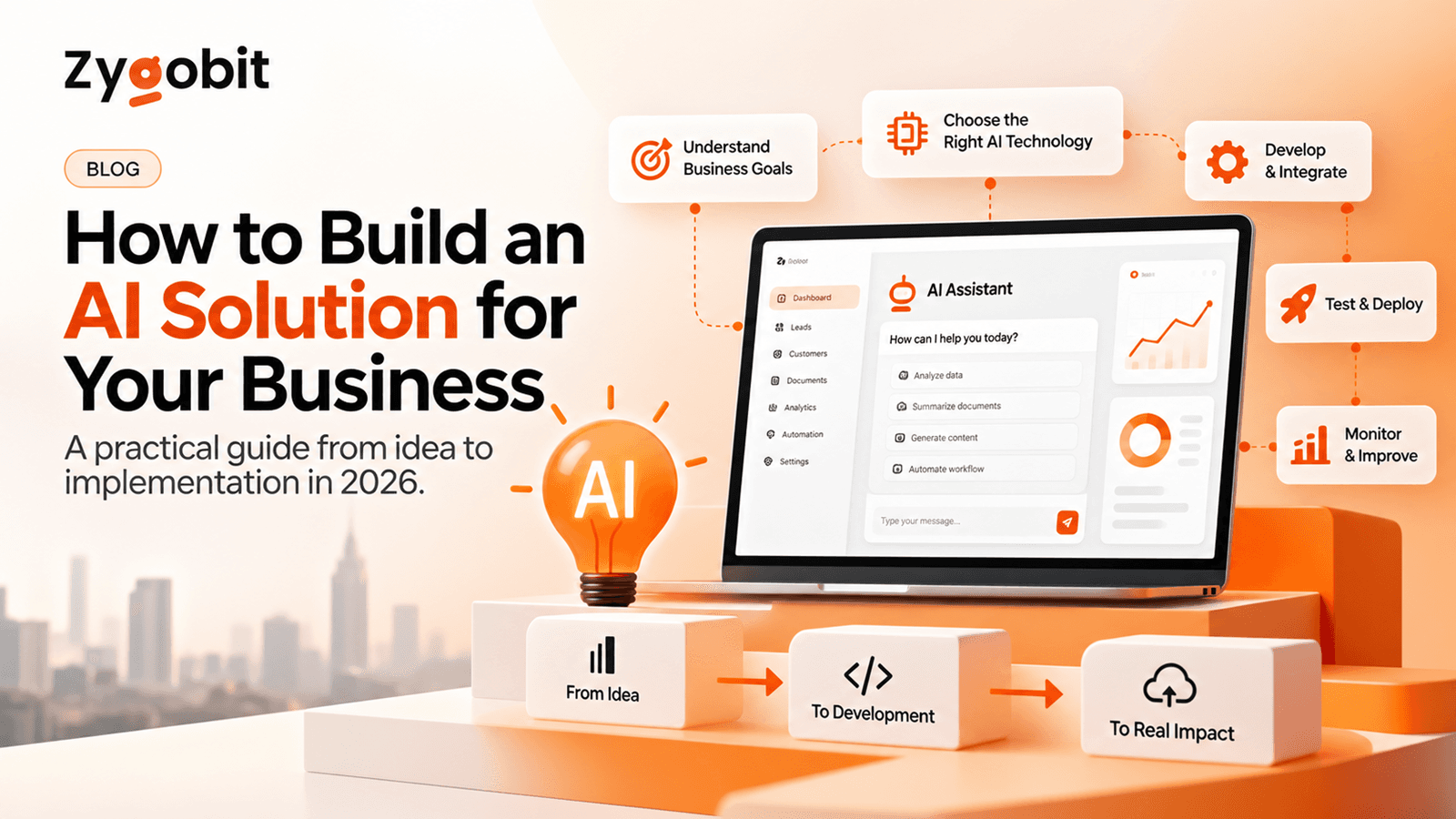
How to Build an AI Solution for Your Business: A Practical Guide for 2026
Learn how to build an AI solution for your business in 2026. Explore custom AI development, AI integration, machine learning, and automation. Discover the key steps from planning and choosing the right technology to development, testing, and deployment to create scalable, secure, and cost-effective AI solutions.