





Digital Marketing Services The Complete Guide to Growing Your Business Online in 2026


Digital marketing services help businesses increase online visibility, attract qualified leads, and drive measurable growth through SEO, PPC, content marketing, social media, email campaigns, and conversion optimization. This complete 2026 guide explains the most effective digital marketing strategies, costs, benefits, and how to choose the right services to grow your business and maximize ROI.
The way customers discover, evaluate, and buy has moved almost entirely online and the businesses that win are the ones that show up at every one of those moments. That is what digital marketing services exist to do: connect your brand with the right people, on the right channel, at the right time, using data to prove what works and cut what doesn't.
The scale of the shift is hard to overstate. Global digital advertising spend is set to surpass $1 trillion for the first time in 2026, with digital now accounting for roughly 69% of all advertising investment. Meanwhile, businesses earn an average of $5 for every $1 spent on digital marketing when campaigns are well planned. The opportunity is enormous but so is the noise, which is exactly why a clear understanding of each service matters.
This guide breaks down what digital marketing services are, the core services that move the needle, how they work together, how much they cost, and how to choose the right partner or build the right in-house mix. Whether you're a startup founder, a small-business owner, or a marketing lead, you'll leave knowing exactly where to focus.
What Are Digital Marketing Services?
Digital marketing services are the specialized activities, strategies, and tools used to promote a brand, product, or service across digital channels, search engines, social media, email, websites, and paid advertising platforms. Rather than a single tactic, they form an interconnected system designed to attract the right audience, guide them through the buying journey, and turn attention into measurable business results.
The defining advantage of digital marketing over traditional advertising is measurability. Every click, impression, and conversion can be tracked, attributed, and optimized. That means budgets of any size can compete, campaigns can be tested and refined in real time, and spend can be steered toward whatever is actually generating revenue.
It's worth distinguishing strategy from services. Strategy is the plan who you're targeting, what message you're using, and which channels fit your goals. Services are the specialized capabilities you deploy to execute that plan. The best results come when the two are aligned around clear business objectives rather than vanity metrics like follower counts or raw traffic.
The Core Digital Marketing Services That Drive Results
No single service works in isolation. Below are the essential digital marketing services, what each one does, and where it fits in your growth strategy.
1. Search Engine Optimization (SEO)
SEO is the practice of optimizing your website and content so it ranks higher in organic search results. When someone searches for a problem your business solves, SEO is what puts you in front of them without paying for each click.
Effective SEO spans several disciplines: technical SEO (site speed, mobile-friendliness, crawlability), on-page SEO (keywords, meta descriptions, headings, internal links), content SEO (answering search intent with genuinely useful pages), and off-page SEO (earning authoritative backlinks). Increasingly, it also means optimizing for AI-driven search.
$22 for every $1 the average ROI delivered by SEO, one of the highest of any channel.
A major 2026 shift is the rise of AI search. Traffic from AI tools is up more than 500% year over year, and roughly a third of Gen Z now uses AI chatbots to find information. Content that ranks today must be clearer, better structured, and more directly answer-oriented so it can be surfaced both by traditional search and by AI overviews.
2. Content Marketing
Content marketing is the creation and distribution of valuable, relevant content blogs, videos, ebooks, webinars, guides, and more to attract and retain a clearly defined audience. Instead of interrupting people with ads, it earns attention by being genuinely useful.
Content is the fuel for nearly every other service: SEO needs pages to rank, social media needs posts to share, email needs something worth sending, and paid campaigns need landing pages that convert. Diversifying across formats a blog paired with a short video, a gated ebook, or a webinar dramatically widens your reach and lead-generation potential.
AI has reshaped how content is produced. Over 80% of marketers now use AI in content creation, and teams that adopted AI tools publish significantly more per month. The winners, however, pair AI efficiency with human expertise, originality, and brand voice because search engines and audiences alike still reward genuine authority.
3. Social Media Marketing
Social media marketing uses platforms like Instagram, LinkedIn, TikTok, Facebook, and X to build brand awareness, engage audiences, and drive traffic. With roughly 5 billion people on social media worldwide, it offers unmatched reach and precise targeting by age, location, and interest.
Beyond promotion, its real power is community. Meaningful engagement turns customers into advocates who promote your brand unprompted. Each platform has its own culture, format, and metrics, so a strong approach tailors content per channel and includes social listening monitoring conversations to understand what your audience actually cares about. Global social ad spend alone is projected to reach roughly $220 billion in 2026.
4. Pay-Per-Click & Paid Advertising (PPC)
Paid advertising lets you buy visibility on search engines, social platforms, and display networks paying only when someone clicks (PPC) or based on impressions. Where organic tactics build momentum over months, paid channels deliver targeted reach almost immediately, making them ideal for launches, promotions, and testing.
The appeal is control and clarity: you set a budget, target specific audiences, and see results in real time. You can A/B test imagery, copy, and calls-to-action to learn what resonates, then feed those insights back into your organic strategy. Google Ads returns roughly $8 for every $1 spent, and paid search delivers an average 200% return when campaigns are well managed.
5. Email Marketing
Email marketing remains one of the highest-performing digital marketing services and it isn't close. It delivers around $36 for every $1 invested, the best ROI of any channel. As third-party cookies disappear and privacy concerns grow, email's reliance on first-party data (people who've opted in) makes it more valuable than ever.
$36 for every $1 the average return on email marketing, the highest ROI of any digital channel.
Its strength is personalization and segmentation: you can tailor messages by behavior, interest, and purchase history. AI-powered automation now makes it easy to send the right follow-up at the right moment for example, recommending a related resource to everyone who downloaded a particular guide driving click-through and conversions at scale.
6. Influencer & Partnership Marketing
Influencer marketing partners your brand with creators who have earned the trust of a targeted audience. Done well, it delivers authentic reach and social proof that traditional ads struggle to match. The key is fit over follower count and an engaged, relevant niche audience outperforms a large but indifferent one.
Collaboration can take many forms: sponsored content, product gifting, giveaways, channel takeovers, event hosting, or commissioned original content. A clear brief aligning goals, audience, and messaging is essential to keep both sides on the same page.
7. Analytics, Conversion Rate Optimization & Marketing Automation
The service that ties everything together is measurement. Analytics and conversion rate optimization (CRO) turn raw data into decisions identifying which channels drive revenue, where visitors drop off, and how to improve the journey from click to customer.
Marketing automation layers on efficiency: segmenting audiences, scoring leads, and nurturing prospects through timely, relevant sequences without manual effort. AI-driven campaigns now deliver around 22% better ROI than traditional ones, and teams using AI strategically report 44% productivity gains which is why analytics and automation have become foundational rather than optional.
How Digital Marketing Services Work Together
The biggest mistake businesses make is treating each service as a separate silo. In reality, they compound. A single blog post can rank in search (SEO), be shared across social media, be repurposed into an email, and serve as the landing page for a paid ad, one asset working across four channels.
A typical integrated flow looks like this:
1. Attract SEO and paid ads bring the right people to your site.
2. Engage content and social media build trust and answer questions.
3. Capture gated content and enticing offers convert visitors into leads.
4. Nurture email and automation guide leads toward a decision.
5. Convert & Retain optimized journeys turn leads into loyal, repeat customers.
6. Measure & Refine analytics reveal what's working so you double down and cut what isn't.
How to Choose the Right Digital Marketing Services
There's no universal formula; the right mix depends on your goals, audience, budget, and stage of growth. These principles help you decide where to invest first.
Start with your business goals
Are you trying to build awareness, generate leads, drive online sales, or retain existing customers? Awareness leans toward social and content; immediate leads favor PPC; long-term growth rewards SEO and email. Define the outcome before the tactic.
Know your customer deeply
Build clear buyer personas: where your audience spends time online, what language they use, and what pain points drive their decisions. This determines which channels are worth your budget and how to speak to people once you reach them.
Match services to your budget and timeline
Need results this quarter? Paid channels deliver fastest. Building durable, compounding growth? SEO, content, and email pay off over time and lower your cost per acquisition as they mature. Most businesses blend both paid for momentum, organic for the long game.
Prioritize measurement from day one
Set key performance indicators tied to real business goals, not vanity metrics. Review at regular intervals, isolate what's underperforming, and reallocate. The ability to research, plan, and refine is what separates campaigns that scale from spend that leaks.
In-House, Freelance, or Agency: Who Should Deliver Your Services?
Once you know which services you need, the next decision is who executes them. Each model has trade-offs.
• In-house team: Deep brand knowledge and full control, but higher fixed costs and a narrower skill range. Best for established brands with consistent, ongoing needs.
• Freelancers: Flexible and cost-effective for specific, well-defined tasks, though harder to scale and coordinate across channels.
• Agency: Access to a full spectrum of specialists, tools, and integrated strategy without hiring each role. Ideal when you need multiple services working together and measurable accountability.
Many growing businesses use a hybrid: a lean internal team owning brand and strategy, supported by a specialist partner for execution across SEO, paid, content, and analytics.
How Much Do Digital Marketing Services Cost?
Pricing varies widely by scope, competitiveness of your market, and the level of expertise involved. Rather than fixed numbers, focus on how pricing is typically structured more importantly on return rather than raw cost:
• Monthly retainers a set fee for an ongoing bundle of services; common for SEO, content, and social.
• Project-based pricing a one-time fee for a defined deliverable such as a website or campaign.
• Percentage of ad spend common for paid media management, typically a share of the budget managed.
• Performance-based fees tied to results like leads or revenue generated.
The right lens is ROI, not price tag. A service that costs more but returns $22 for every $1 (as SEO does on average) is far cheaper than a bargain that returns nothing. AI is also reshaping the equation. Companies using it strategically report around 37% lower marketing costs and 29% lower customer-acquisition costs.
Digital Marketing Services in 2026: What's Changing
The fundamentals know your customer, deliver value, measure everything are timeless. But several forces are reshaping how services are delivered:
• AI everywhere: 91% of marketing teams now use AI, from content creation to campaign optimization. It amplifies output but doesn't replace strategy or originality.
• AI-driven search: With AI search traffic up over 500% year over year, optimizing to be cited by AI answers is now part of SEO.
• First-party data: As cookies fade, owned channels like email and communities grow more valuable for reaching audiences you actually control.
• Outcome-driven spend: Marketers are shifting from vanity metrics to measurable business results, demanding accountability from every channel.
• Mobile-first: Smartphones are projected to drive roughly 69% of total ad spending, making mobile experience non-negotiable.
Final Thoughts: Building Your Digital Marketing Engine
Digital marketing services aren't a menu of disconnected tactics they're the components of a single growth engine. SEO and content build lasting visibility, paid ads deliver immediate reach, social media builds community, email drives loyal revenue, and analytics keeps the whole system honest and improving.
The businesses that win in 2026 won't be the ones doing everything they'll be the ones doing the right things well, aligned to real goals, and refined by data. Start with your objective, understand your customer, choose the services that fit, and measure relentlessly. Do that, and every dollar you invest works harder.
Ready to put these services to work? Start with your objective, choose the channels that fit your goals, and invest in integrated digital marketing services that turn online attention into measurable, compounding growth.
Frequently Asked Questions About Digital Marketing Services
What is included in digital marketing services?
Digital marketing services typically include search engine optimization (SEO), content marketing, social media marketing, pay-per-click and paid advertising, email marketing, influencer and partnership marketing, and analytics with conversion rate optimization. Most providers bundle several of these together into an integrated strategy tailored to your goals, rather than selling them as isolated tactics.
Which digital marketing service is most effective?
There is no single "best" service effectiveness depends on your goals, audience, and budget. That said, email marketing consistently delivers the highest ROI (around $36 for every $1), while SEO offers the strongest compounding long-term returns (about $22 for every $1). Paid advertising is most effective when you need immediate, targeted traffic. The greatest impact usually comes from combining several services so they reinforce one another.
How long does it take to see results from digital marketing?
It varies by channel. Paid advertising can generate traffic and leads almost immediately, while SEO and content marketing typically take three to six months (or longer) to build momentum before compounding. Email and social media fall in between. A balanced strategy pairs fast-acting paid channels with slower-building organic ones so you see both short-term wins and durable growth.
Do small businesses need digital marketing services?
Yes. Digital marketing is often more valuable for small businesses because it levels the playing field precise targeting and measurable budgets let smaller brands compete with larger ones without huge spend. Local SEO, email marketing, and focused social media are especially cost-effective starting points for SMEs looking to grow visibility and leads.
Should I hire an agency or build an in-house team?
It depends on your needs and resources. Agencies give you access to a full range of specialists and tools without hiring each role, making them ideal when you need multiple services working together. In-house teams offer deeper brand knowledge and control but cost more and cover fewer skills. Many businesses use a hybrid model an internal team owning strategy, with a specialist partner handling execution.

Ready to build your next digital product?
Talk to Zygobit about web apps, mobile apps, AI solutions, automation, and scalable software development tailored to your business goals.
Explore Related Articles
More reading on web, mobile, AI, and product engineering from the Zygobit team.
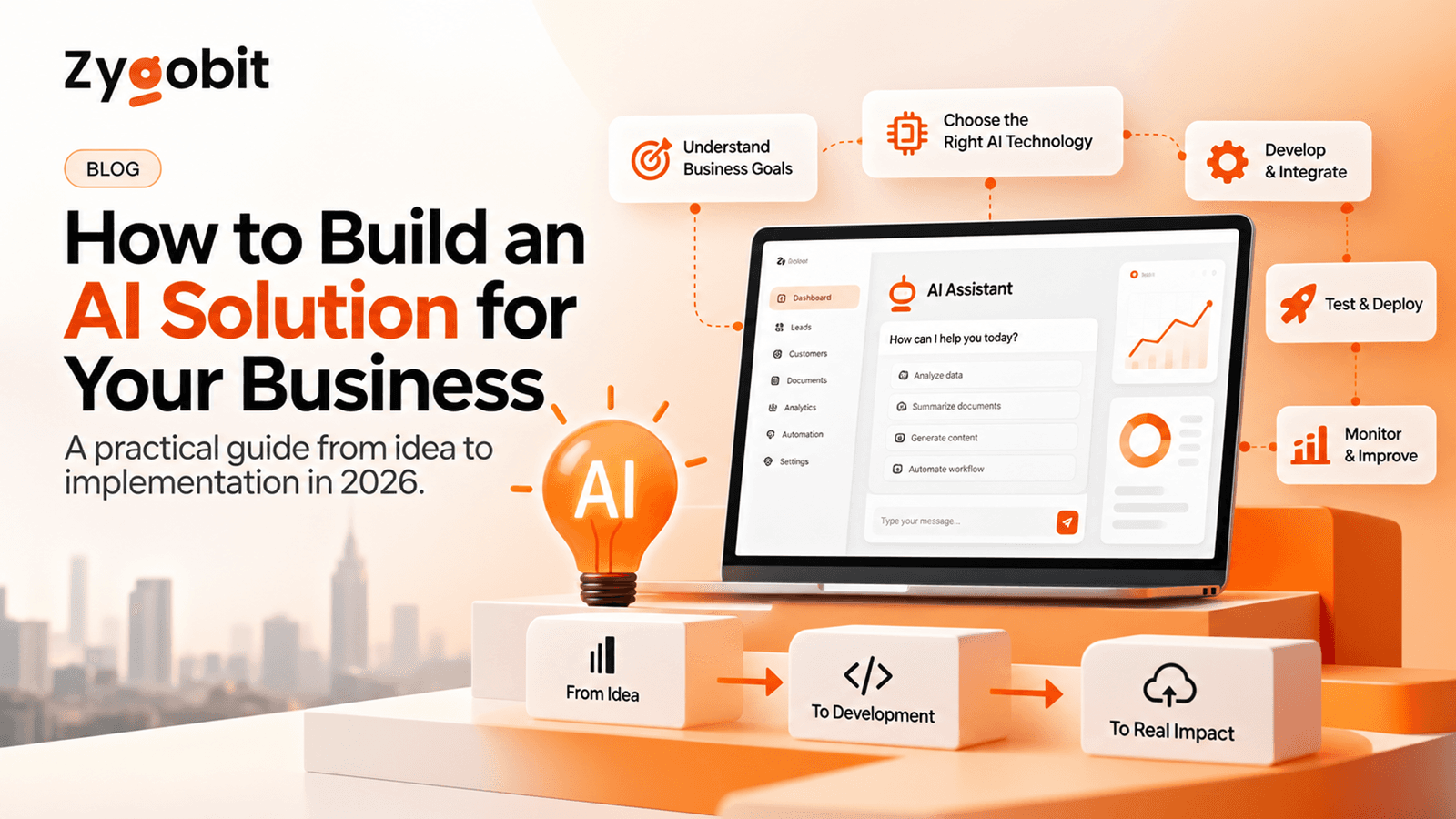
How to Build an AI Solution for Your Business: A Practical Guide for 2026
Learn how to build an AI solution for your business in 2026. Explore custom AI development, AI integration, machine learning, and automation. Discover the key steps from planning and choosing the right technology to development, testing, and deployment to create scalable, secure, and cost-effective AI solutions.
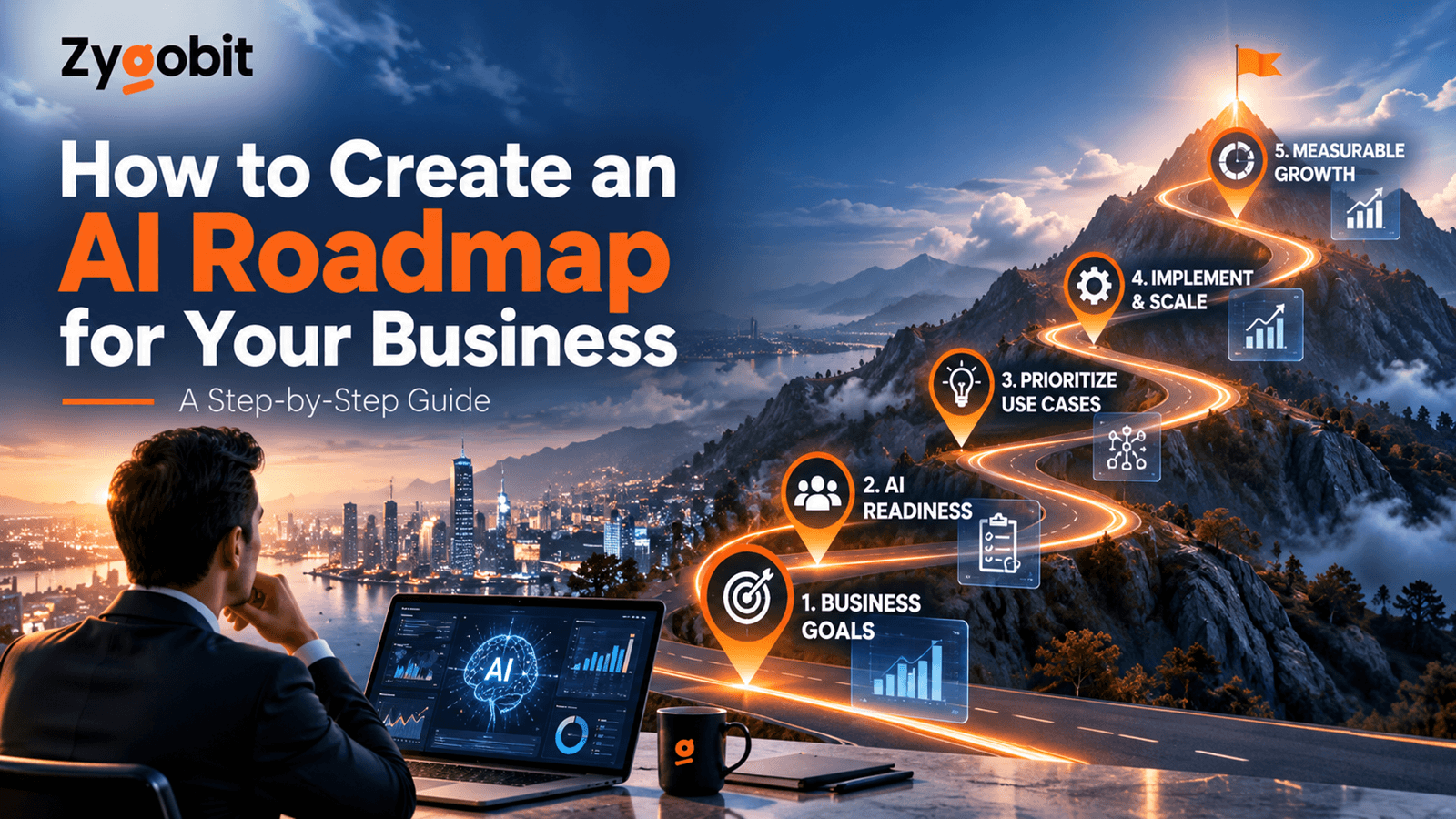
How to Create an AI Roadmap for Your Business A Step-by-Step Guide
Discover how to create an effective AI roadmap for your business with this step-by-step guide. Learn how to assess AI readiness, identify high-value use cases, prioritise opportunities, estimate implementation costs, and measure results. Explore how AI roadmap consulting helps businesses reduce risks, make smarter technology investments, and achieve sustainable growth through artificial intelligence.
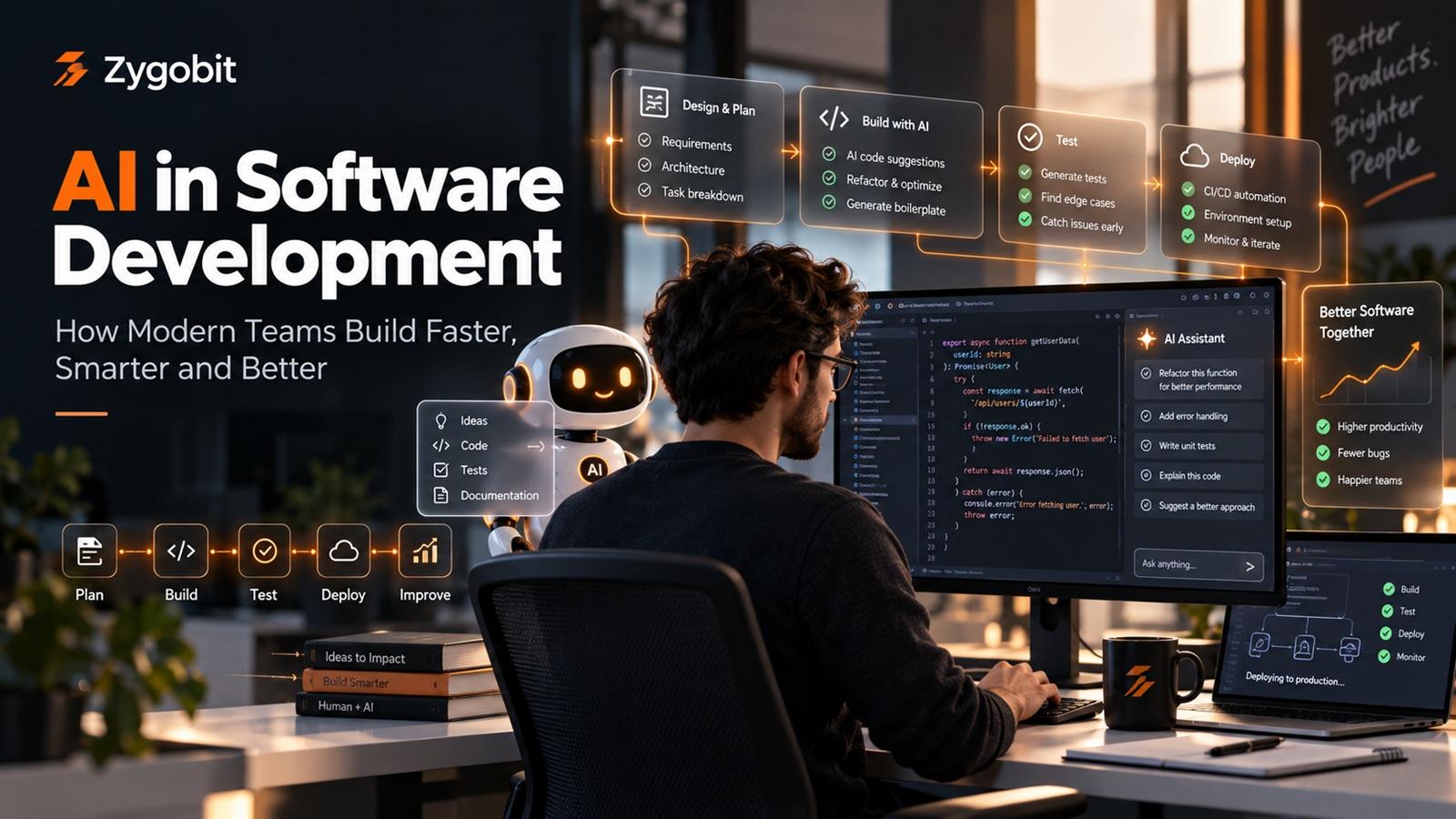
AI in Software Development: How Modern Teams Build Faster, Smarter and Better
Discover how AI is transforming software development across coding, testing, reviews, automation, and deployment. Learn how Zygobit helps businesses build smarter, faster, and more scalable AI-powered software solutions.