





How Much Do AI Chatbots Cost? Complete Pricing Guide for 2026


Discover AI chatbot development costs in 2026. Compare pricing models, feature costs, enterprise vs. SMB solutions, and estimate your chatbot budget.
Businesses deploying AI chatbots in 2026 face a wide pricing landscape from $5,000 entry-level deployments to enterprise solutions exceeding $1 million. Understanding what drives these costs is essential before committing any budget.
This guide breaks down every major cost factor, compares pricing models, examines industry-specific expenses, and offers actionable strategies to maximize your return on investment.
The Short Answer: 2026 Chatbot Pricing at a Glance
Chatbots reduce enterprise customer service costs by 40–60%, making them one of the highest-ROI technology investments available today but only when the pricing model and feature set align with actual business needs.
What Drives Chatbot Costs? The 3 Core Factors
1. Technical Features and Capabilities
The single biggest cost driver is the feature set you require. More sophisticated capabilities require more development time, specialized engineering, and ongoing model tuning.
Feature Cost Estimates:
Natural Language Processing (NLP): $20,000 – $50,000
Multi-language support: $10,000 – $30,000
Sentiment analysis: Starting at $15,000
Voice interface integration: $25,000 – $100,000
2. System Integration Requirements
Connecting a chatbot to your existing technology stack CRM, helpdesk, ERP, payment systems is where many projects go over budget. Integration complexity scales with how modern or legacy your infrastructure is.
As a rule of thumb, integrations add 20–50% to your total project cost. Each individual API connection typically costs $5,000 – $25,000 to develop and test.
3. Ongoing Maintenance and Updates
A chatbot is not a one-time build. It requires continuous attention to remain accurate and compliant.
Typical Annual Maintenance Costs:
Basic system maintenance: $1,000 – $5,000/year
NLP model updates: $2,000 – $10,000/quarter
Security patches: $500 – $2,500/month
Compliance recertification: $2,000 – $10,000/year
24/7 support staffing: $15,000 – $50,000/year
Emergency support incidents: $150 – $500/hour
Managed platforms bundle most of these costs into a predictable monthly fee, which is why they appeal to businesses without dedicated engineering teams.
Chatbot Pricing Models Explained
Three pricing structures dominate the market in 2026. Each suits a different business profile.
Monthly Subscription
Best for businesses that need predictable operating expenses without large upfront capital outlays.
Premium support typically runs an additional $200/hour on top of subscription fees.
Usage-Based (Per Resolution)
Charges are applied per successfully resolved conversation, typically $2 – $6. Financial services providers sit at the higher end due to compliance overhead.
What to watch out for: Unexpected traffic spikes can inflate costs by up to 40% if volume commitments aren't negotiated upfront. Businesses handling over 50,000 monthly interactions can often negotiate 15–25% volume discounts.
All-in-one example Crescendo AI charges a flat $1.25 per resolution plus a fixed monthly platform fee. That rate covers NLP-powered chat, email, SMS, and voice support; AI deployment and integrations; knowledge base management; multilingual support across 50+ languages; white labeling; sentiment analysis; automated CSAT scoring; and access to 3,000+ human agents for complex escalations.
Hybrid (Setup + Usage)
Combines an upfront setup fee ($5,000 – $30,000) with per-use charges ($1 – $2.25) and annual maintenance ($1,000 – $5,000). Common in regulated industries where the initial compliance and customization work is substantial. A healthcare e-commerce solution, for instance, might charge a $15,000 setup fee alongside a 3% revenue-share model.
2026 Price Ranges by Chatbot Type
Basic Rule-Based Chatbots: $5,000 – $30,000
These bots follow decision trees and pre-programmed response pathways. They handle well-defined, repetitive tasks FAQs, order status lookups, appointment scheduling without any machine learning.
Typical cost breakdown:
Development: $3,000 – $15,000
Basic CRM integration: $1,000 – $8,000
Response pathway setup: $1,000 – $7,000
A $15,000 retail chatbot can realistically manage order tracking with 10+ response pathways. This is the right entry point for small and mid-sized businesses testing automation for the first time.
AI-Powered Chatbots: $75,000 – $500,000+
These bots use machine learning and NLP to handle nuanced, context-dependent conversations. Projects with three or more integration points typically run around $112,000.
Primary cost components:
NLP engine development: $20,000 – $50,000
Machine learning training: $15,000 – $100,000
Custom API integrations: $10,000 – $75,000
Sentiment analysis module: $25,000+
Enterprise AI Solutions: $200,000 – $1,000,000+
Built for large-scale regulated deployments banking, healthcare, government with advanced security, compliance certifications, and deep system integrations.
Typical enterprise cost components:
SOC 2 compliance setup: $50,000 – $150,000
Real-time monitoring infrastructure: $30,000+
Custom encryption protocols: $25,000 – $75,000
Continuous learning systems: $60,000+/year
For projects exceeding $500,000, additional capabilities often include multimodal interfaces (voice, text, and visual) from $75,000, and predictive analytics engines from $90,000. An $850,000 banking chatbot, for example, can incorporate biometric authentication and real-time transaction verification while meeting stringent regulatory requirements.
Industry-Specific Cost Differences
Your industry is one of the most significant cost variables. Compliance requirements, integration complexity, and data sensitivity all push prices up or down.
E-Commerce: $50,000 – $150,000/year
E-commerce bots handle high transaction volumes and require tight platform integrations driving costs 30–40% higher than comparably complex bots in less transaction-intensive settings.
The payoff is measurable: e-commerce chatbots typically improve conversion rates by 15–35%.
Healthcare: $120,000 – $350,000+
Medical chatbots require specialized compliance infrastructure. HIPAA-compliant cloud storage alone runs $2,000 – $4,000/month, compared to $500 – $1,000 for standard deployments.
Key cost components:
HIPAA compliance setup: $35,000 – $60,000
Electronic health record (EHR) integration: $30,000 – $60,000
Symptom analysis module: $45,000 – $80,000
Financial Services: 25–35% Higher Than Standard
Security requirements in fintech and banking push development costs significantly higher than baseline.
Institutions operating in Europe must also budget for FINRA certification ($35,000 – $50,000) and GDPR implementation ($20,000 – $30,000).
Are Chatbots Worth the Investment?
Yes for most businesses operating at meaningful scale, the economics are compelling:
Chatbots handle thousands of simultaneous conversations, 24/7, with no downtime or queue times
They support 50+ languages at a fixed cost, eliminating the need to scale multilingual support headcount
Human agents are reserved for complex, high-value interactions reducing overall support cost per ticket
Enterprise deployments typically see 40–60% reductions in customer service operating costs
The ROI calculation improves further when you factor in CSAT improvements, faster resolution times, and the ability to scale support instantly during peak periods.
Budget Planning: 5 Strategies to Control Costs
1. Choose an all-in-one per-resolution model to avoid the hidden costs of custom development, integrations, and maintenance management.
2. Phase your feature rollout. Launch with core functionality, then add NLP refinements, sentiment analysis, and voice capabilities as you validate ROI.
3. Outsource rule-based development. For mid-sized businesses, third-party development of rule-based systems costs $1,000 – $5,000 per project far less than building in-house.
4. Use Cloud-as-a-Service (CaaS) platforms for initial deployment to reduce infrastructure costs and validate use cases before committing to custom builds.
5. Track ROI with hard metrics. Monitor cost-per-resolution (target under $0.70), first-contact resolution rate (target above 65%), CSAT score improvements, and conversion rate changes.
Frequently Asked Questions
Q.1 How much does a custom AI chatbot cost in 2026?
Costs range from $10,000 for basic rule-based systems to over $1 million for enterprise AI deployments. AI-powered chatbots with NLP and integrations typically fall between $75,000 and $150,000. Managed per-resolution platforms like Crescendo AI offer an alternative at $1.25/resolution with no development cost.
Q.2 What ongoing costs should I budget for?
Annual support ranges from $1,000 – $5,000, with quarterly update and maintenance costs of $6,000 – $10,000. Security, compliance, and staff costs are additional.
Q.3 How do I reduce development costs?
Start with a managed platform, phase feature additions, outsource rule-based development, and use CaaS infrastructure for early-stage deployments.
Q.4 Are chatbots more cost-effective than human agents?
Yes. Chatbots handle unlimited concurrent conversations at a fixed cost, support multiple languages without additional headcount, and require human intervention only for genuinely complex cases making them significantly more cost-efficient at scale.

Ready to build your next digital product?
Talk to Zygobit about web apps, mobile apps, AI solutions, automation, and scalable software development tailored to your business goals.
Explore Related Articles
More reading on web, mobile, AI, and product engineering from the Zygobit team.
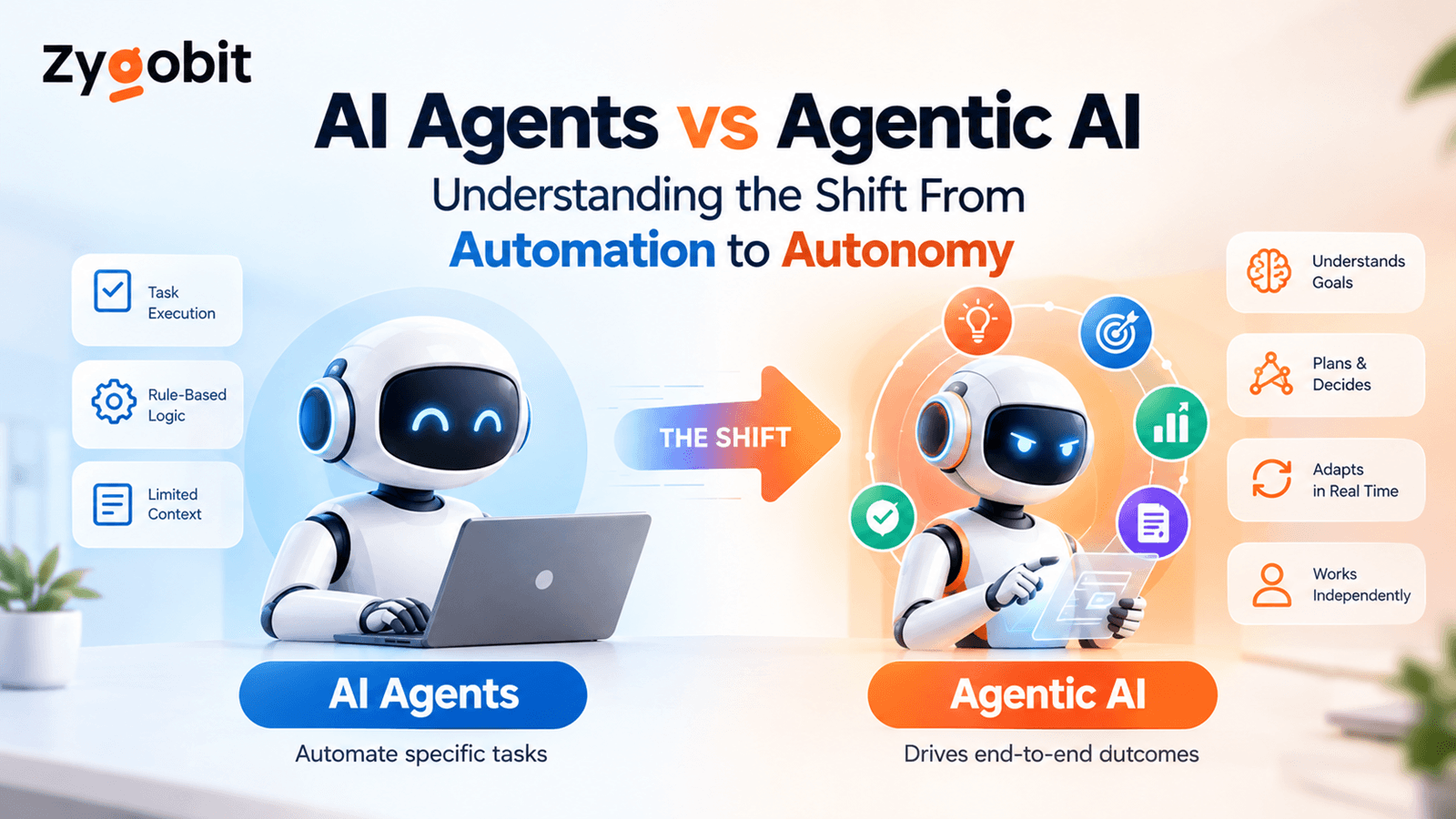
AI Agents vs Agentic AI Understanding the Shift From Automation to Autonomy
AI agents are changing business automation by moving beyond simple responses to intelligent action. This article explains the difference between AI agents and agentic AI, including planning, tool use, workflow orchestration, state management, human approvals, security, observability, and enterprise use cases.
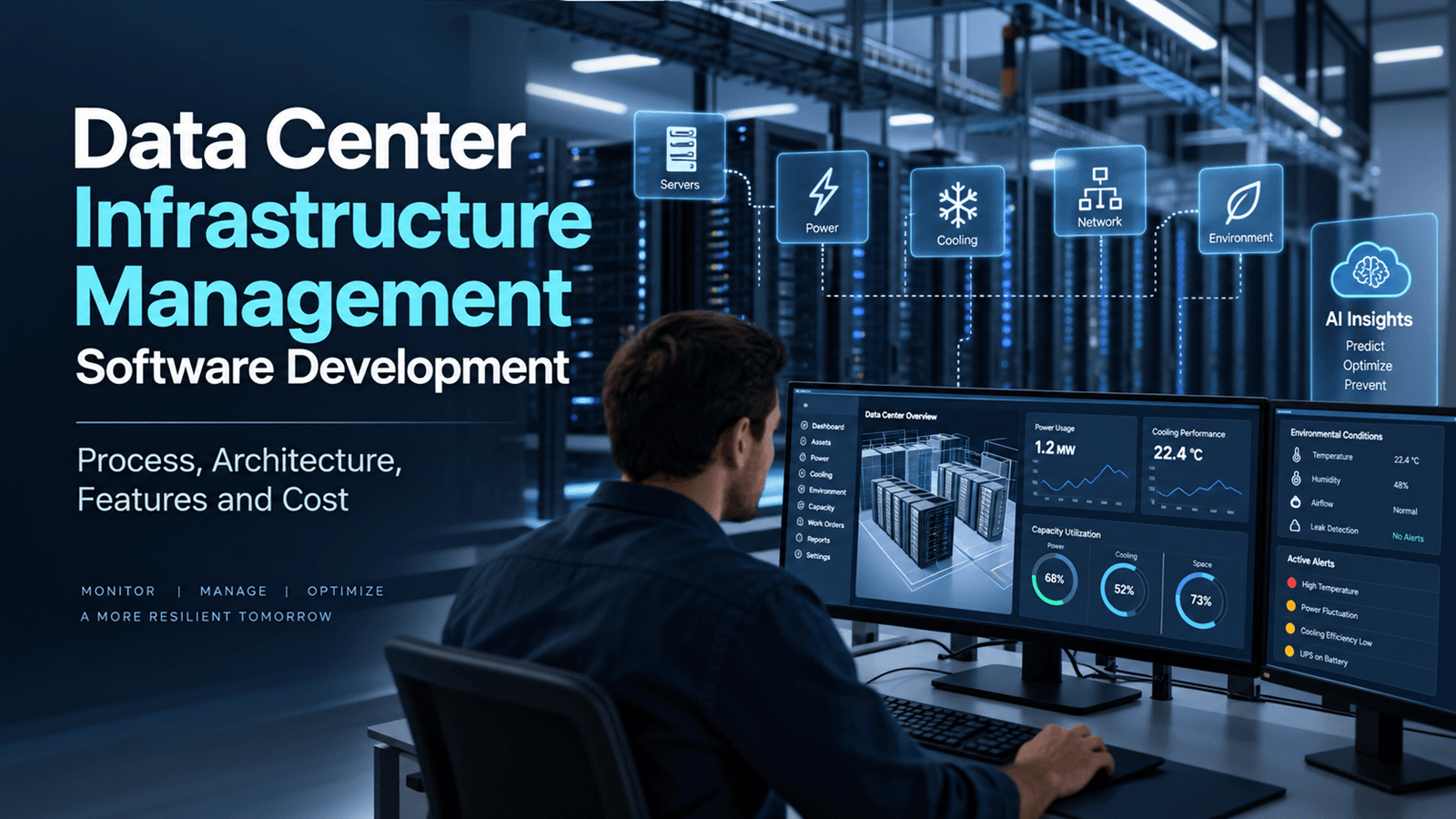
Data Center Infrastructure Management Software Development Process, Architecture, Features and Cost
Explore how Data Center Infrastructure Management software helps organizations monitor assets, power, cooling, capacity, and real-time infrastructure data. This guide covers DCIM software development, system architecture, key features, AI capabilities, security, integrations, implementation process, cost considerations, and future trends shaping modern data center operations.
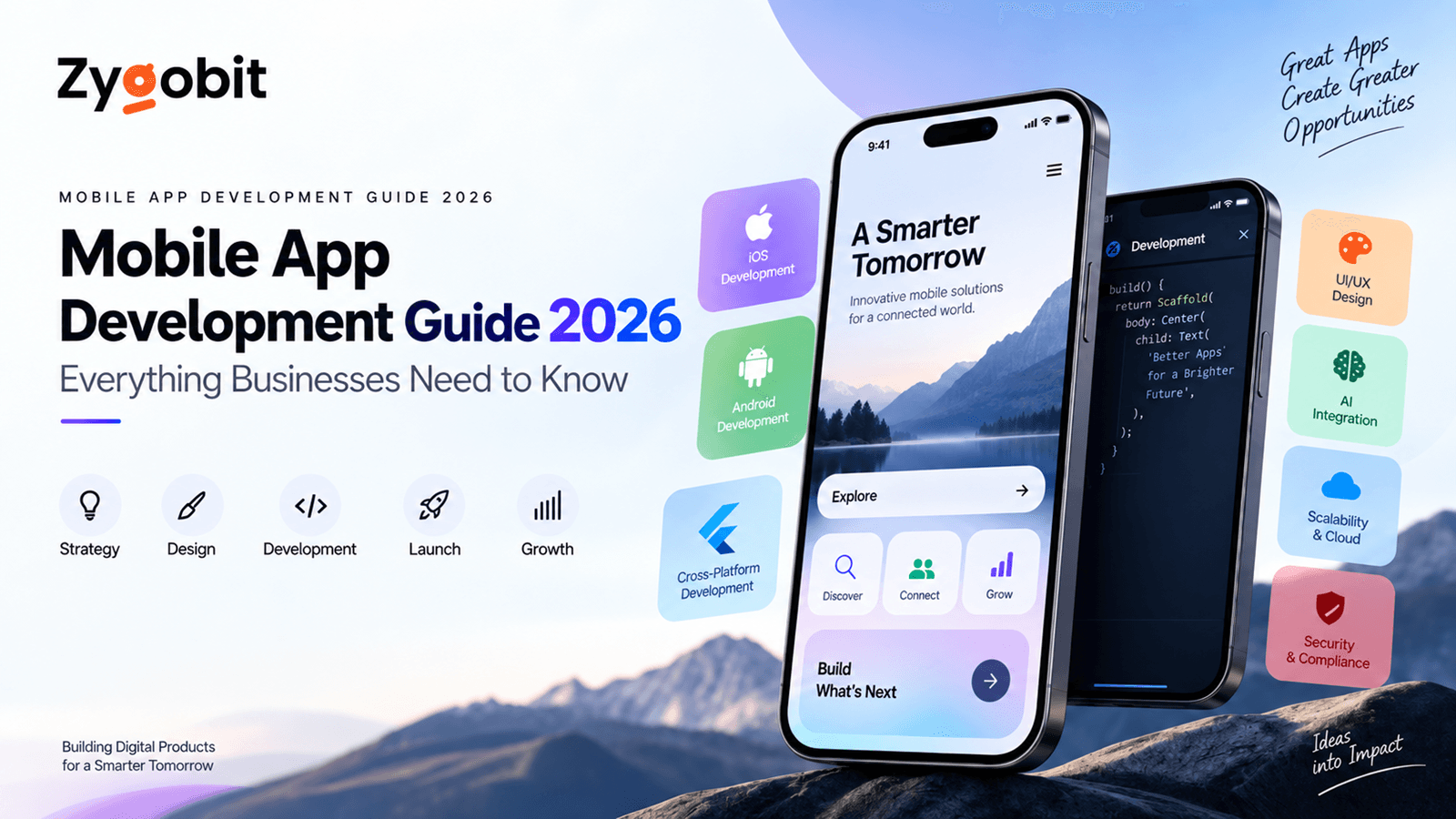
Mobile App Development Guide 2026 Everything Businesses Need to Know
Explore the complete mobile app development guide for 2026 and learn how businesses can plan, design, build, secure, test, launch, and scale successful mobile applications. Discover the right development approach, modern technologies, AI integration, UX best practices, backend architecture, cost factors, and key steps for creating high-performing, scalable digital products.