





AI Software Development Cost in 2026 What Startups & SMEs Actually Pay


Wondering how much AI development costs in 2026? This comprehensive guide breaks down AI development pricing, key cost factors, project types, development models, and ongoing maintenance expenses. Learn the costs of AI chatbots, machine learning systems, generative AI, AI agents, and enterprise AI platforms to plan your investment effectively.
AI isn't a competitive advantage that is only for the tech giants. In 2026: Companies across all industries from healthcare to logistics to financial services are embedding AI directly into their products, operations, and customer experiences. The question is no longer building with AI. That's what it takes to do it right.
Honestly? Building AI in 2026 will cost from $20,000 for a small, well-scoped solution to well over $700,000 for large enterprise platforms. The range is wide because AI is not one single technology. It’s a continuum of approaches, from rule-based automation and predictive models, to generative AI systems and autonomous agents, with their own complexity, data needs and infrastructure requirements.
This guide takes a clear, practical look at the cost of developing AI. If you are a startup looking to add your first AI feature or an enterprise considering a multi-phased AI rollout, the numbers and context here will help you build a realistic budget, avoid common cost traps, and make smarter build decisions.
AI Development Cost Overview 2026
Before you get caught up in cost, it helps to understand what modern AI development actually is. In 2026, building AI is more than training a model. It’s an end-to-end engineering exercise involving data strategy, model selection/training, integration into live systems, deployment infrastructure, and ongoing performance management.
Three broad paradigms are shaping most AI projects today:
Predictive and analytical AI uses machine learning to identify patterns in past data and predict outcomes—demand spikes, fraud signals, customer attrition, machine failures. They are well understood, more predictable to build, but they are highly dependent on data quality and volume.
Generative AI is typically powered by large language models to generate content such as text, summaries, code, images and structured documents. Generative systems need crafted prompt engineering, retrieval architecture (RAG), guardrails and continuous monitoring for quality and cost control.
Agentic AI is leading the way in 2026 deployments. AI agents can understand context, plan multi-step tasks, invoke external tools, and perform actions across systems with little human intervention. They are powerful but need the most rigors design, testing and oversight.
The most important first step in estimating the cost of an AI project is to understand which of these categories your project falls into.
Key Factors Affecting AI Development Costs
AI pricing is grounded in concrete, practical choices, not abstract technical complexity. These are the things that impact most directly on what you will spend.
1. AI Solution Type
The nature of the AI system puts a ceiling and a floor on your budget. A customer support chatbot that leverages existing LLM APIs with light customisation is a very different engineering problem than a computer vision pipeline for inspecting manufacturing defects in real time or an AI agent that autonomously manages procurement workflows.
As a general rule: the more context-sensitive, integrated and autonomous the AI has to be, the more expensive its development will be.
2. Data Quality and Readiness
Data is the fuel for AI. When your data is already documented, well-structured and clean, development is faster and cheaper. When data is spread across legacy systems, in inconsistent formats or missing key labels, you’ll end up spending a huge chunk of your budget on data engineering before you train a single model.
For regulated industries, like healthcare, finance and insurance, this means that data readiness also involves compliance checks, anonymization, and audit trails, which add meaningful effort and cost.
Practical rule: Projects with good data foundations are 30-40% faster than projects that require heavy data remediation.
3. Model Approach: API, Fine-Tuning, or Custom Training?
The largest cost impact is how you source or build the core AI model:
The fastest path with the lowest upfront cost is to use a third-party API (OpenAI, Anthropic, Google, etc.). The main effort is prompt engineering and integration. Best for chatbots, content creation tools, and general language tasks.
Fine-tuning an existing model can improve accuracy for domain-specific use cases. It needs curated training data and more compute, but it performs meaningfully better on specialised applications.
The most expensive way to do this is to train the model from scratch, which is only appropriate when proprietary data, unique architectural requirements or competitive differentiation are required.
Most 2026 projects rely on API integration or fine-tuning. Generally, custom training from scratch is reserved for enterprise-scale or heavily regulated deployments.
4. Infrastructure and Deployment Environment
The location and operation of the AI system directly impacts the development effort and long term operating costs.
The cloud deployments (AWS, Azure, Google Cloud) are the most popular choice. They offer speed, scalability and managed services that decrease DevOps overhead. But costs increase with use, which is a big deal for generative AI apps.
On-premise or hybrid deployments give you more control, and are often required in regulated or security-sensitive environments. They require more up front investment in infrastructure, more complex setup and more maintenance burden in the long run.
Edge deployments running AI inference on local devices are on the rise in 2026 for use cases where latency, privacy or connectivity constraints make the cloud a non-starter. These add initial costs and optimisation costs not included in most estimates.
5. Complexity of the Integration
AI models that work in isolation rarely produce business value. It is often underestimated the cost of embedding AI into your existing systems CRMs, ERPs, data warehouses, mobile apps, internal APIs.
The more systems the AI has to read from and write to, the more work of integration. One of the most common causes of cost overruns and launch delays is poorly integrated AI.
6. Explainability, Compliance and Security Requirements
Enterprise and regulated deployments add overhead. Scope and cost are driven by GDPR compliance, handling of data for HIPAA, SOC 2 readiness, explainability of the models for auditors, and AI governance documentation. They are not add-ons you can opt out of, they are baseline requirements for deployment across many industries.
AI Development Cost Breakdown: Where Your Budget Goes
Understanding how AI budgets are actually distributed helps you ask better questions and spot proposals that are under-scoped in critical areas.
10-15% Planning and Use Case Design
This phase is about defining the problem, assessing feasibility, choosing the right AI approach and mapping the data requirements. Poor planning is the most frequent root cause of cost overruns teams that skip this phase often find out mid-development that the architecture needs to change or the data is not fit for purpose.
Data Cleaning & Preparation (20-30%)
In AI development, data work is always the slowest and least glamorous part. This includes data collection, schema normalisation, de-duplication, missing value handling, feature engineering and labelling (for supervised learning).
For strong data bases projects this is manageable. This can quickly become the largest single cost driver for projects with fragmented, legacy or unlabeled data.
Model Development or Integration (25-35%)
That’s where the AI is really built. This includes selecting and configuring pre-trained models, designing prompt logic and retrieval pipelines for generative AI, fine-tuning models with data from specific domains, or training models from scratch. It’s the most complicated phase of all.
Integration of Backend and Frontend (10-15%)
An AI model can be very accurate but will fail in production if the integration is poor. This stage connects the AI to your application via APIs, builds the data pipelines to feed it real-world inputs, and designs the interfaces that users or systems will use to engage with it.
Testing and Validation (8-12%)
AI testing is NOT your typical QA. This encompasses accuracy benchmarking, edge case testing, bias audits, latency testing and failure mode analysis. For regulated industries, documentation is a big additional effort.
Set up Deployment and Monitoring (5-10%)
When an AI system goes live it needs monitoring. Model drift is a real, pervasive problem. It is the slow decay of model accuracy as real-world data changes. You need monitoring infrastructure. You need alerting systems. You need retraining pipelines to keep AI doing what it’s supposed to do.
Average AI Development Cost by Use Case 2027
AI Chatbots & Virtual Assistants $40K to $120K
Chatbots are still one of the most accessible types of AI investments; The majority of 2026 deployments are utilising LLM APIs with custom system prompts, knowledge base retrieval (RAG), and integration with support ticketing or CRM platforms.
The lower end pricing is for simpler, one-channel bots with fewer integrations. The extra cost comes from multi-channel assistants with memory, escalation logic, analytics dashboards and deep system integration.
Typical Use Cases: Customer Support Automation, Internal IT Helpdesks, Sales Qualification, Appointment Scheduling.
Machine Learning and Predictive Systems $70,000 to $200,000
Predictive ML systems work on structured data, predicting future events, finding anomalies, or ranking options. The main factors influencing the cost range are the data size, the required model accuracy, and the number of targets to be predicted.
Financial services fraud detection systems are on the high end due to class imbalance challenges and the high cost of false negatives. Demand forecast for retail or logistics can be built more economically if clean historical data is present.
Typical Applications: Forecasting demand, Fraud detection & risk, Churn prediction, Pricing optimisation, Personalised recommendations.
Generative AI Use Cases $120,000 to $350,000
The generative AI deployments in 2026 will be all over the map when it comes to complexity. At the simple end are content generation tools built on LLM APIs with prompt templates and light post-processing. On the complex side we have enterprise copilots with multi-source RAG pipelines, long context memory, citation systems and governance controls.
With generative AI, you’ll also want to factor in ongoing API costs, which are usage-based. High volume deployments can lead to high monthly inference costs that need to be planned for on top of development investment.
Common Use Cases: AI writing assistants, document intelligence and summarization, knowledge base Q&A, code generation tools, AI copilots for internal workflows.
Computer Vision Systems to $150K to $400K
Computer vision adds the complexity of image or video data, requiring specialised preprocessing pipelines, often more compute-intensive training, and consideration of edge cases of visual environments. Annotating image datasets is labour intensive and adds to the cost of big data preparation.
Typical Applications: Manufacturing quality control, retail shelf analysis, medical image support, security and surveillance, and autonomous vehicle components.
AI Agents & Workflow Automation $200,000 to $500,000+
AI agents are the fastest-growing and most sophisticated category in 2026. It requires careful orchestration design, a robust tool-calling infrastructure, extensive edge-case handling and strong guardrails to make the operation reliable and safe to do in production settings.
Agent systems that interact with high-stakes processes such as financial transactions, patient records and legal documents have additional validation and compliance overhead.
Common Use Cases: Autonomous research and reporting, multi-step customer service resolution, procurement and vendor management automation, and IT operations agents.
Enterprise AI Platforms $300K to $700K+
The top tier investment is big AI platforms for multiple departments, business functions or customer segments. These projects tend to involve multiple AI modules, large data infrastructure, enterprise security and access controls, compliance structures, and commitments to long-term support.
Typical Use Cases: Enterprise decision intelligence platforms, AI-enabled ERP extensions, massive customer analytics platforms, and organization-wide AI productivity infrastructure.
In-House vs. Outsourced AI Development: An Actual Cost Comparison
Build In-House AI
Building AI in-house gives you the most control and over time builds internal capability. But the true cost is often underestimated.
In 2026, senior AI engineers and ML scientists make $180,000 to $350,000+ per year in North American markets. In addition to salaries, in-house teams also require tooling licenses, cloud compute budgets, data infrastructure and management overhead. In fact, for most organisations building their first or second AI system, the time it takes to hire and ramp up a capable team often outlasts the timeline of the project itself.
AI is a core, long-term competitive capability, when the right choice, not for one-off or time-sensitive projects.
AI Development Outsourcing
When you outsource you gain immediate access to experienced teams without the hiring timeline and overhead. Project based engagements are cost predictable. Dedicated team models are flexible and provide continuity for longer roadmaps.
Offshore teams (Eastern Europe, South Asia, South-east Asia) are the cheapest usually $40-$80/hour for senior AI engineers. Nearshore teams (Latin America, Eastern Europe) for US clients have better time-zone alignment, at $70 to $120/hour. Onshore teams are in North America and Western Europe. They are closest to you and cost $150-$300/hr.
For most startups and mid-market companies, an outsourced or hybrid model (outsourced build, internal ownership after launch) offers the best cost-to-outcome ratio.
AI Development Pricing Models in 2026
The way you engage with a development team is as important as what you build. What's the right pricing model for you? It depends on how clearly you define your requirements, how flexible you are with your timeline and what you want to do long term.
Projects Involving Fixed Costs
It works best when the needs are well defined and not expected to change. Budgeting is easy as scope, time and deliverables are determined before development starts. Perfect for AI chatbots defined ML features and proof of concept builds.
The risk: scope changes during development will typically result in change orders and additional charges. Fixed-cost projects require an unusually detailed specification up front.
T & M (Time & Material)
The most flexible model of engagement (pay for actual time and effort) Best suited for complex AI systems where requirements evolve through discovery, data exploration or iterative model improvement. Close collaboration and active monitoring of the budget is required to prevent scope creep.
AI Specialist Team
We usually have a dedicated team of AI engineers, data scientists, and MLOps engineers working exclusively on your project on a monthly retainer. This model provides continuity, institutional knowledge of your product and data, and the flexibility to pivot as AI needs evolve. This is the most cost effective model for on-going, multi-phase AI development programmes.
AIaaS
Usage based AI services allow businesses to leverage AI capabilities via APIs, paying per call, token or compute unit rather than a large development investment. This means much lower upfront costs and much faster deployment, but variable ongoing costs that scale with usage. In particular generative AI based features can have significant scale inference monthly costs and these should be carefully modelled.
Post-Launch: The Cost of AI in Production
The post-launch phase is one of the most often forgotten pieces of AI project cost estimation. AI systems are not static software products. Over time, they degrade as the real-world data they are operating on drifts away from the distribution they were trained on (a phenomenon called model drift).
The annual expense of maintaining a production AI system is typically 15 to 25% of the initial development investment. This is including:
Model Monitoring
Measuring accuracy, latency and behavioural drift in real-time.
Retraining Pipelines
Regularly retrain the models on new data to keep performance.
Infrastructure Cost
Cloud compute, storage and API usage that scales with use.
Security and Compliance Updates
Ensuring the system is compliant with changing regulatory requirements.
Feature Improvements
The AI road map doesn't normally stop at v1.0.
You should factor these ongoing costs into your initial budget forecast, to get a true total cost of ownership calculation.
How Much Does Developing AI Cost?
Rather than working backwards from a budget, the best way to estimate AI costs is to start with four questions.
1. What Specific Problem Is AI Solving?
The more specific you can be about the outcome “reduce customer support ticket volume by 30% using automated resolution” versus “build an AI chatbot” the better a development team can scope the work.
2. What Data Do You Have and in What Format?
A credible estimate requires an honest assessment of data readiness. Teams that don’t look at their data before asking for proposals consistently get estimates that are below the real cost.
3. Are You Integrating with Existing Systems or Starting from Scratch?
There is an engineering work for each integration point. Before you kick off the scoping process, you should have an inventory of all the systems that your AI will need to interface with.
4. What Does Success Look Like 12 Months After Launch?
Teams can identify measurable outcomes early on and prioritise features, avoid over-engineering and build monitoring systems to track the right metrics from day one.
Summary
The investment in AI development in 2026 is serious and increasingly vital for businesses that want to operate efficiently, serve customers better, and make faster and more informed decisions.
"The costs are real, but the return is real as well. AI projects that are well scoped deliver measurable improvements in productivity, accuracy, speed and customer satisfaction, consistently. The best businesses are those that invest in clear problem definition, honest data assessment and the right development partnership before writing a single line of code."

Ready to build your next digital product?
Talk to Zygobit about web apps, mobile apps, AI solutions, automation, and scalable software development tailored to your business goals.
Explore Related Articles
More reading on web, mobile, AI, and product engineering from the Zygobit team.
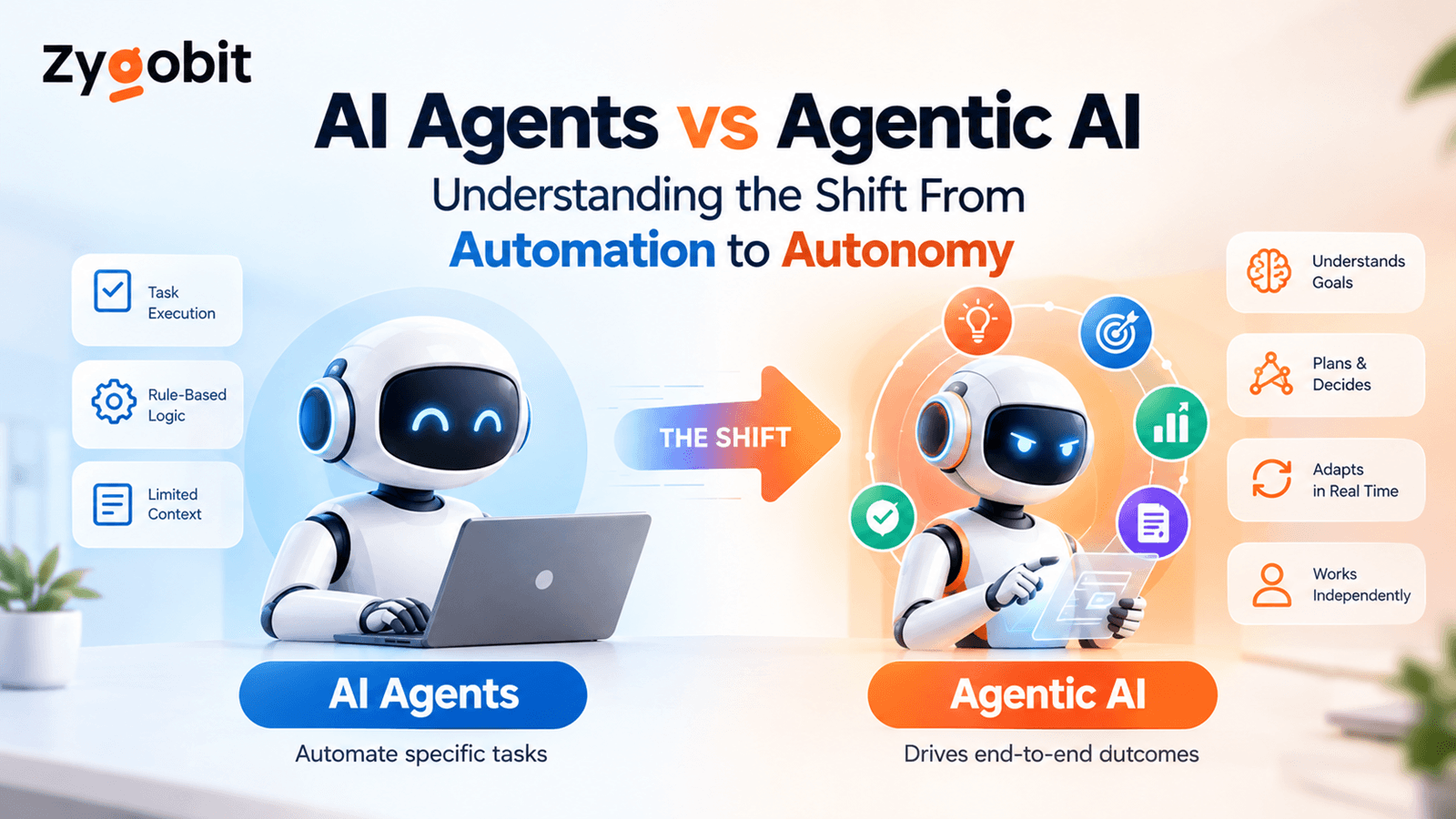
AI Agents vs Agentic AI Understanding the Shift From Automation to Autonomy
AI agents are changing business automation by moving beyond simple responses to intelligent action. This article explains the difference between AI agents and agentic AI, including planning, tool use, workflow orchestration, state management, human approvals, security, observability, and enterprise use cases.
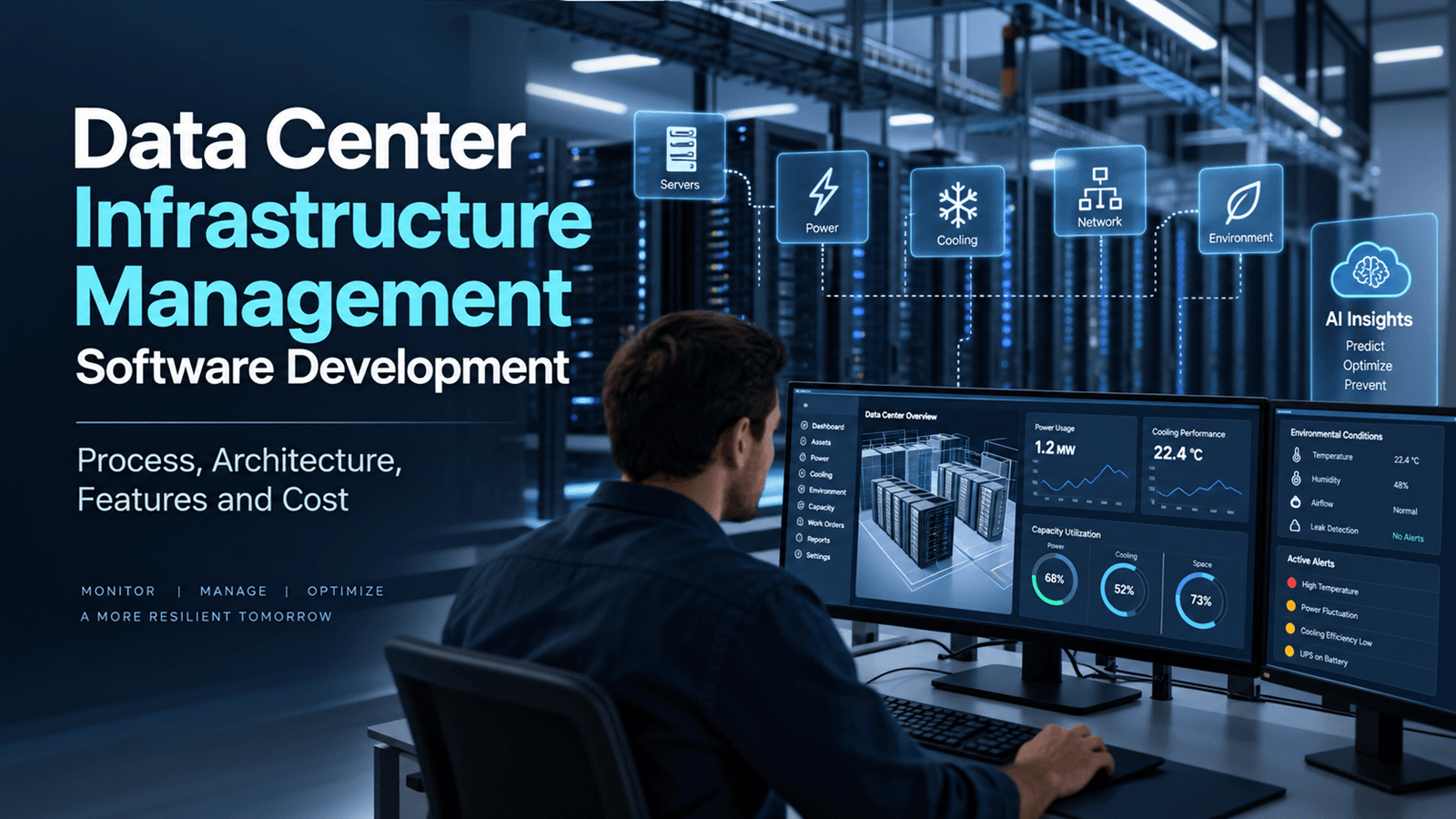
Data Center Infrastructure Management Software Development Process, Architecture, Features and Cost
Explore how Data Center Infrastructure Management software helps organizations monitor assets, power, cooling, capacity, and real-time infrastructure data. This guide covers DCIM software development, system architecture, key features, AI capabilities, security, integrations, implementation process, cost considerations, and future trends shaping modern data center operations.
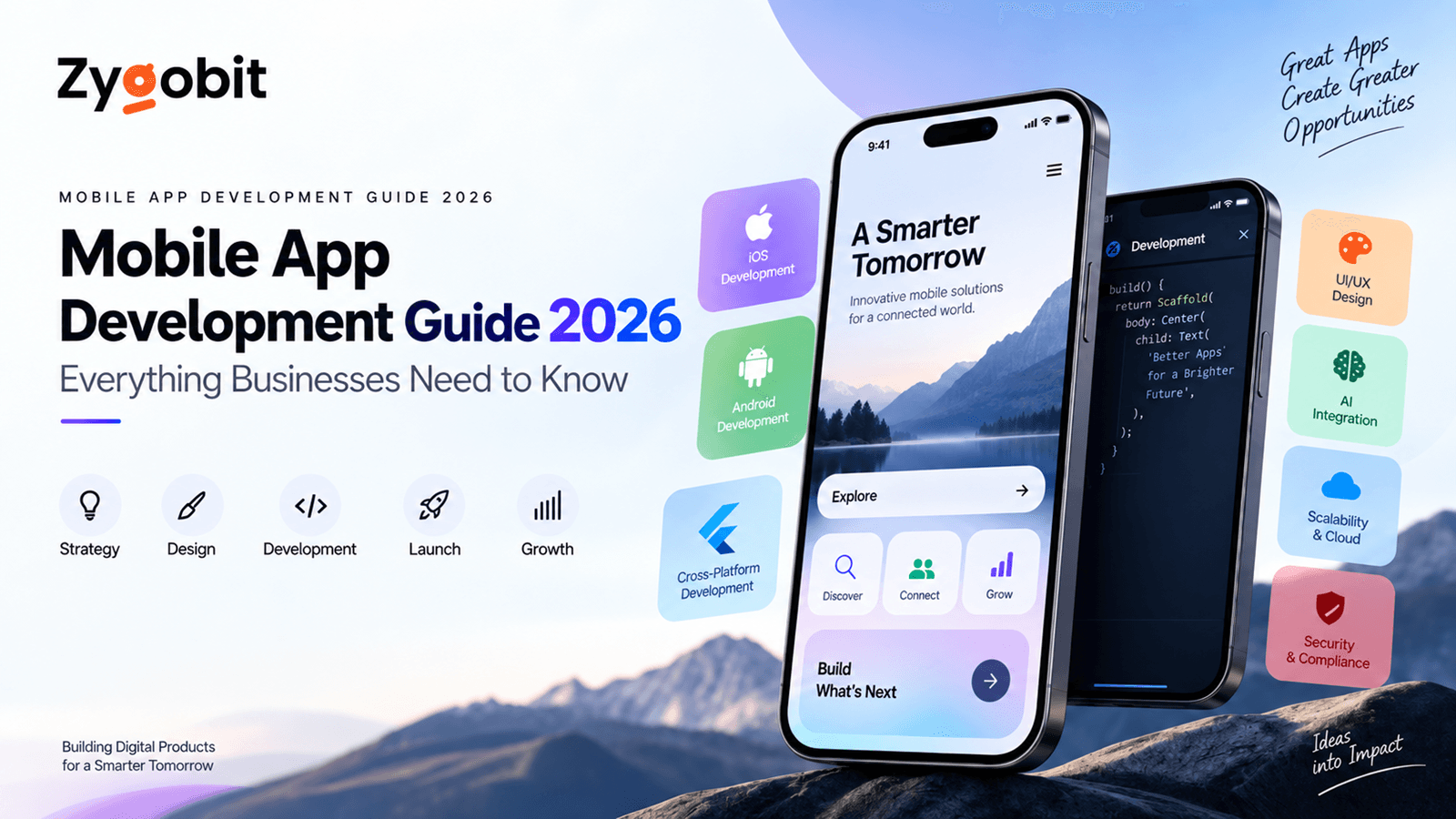
Mobile App Development Guide 2026 Everything Businesses Need to Know
Explore the complete mobile app development guide for 2026 and learn how businesses can plan, design, build, secure, test, launch, and scale successful mobile applications. Discover the right development approach, modern technologies, AI integration, UX best practices, backend architecture, cost factors, and key steps for creating high-performing, scalable digital products.