


AI Receptionist for Small Business and How to Choose One

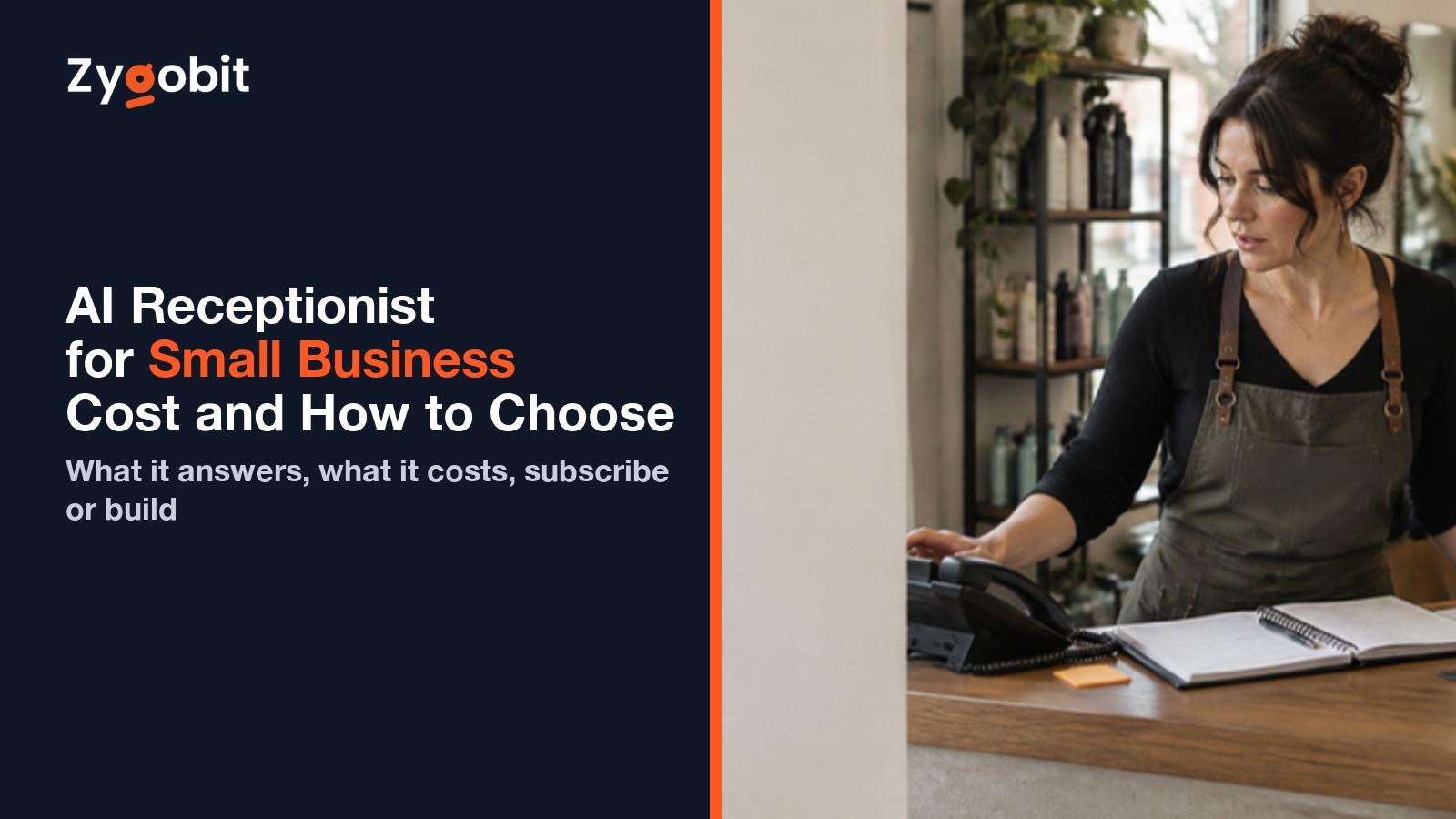
An AI receptionist answers your business phone, books appointments and takes messages when nobody can pick up. This guide covers what one can and cannot do, 2026 prices by type (subscription, per-minute, human-backed, custom), how it compares with a human receptionist, which businesses get the most from it, and a checklist for choosing one.
An AI receptionist is software that answers your business phone when nobody else can. It talks to the caller in a normal voice, answers the questions that make up most of your calls, books or moves appointments, takes a message, and passes anything it cannot handle to a person. It does this at 7 pm, during the lunch rush, and on the third ring when both your staff are already on the line.
Searches for "AI receptionist" have grown faster this year than almost any other business software term, and it is easy to see why. The problem it solves is one every owner can count. The calls that went to voicemail and never came back. What is harder to work out from the vendor pages is what these things actually do well, what they cost under each pricing model, and whether your business is one of the ones that benefits. That is what this guide is for.
We build custom voice agents for US businesses, so we have an interest here, and we also tell plenty of owners that a $99 subscription is the right answer for them. Both options are covered honestly below.
What an AI Receptionist Actually Does
Strip away the marketing and an AI receptionist does five jobs.
- Answers the phone, every time, in a voice most callers find natural. No hold music, no "press two".
- Answers the common questions. Hours, location, parking, prices for standard services, whether you take a particular insurance or card. It answers from information you give it, not from the internet.
- Books, moves and cancels appointments when it is connected to your calendar or booking system. Without that connection it can only promise a callback.
- Takes messages and captures leads, with the caller's name, number and reason for calling, and sends them to you by text or email as the call ends.
- Transfers to a person when the caller asks for one, when the question is outside what it knows, or when you have told it certain topics are human-only.
What it does not do. Make judgement calls, quote custom work, handle an angry complaint well, or know anything you have not told it. A good one admits that and hands over. A bad one improvises, which is how a caller ends up booked for a service you do not offer.
It is also not a phone menu. Callers speak normally, interrupt, change their mind, and the agent keeps up. The technology under the surface is the same as a voice agent; "receptionist" is just the name the product takes when it sits on a small business's main line.
Which Businesses Get the Most From One
The pattern is consistent. High call volume, mostly routine calls, and a missed call that costs real money.
Dental and medical practices. The clearest case. Lunch hours and after five are when patients call, the front desk is busy with the people in front of it, and a new patient who hits voicemail books with the practice down the road. Booking, rescheduling, insurance questions, directions, and an after-hours path to the on-call number.
Salons, spas, barbers and clinics with chairs. Every missed call during a service is a missed booking. The agent fills the diary while the stylist keeps working.
Trades and home services. Plumbers, electricians, HVAC, cleaners, landscapers. The owner is on a roof or under a sink when the phone rings. The agent takes the job details and address, quotes the standard call-out fee, and books the next slot.
Law, accounting and consulting practices. New enquiries captured with the details a conflict check needs, consultations scheduled, existing clients routed to the right person. Callers to a professional practice are often nervous, and an immediate, calm answer matters.
Real estate and property management. Buyer and tenant enquiries qualified, viewings booked, maintenance requests logged at two in the morning without waking anyone.
Restaurants. Reservations, hours, directions and the large-party enquiry that arrives during service when nobody can reach the phone.
And the honest other side. If you get a dozen calls a day and most need your personal judgement, an AI receptionist will not change much. The maths below will show you.
What an AI Receptionist Costs in 2026
There are four ways to pay. Prices below are what small-business products and custom builds are publishing this year; always check the current plan page.
Subscription products. $30 to $300 a month
The most common option. A monthly plan with a set number of calls or minutes, usually from about $30 for a capped starter plan up to $300 for unlimited, round-the-clock cover with calendar and CRM connections. Most small service businesses handling 50 to 200 calls a month land between $50 and $150. Set-up takes a day. Watch the overage rate. A $99 plan with a cheap-looking per-minute charge above the cap becomes a $240 plan in a busy month.
Per-minute or per-call platforms. $0.07 to $0.50 a minute
Platforms built for businesses that configure their own agent charge by usage, commonly $0.07 to $0.50 a minute all-in depending on the voice quality and model behind it. Cheap at low volume, flexible, and more work to set up and keep tuned. Best when you have someone technical, or a partner who does the set-up.
Human-backed answering services. $250 to $450 a month
Some services pair an AI first layer with live agents for anything it cannot handle. You pay more, roughly $250 to $450 a month for typical small-business volumes, and get a person on complex calls. Worth it for practices where a nervous caller matters more than the per-call cost.
Custom-built. $5,000 to $50,000 to build, plus usage
When the receptionist has to work inside software the subscription products do not support (a practice management system, your own ordering system, an internal job board), follow complicated rules across locations, or handle regulated data you want control over, you build one. A basic custom agent runs about $5,000 to $15,000, a mid-level one with several integrations $15,000 to $50,000, and the running cost is the underlying telephony, speech and model usage, usually well below platform per-minute pricing at volume. You own it. We cover the build economics in our guide to AI agent development cost.
The hidden costs
Onboarding fees. Integration charges for connecting a calendar or CRM. Premium voices and extra languages. Concurrent call limits, which decide whether the agent takes three calls at once in a rush or makes two of them wait. Call recording storage and where it lives, which matters in healthcare and finance. Ask for all of these in writing before you sign.
AI Receptionist vs a Human Receptionist
This is the comparison owners actually make, so here it is without the sales gloss.
A full-time receptionist in the United States costs somewhere between $40,000 and $60,000 a year once you include employer taxes and benefits, works about 40 hours a week, takes holidays and sick days, and handles one call at a time. A subscription AI receptionist costs $600 to $3,600 a year, works every hour of every day, and takes as many calls at once as your plan allows.
That is not the whole story. A good human receptionist does things no AI does. Reads the mood of a nervous patient, makes a judgement call on a cancellation fee, notices the regular who sounds unwell, keeps the waiting room calm. If your front desk is the face of the business, you are not replacing that person.
What most small businesses actually do is neither replace nor ignore. They keep the person for the hours and calls that need judgement, and put the AI on the calls the person could never take. After hours, overflow, lunch, and the routine bookings that interrupt them forty times a day. The receptionist gets their afternoons back, and the business stops losing the calls it never heard ring.
Will It Pay For Itself? A Two-Minute Check
Three numbers. How many calls you miss a week, what share of those would have become a booking, and what a booking is worth.
A dental practice missing 25 calls a week, with a third of them likely to book and a first appointment worth $150, is losing roughly $1,250 a week, about $5,000 a month, in appointments that never happened. A $150 subscription that recovers a quarter of them pays for itself eight times over. A consultancy missing three calls a week gets a different answer, and that is fine; the point is to do the sum with your numbers before you buy anything.
If you do not know how many calls you miss, your phone provider's call log will tell you, and that log is the single most useful thing to bring to any vendor conversation.
How to Choose an AI Receptionist. The Checklist
- Does it connect to your booking system? Not "a calendar" in general; the one you use. If it does not, it can only take messages, and you are paying for an answering machine.
- Can you hear it on your own script? Any serious vendor will run a live demo with your opening hours and services loaded. If they will only play a canned demo, move on.
- What happens when it does not know? The right answer is "it says so and offers a message or transfer". The wrong answer is anything involving the word "handles".
- How does a caller reach a person? At any point, by asking. Test it on the demo.
- How many calls at once? Ask for the concurrent call limit on your plan.
- Where do recordings and transcripts live, and for how long? Essential if you handle health or payment information; sensible for everyone.
- What are the overage charges? Get the per-minute or per-call rate above your plan's cap in writing.
- Can you read the transcripts? You will need to for the first month, to fix wrong answers. A product that hides them from you is not one you can improve.
- Does it tell callers it is an AI? It should, at the start of the call. Some US states require it, and callers trust an honest agent more than one that pretends.
- What does leaving cost? Your phone number, your call data, and your scripts should come with you.
Subscribe or Build Your Own
For most small businesses a subscription product is the right first step. It is cheap to try, live in a day, and good enough for bookings and the common questions. We recommend starting there to most owners who call us.
Build a custom AI receptionist when at least one of these is true. Your booking or practice software is not on any vendor's integration list; you have several locations with different rules; you handle regulated data and want control over where it lives; your call volume makes per-minute pricing expensive; or you want the receptionist to be one part of a bigger automation, such as creating the job, dispatching the technician and texting the customer. Two or more of those and a custom build is usually cheaper over two years, and far more useful.
Either way, roll it out the same way. Start on after-hours and overflow calls only, read the transcripts weekly for a month, fix the answers, and widen to daytime cover when the numbers justify it. Our voice agent guide has the six-step rollout plan, and our small business automation guide shows where the receptionist fits among the other tasks worth handing off.
How We Build Them at Zygobit
Our AI receptionist and voice agent development work starts with a week of your real call logs rather than a generic script. We map the common call types, agree what the agent may do on its own, connect it to your booking or practice management system, and launch it on the calls you were missing anyway. Our engineers are in Mohali, India, with a US office in East Windsor, New Jersey, which keeps a custom build within reach of a small business budget. If a subscription product is the better fit for you, we will say so on the first call.
Get in touch or book a free 30-minute call on Calendly. Bring your missed-call count if you have it.
The Short Version
An AI receptionist answers the calls your business cannot, books appointments, takes messages and hands anything complicated to a person. Subscription products cost $30 to $300 a month, per-minute platforms $0.07 to $0.50 a minute, human-backed services $250 to $450 a month, and a custom build $5,000 to $50,000 plus usage. It pays off when you miss calls that would have booked, which is most clinics, salons, trades and practices. Count your missed calls, test the product on your own script, start on after-hours and overflow, and build your own only when your systems or volume demand it.
Frequently Asked Questions
What is an AI receptionist?
Software that answers your business phone with a natural voice, answers common questions from information you provide, books and reschedules appointments when connected to your calendar, takes messages, and transfers to a person when needed. It works around the clock and takes several calls at once.
How much does an AI receptionist cost?
Subscription products run $30 to $300 a month depending on call volume and features. Per-minute platforms charge roughly $0.07 to $0.50 a minute. Human-backed services cost $250 to $450 a month. A custom-built receptionist costs $5,000 to $50,000 to build plus usage, and makes sense when you need your own integrations or rules.
Can an AI receptionist book appointments?
Yes, when it is connected to your calendar, booking tool or practice management system. It reads availability, books, reschedules and cancels, and sends confirmations. Without that connection it can only take a message and promise a callback.
Is an AI receptionist better than a human receptionist?
It is cheaper and available at all hours, and it handles routine calls well. A human is better at judgement, empathy and complex situations. Most small businesses use the AI for after-hours, overflow and routine bookings and keep a person for the calls that need one.
Will callers know they are talking to an AI?
They should be told at the start of the call. Modern voices are natural enough that many would not notice, but disclosure is required in several US states and builds trust. Most callers do not mind as long as they get what they rang for quickly.
Which businesses benefit most from an AI receptionist?
Dental and medical practices, salons and spas, trades and home services, law and accounting practices, real estate and property management, and restaurants. The common factor is high call volume, mostly routine calls, and a missed call that costs a booking.
How long does it take to set up?
A subscription product can be live in a day. A custom receptionist connected to your own systems typically takes four to ten weeks, including testing on real calls before launch.

Ready to build your next digital product?
Talk to Zygobit about web apps, mobile apps, AI solutions, automation, and scalable software development tailored to your business goals.
Explore Related Articles
More reading on web, mobile, AI, and product engineering from the Zygobit team.
AI Voice Agent for Small Business Costs, Use Cases and Rollout
A practical guide to AI voice agents for small businesses. What they do, which businesses benefit most, 2026 costs under subscription, per-minute, and custom-build pricing, the ways they go wrong, a six-step rollout plan, and how to decide between subscribing and building.
How an AI Phone Answering Service Works for a Small Business
An AI phone answering service picks up your business line, understands what the caller wants, and acts on it. Books the job, takes the message, answers the question, or passes the call to a person. This guide explains how the technology works, the four pricing models and what each costs in 2026, which businesses benefit by industry, where these services fail, and how to set one up without upsetting your callers.
AI Document Processing for Business Without the Re-Keying
AI document processing reads invoices, receipts, forms, delivery notes and contracts, pulls out the fields you need, checks them, and files them in the software you already use. This guide explains how it differs from OCR, where it pays off first, what it costs in 2026 as a subscription or a custom build, what accuracy to expect, and how to run a first project in a month.